Turkey’s centuries of history are replete with wars and an accompanying wealth of experience in the manufacture of firearms, but its commercial gun exports to the United States have suffered in modern times from a lackluster reception by American shooters. Reasons range from a disconnected sense of styling to spotty fit and finish. In recent years, though, Turkish manufacturers have proven that they are willing to listen to input from American importers about gun design, quality and aesthetics, and that has resulted in commercial success for both parties and a renewed sense among U.S. shooters that Turkish guns are worth a second look.
The company that perhaps best proves that point today, Sarsilmaz, is the only privately owned firm in Turkey that has the capability of producing law enforcement, military and civilian guns. It also happens to be Turkey’s largest gunmaker. So, even though it may not yet be a household name among American shooters, Sarsilmaz, which means “unshakable,” is a well-established gunmaker with an enviable reputation for quality in its homeland and many other countries. Several of its commercial products are distributed in the American market under the SAR Arms brand by European American Armory in Rockledge, Fla., which also imports Tanfoglio pistols from Italy, Baikal shotguns from Russia and Weihrauch revolvers from Germany.
Travels to Turkey late last year with EAA President Keith Bernkrant not only brought the country’s rich history alive, it made the Sarsilmaz legacy fully accessible in the form of meetings with the company’s owner, a hunt with its shotguns and a tour of its recently opened manufacturing facility, which has 391,800 square feet under one roof.
Historic Roots, Modern Manufacturing
Sarsilmaz was founded in 1880, during the waning decades of the Ottoman Empire. Today, 133 years later, it is headed by Aral Alis, a fifth-generation descendant of the original owners. A congenial, nattily dressed man, Alis conducts business from a metropolitan Istanbul office that walks out to an overview of the city’s sprawling tile rooftops and the bustling marine traffic in the nearby Bosphorus. The historically strategic strait marks the continental boundary between Europe and Asia and thus divides the city of 13 million into corresponding sectors, leaving most of the country’s area extending to the east where it eventually borders several hostile nations.
His company’s dominance among the more than half a dozen major Turkish gunmakers derives from the fact that Sarsilmaz produces the officially issued pistols of its armed forces and national police. Considering that Turkey has the second largest standing army in NATO and is among the 10 largest in the world, such contracts are significant and have helped ensure the company’s stability, allowing it in just the past year to expand into the new, nearly nine-acre plant two hours east of Istanbul in the culturally diverse city of Duzce. What’s more, Sarsilmaz has spared no pains to ensure that the building is equipped with the most modern manufacturing machines available-an effort that has resulted in the company’s being able to produce hundreds of thousands of pistols and shotguns for customers in more than 70 countries.
Bernkrant, who has spent a lifetime scouring the globe for firearm designs he believed Americans would connect with, justified the latest trip to Turkey as an opportunity to convince a small group of writers that Sarsilmaz is at the forefront of firearm manufacturing. And, true to his word, the plant proved to be a showcase of the latest examples of CNC equipment, including seven-axis mills and fully automated and robotic equipment. And although much of the floor had not yet been occupied at that time, Bernkrant reported recently that new equipment is being added continually. During the tour, he pointed out one particular example, saying, “[The plant] has one of only two machines of its type in the world-the other being at Ferrari. Here it is used to cut aluminum shotgun receivers in only 12 minutes.” The machine’s robotics allow it to shuttle between carefully inventoried bins of tooling cutters in order to carry out each step necessary to the receivers’ manufacture. Further, said Bernkrant, the plant makes and maintains its own tooling, ensuring quality control and quick turnaround times on engineering changes.
Even more remarkably, and in contrast to most other firearm manufacturing plants, Sarsilmaz has its own injection-molding capabilities, manufactures some of its own pistol magazines and has a fully computerized wood shop for stock manufacture-again, all under the same roof. Interestingly, as to the latter, although a CNC mill turns slabs of Turkish walnut into gunstocks four at a time using computer programs rather than pattern stocks, the stocks are still finished by skilled human hands. When it comes to making barrels, a huge Austrian-made GFM cold-hammer-forging machine-the same as is used at the most advanced plants in the United States and in Europe-pounds billets of steel into fully rifled and chambered tubes devoid of seams or rough edges in a matter of minutes. Other procedures carried out in-house include heat treatment and shotgun barrel soldering. And although some metal pistol frame forgings are sourced, polymer pistol frames are molded in-house. Programmable robots handle the final polishing of some metal parts depending on the finish dictated by the customer and the particular firearm. Final quality checks for pistols include test firing with one full magazine each before the guns move on to packaging and shipping.
The American Connection
The Sarsilmaz factory tour included an exhibit of guns that it manufactures but that, for a variety of marketing or regulatory reasons, are not imported to the United States-including center-fire revolvers and a pocket .25 ACP pistol. The slate of guns that EAA does bring in under the SAR Arms brand comprises two categories: center-fire semi-automatic handguns and 12- and 20-ga. pump-action and semi-automatic shotguns. The former include: the not-yet-released SARGUN, a service-size, striker-fired, single-action semi-automatic with a polymer frame that neatly blends modern H&K and Walther styling; the K2, an all-steel double-stack .45 ACP; the K2P, a polymer-frame 9 mm Luger carry pistol with bilateral safety controls; the B6P and B6PL Compact, economical polymer-frame 9 mm Lugers; and the ST10, an all-steel 9 mm Luger that resembles an H&K USP upper mated to a SIG P220 lower. Shotguns include: the SARPA pump-action and the SARSA semi-automatic-both available in a variety of configurations and finishes including all-black, pistol-grip tactical models with the Special Purpose, or SP, suffix.
Aside from the SARGUN, the handguns are built using CZ-75-inspired internal and external design characteristics. For instance, all of the other guns, except for the ST10, feature the CZ’s distinctive slide-in-frame rail design, which offers the advantage of a bore axis that lies relatively low in the hand, minimizing muzzle rise. Second is a trim, ergonomically efficient grip frame that is particularly small in circumference at the top, allowing even smaller-than-average hands excellent purchase on the gun and reasonable access to the controls. Finally, all but the striker-fired, single-action SARGUN feature exposed, hammer-fired lockwork systems that, like the original CZ-75, allow firing in the double-action/single-action mode or in the traditional single-action mode. In the former the first shot requires a long double-action pull and subsequent shots need only a short, single-action pull-whether starting with the manual safety engaged or disengaged-and in the latter the pistol can be carried cocked-and-locked and, after dropping the safety, fired with a consistent, single-action pull.
While obviously a subjective matter, the SARGUN’s overall feel in the hand and shooting experience make it, perhaps, the most intriguing pistol in the line. It packs a lot of features into one platform, including: caliber conversion from 9 mm Luger to .40 S&W to .45 ACP on the same frame; fully bilateral controls, including H&K-style magazine-release paddles integrated into the rear of the trigger guard; interchangeable backstraps; translucent polymer magazines; molded-in accessory rail; three-dot sights; and both loaded-chamber and striker-status indicators. As of this writing, it had not yet become available-save for samples displayed at the NRA Annual Meetings & Exhibits and other trade shows-but was said to be arriving soon.
For the K2 .45 ACP, SAR Arms went in the other direction. At 40 ozs., the full-size, 4.7"-barreled pistol is hefty, but the weight is more than justified by its all-steel construction, pleasing ergonomics and 14-round-capacity magazine. Vertical frontstrap serrations, horizontal serrations on the squared trigger guard’s face, a machined-in accessory rail on the dustcover and a fully adjustable rear sight assembly round out the gun’s features. With a stainless steel slide and barrel assembly, the K2 reaches the upper end of the SAR Arms pricing scale at $925.
With the K2P, SAR Arms courted the personal-defense market with a compact polymer-frame gun that incorporates features designed to make it suitable for everyday carry and protection. They include: bilateral safety levers, a molded-in accessory rail on the frame’s dustcover, a fully adjustable rear sight, front slide serrations and indentations on the grip frame’s exterior on either side of the magazine well to facilitate manual magazine extraction if necessary.
The B6P and B6PL Compact share a stout polymer frame topped with 4.5" or 3.8" slide and barrel assemblies and 17- and 13-round-capacity magazines, respectively. Available in either all-black or natural stainless-finish slide versions, the no-frills guns are complemented by combat-style sights-the rear being drift-adjustable for windage. Grip frame indentions above the magazine well like those on the K2P and the lack of a light rail further distinguish the gun, which has a remarkably low suggested retail price of $377.
In its ST10, which, like the SARGUN has a conventional slide and frame arrangement, the company has produced an aluminum-frame, 15-round-magazine-capacity 9 mm Luger pistol with a total weight of 34.3 ozs. Somewhat resembling an H&K USP upper mated to a SIG P220 frame, the ST10 has a matte-black finish, integral accessory rail on the frame’s dustcover, vertical frontstrap serrations and horizontal serrations on the trigger guard’s face. It also has a fully adjustable rear sight and comes with a holster and dual magazine pouch.
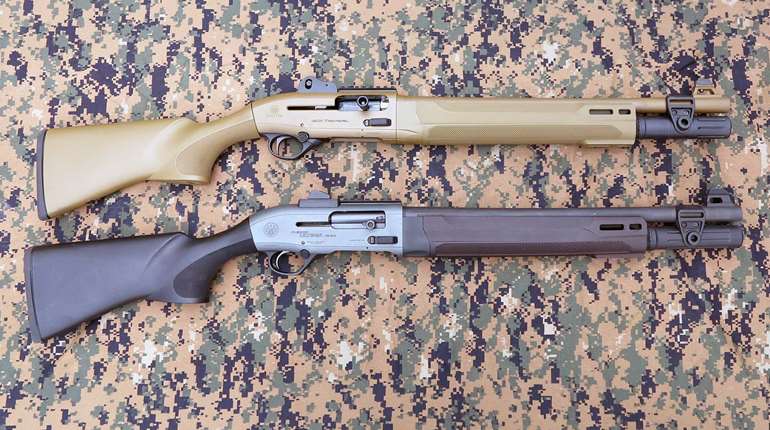
When it comes to shotguns, SAR Arms offers both 12 and 20 gauges in either its SARSA gas-operated semi-automatic or SARPA pump-action designs with the former chambering 3" shells. Both feature machined aluminum receivers and synthetic stocks, including youth models with shorter lengths of pull, in either black or camouflage finishes and in either traditional or pistol-grip stock configurations. Some sporting pump models chamber 31/2" shells. Both have long fore-ends, which is particularly noticeable on the SARPA since it can be grasped near the receiver and manipulated with relative ease even by a shooter with shorter-than-average arms. SAR Arms literature is quick to point out that the guns’ barrels are drilled and honed and that the high-grade polymer used in the stocks has adequately thick cross sections for long-term durability. Smartly, the engineers chose to thread the guns’ choke tubes to be compatible with the Remington pattern.
Something A Little Different
An opportunity to shoot the aforementioned guns was part of the factory tour in Turkey and afterward examples of several of the currently imported models arrived at NRA Headquarters for hands-on evaluation. Two guns-the K2 .45 ACP pistol and the Tactical Semi Auto Shotgun-were put through additional paces using the applicable American Rifleman protocols. The results of those range sessions are tabulated nearby.
The big K2 proved to be one of the most pleasant-shooting .45s in recent memory-especially considering that it is a double-stack. Unlike most such guns, even those of average or smaller build will find that smoothly contoured recesses at the top of the K2’s frontstrap and backstrap give it an unusually comfortable feel in the hand. According to EAA, the frame is machined from a steel forging. Tooling marks on both it and the slide are, as in most areas of the gun, are nearly indiscernable.
The K2 is designed around an Italian-produced Mec-Gar 14-round Para USA-pattern magazine that features a matte-black finish, black polymer baseplate and follower and witness holes designated “5,” “10” and “14” for keeping track of remaining rounds. The gun itself is also finished in an evenly applied matte-black finish that contrasts sharply with its highly polished barrel and guide rod. A fully adjustable rear sight features a square notch with white dots on either side, and the ramped front sight has a larger white dot as well. The gun’s grip frame has vertical serrations on its backstrap and frontstrap. The trigger guard’s face features horizontal serrations and a toe at its lower edge in the European style. An accessory rail consisting of three cross slots is machined into the frame’s dustcover.
The gun’s internal components and springs appear beefy and well-designed for their respective functions. The pivoting trigger actuates a stirrup-shaped bar that retracts the hammer and releases the sear. The design makes for a fairly crisp two-stage single-action pull that broke at 3 lbs., 13.4 ozs. and a somewhat long, yet manageable double-action pull that measured 9 lbs., 13 ozs.
All in all, the K2 offers those willing to carry a relatively large heavy gun a tremendous amount of .45 ACP firepower in a comfortable, solid-shooting platform that should stand up to many tens of thousands of rounds of firing.
Although writers on the visit to Turkey were issued SARSA SP shotguns for a night hog hunt in the Turkish countryside, most were not successful because of difficulties with the red-dot optics that topped them. But all agreed that the guns’ mechanical and ergonomic characteristics were sound. Back in the United States, sample guns proved reliable and pleasant-shooting throughout a number of trips afield. Indoor testing at the NRA headquarters range with several different factory loads, including one buckshot load, confirmed the gun’s reliability.
The SARSA is reminiscent of the Remington Model 1100 design, employing a one-piece steel action bar consisting of parallel arms connecting front and rear sections machined to mate to an action bar sleeve at the front and to the bolt body at the rear. It differs, however, in that its action spring surrounds the magazine tube, requiring nothing more than a throughbolt in the buttstock. A reversible gas piston handles both light and heavy loads and a simple polymer O-ring seals the system.
The gun’s rubber-clad and finger-grooved pistol grip and rubber recoil pad with side scallops helped to mitigate felt recoil and keep it on the shoulder. The fully adjustable ghost-ring rear sight and red fiber-optic front sight are quick to acquire and provide good practical accuracy for such a platform. A 6" section of Picatinny rail is secured to the top of the 8"-long receiver with four screws for the mounting of a red-dot or low-magnification traditional optic.
Controls consist simply of an operating handle with a curved, serrated face, an action release button on the receiver’s lower right front and a crossbolt safety at the rear of the polymer trigger guard. The fire-control housing is held in the receiver by way of two crosspins located above the front and rear of the triggerguard. The gun’s trigger pull measured a reasonable 5 lbs., 14.5 ozs.
The gun’s 13"-long polymer fore-end has a raised grasping surface with three panels of golfball dimpling, which provide good purchase by the support hand. The buttstock has a smooth, straight, dropped comb. With a proper mount, it did not tend to smack the cheek as can sometimes occur with other designs.
Oddly, both the SARSA and SARPA SPs are devoid of sling swivels. In addition, their buttstocks could benefit from a spacer system, which would allow for length-of-pull customization based on shooter build and clothing and/or tactical requirements. Such deficiencies are likely to be overlooked given the guns’ relatively low suggested retail prices. More important for the budget-minded armed citizen interested a home-defense shotgun is that the SARSA appears to hold up well and function flawlessly. In that respect it is a solid value.
Wringing out both the K2 and the SARSA SP was an enjoyable experience. No malfunctions were experienced with either gun, and both proved comfortable to shoot thanks to ergonomically sensible contours and controls.
A Force To Be Reckoned With
As advances in its technology, and the exigencies of territorial conflicts, have propelled Turkey to the forefront of modern manufacturing, its current crop of guns, particularly those of leaders such as Sarsilmaz, have come a long way. The SAR Arms guns as imported by EAA require little in the way of excuses to justify their value and quality. The SARGUN, in particular, holds tremendous promise as an example of the latest in technical and design innovation at a competitive price.
SAR Arms guns seem to have all the necessary ingredients for success in today’s value-conscious American firearm market: proven design, quality manufacturing and reasonable price. So despite the fact that Sarsilmaz means “unshakable,” it appears that EAA and its SAR Arms brand are well on the way to also making it synonymous with “unstoppable.”