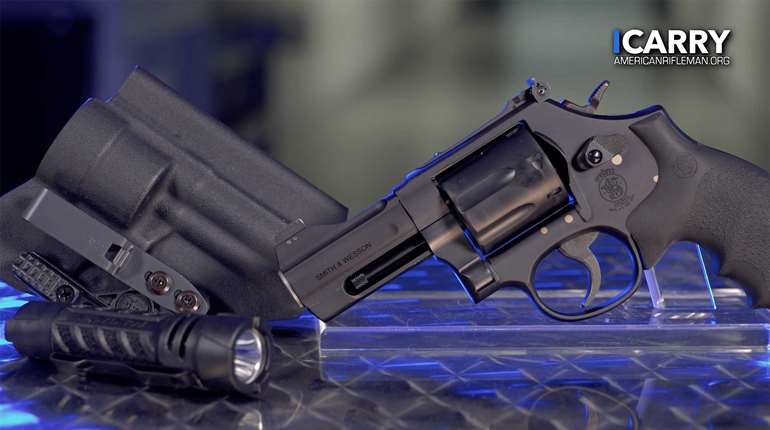
The defensive revolver is very much like the fighting shotgun in that it doesn't hold all that many cartridges and should be topped off whenever the situation allows. Certainly this should be done when the shooting has ceased, or when there is a lull in the fight. If, for some reason, you have to move from your cover, it is also a good idea to top off your defensive revolver before making that move.
To perform a tactical reload, the revolver is placed in the palm of the left hand, just as suggested in the revolver speed reload. The index and little fingers support the right side of the frame, while the two middle fingers are used to push the cylinder open when the cylinder release is activated with the right thumb. Once the cylinder is open, the left thumb and two middle fingers hold the cylinder and rotate it as necessary.
With the muzzle pointing down, the left thumb pushes the ejector rod just enough to raise the cartridges out of their chambers, but not enough to eject the cartridges entirely. The empty rounds are then plucked out of the cylinder with the fingers of the right hand. It is important to simply pluck the empties clear of the cylinder and let them fall to the ground. Trying to hold onto them, or throw them away, wastes precious time. Just pull them clear of the revolver and let them fall.
At this point, the right hand goes to the ammo carrier and transports fresh cartridges to the cylinder. With a little practice, most folks can easily handle and load two cartridges at a time. I particularly like the belt pouches that have three pockets, holding two cartridges each. If a speed strip is used, such as those made by Bianchi and Tuff Products, it is brought to the gun, cartridges inserted and peeled off of the strip with a twisting motion of the right hand.
It is particularly important to perform the tactical reload with the revolver held up high, somewhere between your shirt pockets and your chin. This allows the defensive shooter to remain alert to what is going on around him or her and, in particular, keep an eye on the bad guys. It's a real mistake to take the revolver down to belt-level as we often see competitive shooters do. Hold the revolver high and take the ammo to the gun, instead of the other way around.
As a general rule, we like to perform defensive functions that do not require the use of fine motor skills. When you are nervous or stressed, fine motor skills are among the first skills to leave you. However, pulling empty cartridges from a cylinder and replacing them with loaded rounds is a fine motor skill function. For this reason, revolver shooters need to spend a lot of time practicing this reload. The more you practice, the more agile you will become, even under stress.
When I am carrying a revolver, I usually wear a six-round ammo pouch on my belt and have a six-round speed strip in my pocket. Since fine motor skills are required for the tactical reload, it is very possible to drop a live round during the process. It is a waste of time to try to bend down and pick it up. It is far quicker to just go to your pouch, or speed strip for more ammunition.
Once the tactical reload is completed, the cylinder is pushed shut with the left hand and the two-hand grip is resumed on the handgun. It is important to only use enough force to push the cylinder shut. Slamming the cylinder shut may bend the crane and cause the revolver to eventually get out of time, which can cause problems with the gun.
As mentioned earlier, practice is very important if one expects to be smooth with a tactical reload for the revolver. The serious defensive shooter would be well-advised to buy some dummy rounds and practice this technique at home as part of the regular dry practice. Developing a good defensive technique for the tactical reload and then putting in lots of practice time is needed if the revolver is your choice for personal defense.
Most Popular