Engineer Christopher Miner Spencer was one of those 19th century Yankee polymaths who was responsible for a huge number of different, fascinating contrivances. But it was his eponymous repeating rifle that really established his place in the hierarchy of American inventors. His remarkable seven-shooter was a wonder. Few military arms could come close to its reliability for a good number of years following its introduction.
Spencer patented his rifle on March 6, 1860. Featuring a rotating block and tubular magazine in the butt, the gun was a snap to use. The shooter simply dropped a number of cartridges, nose-first, into the magazine, then the spring-loaded follower was inserted into the tube and locked into place. Next, the hammer was put on half cock, and the lever lowered to allow a cartridge to be pushed into position by the follower. Raising the lever chambered the round. Now all one had to do was cock the hammer, aim, fire and repeat the process until the magazine was empty. Spent cases were ejected from the top of the receiver.
A factory was established at Cheney Brothers Silk Mfg. Co., where Spencer worked, and his arms company was in business. Early models involved smallbore sporting rifles, of .36 and .44 caliber, as well as prototype .44-cal. military arms.
At the beginning of the Civil War the Union Army’s principal infantry arm was a single-shot muzzleloading rifled musket, and the cavalry was supplied with a wide variety of breechloaders and muzzleloaders. After demonstrating his arm to the Navy Dept. in mid-1861, the U.S. Navy put in an order with Spencer for 700 rifles, which he boosted to 1,000. When some Army officers saw the rifle work, many were so impressed they purchased them privately for themselves and their men.
The gun was chambered in a rimfire .56-56 cartridge, though the caliber was actually .52-the .56-56 designation coming from the measurements at the top and bottom of the case, the bullets themselves actually ran in the 0.540"-0.552" range.
Reports from the field were universally favorable. The majority of early Spencers appear to have been rifle-length long arms, though it was as a carbine that the repeater really came into its own. Following Christopher Spencer’s personal shooting session with President Abraham Lincoln, the War Dept. increased orders dramatically. By the time the Civil War ended, some 50,000 had been made, not counting the follow-on .50-cal. Model 1865 manufactured by the Burnside Rifle Co., a plant drawn into production because the main manufacturing facility just couldn’t keep up with demand. It became the North’s second most popular carbine, topped only by the Sharps, and it was so highly sought-after that practically all delivered before the cessation of hostilities saw use. Today it is unusual to find a wartime Spencer in exceptional condition.
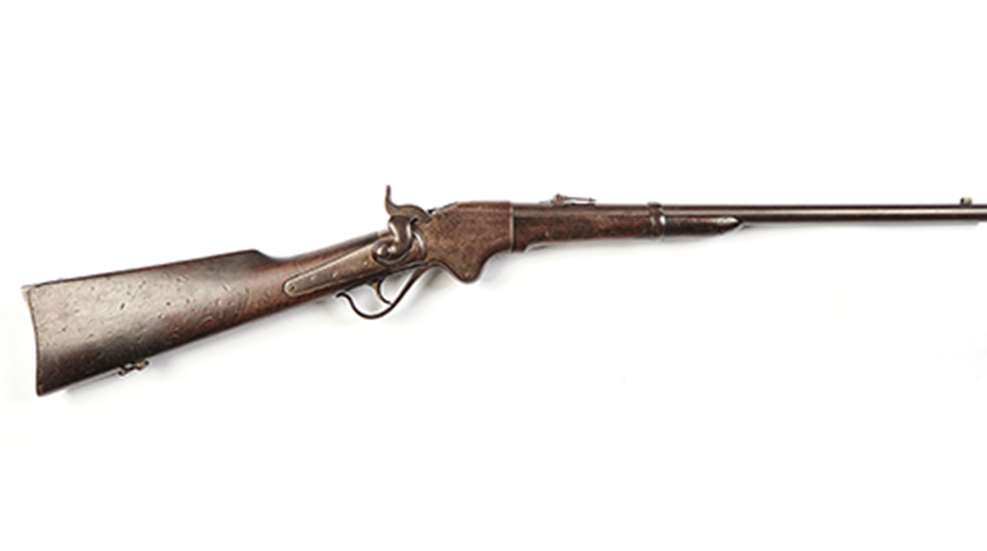
The Spencer shown here is in NRA Antique Very Good condition, with an excellent bore, traces of case-hardening and a good bit of patina on the barrel. As such, it would be worth $2,750 to $3,000.
Gun: Model 1860 Spencer Carbine
Manufacturer: Spencer Repeating Rifle Co., Boston, Mass.
Serial Number: 54803
Condition: NRA Antique Very Good
Caliber: .56-56 Spencer Rimfire
Value: $2,750 to $3,000