I was just a couple of years into my handgun shooting career when a family member was kind enough to buy a couple of boxes of ammunition for my birthday. They had driven all the way across town to find what I wanted. When the present was unwrapped, there was an unfortunate sense of disappointment. The handgun in need of ammunition was a .38 Spl. revolver. The not-so-cheap ammunition in the package was .38 Super, a semi-automatic pistol cartridge that wouldn’t fit.
When it was pointed out that I could just exchange the semi-auto cartridges for revolver cartridges, I had to explain that most stores have policies in place preventing the return or exchange of ammunition. This is because firearm cartridges are explosive devices that can be tampered with, altered, or exchanged for an inferior product. If a cartridge malfunctions and causes damage to a gun, or the person shooting it, then liability issues come into play. Since there is no way for a store clerk to verify that the exact same cartridges that walked out of their location are walking back in to it, they stick with the simple and safe policy of no returns.
So what should you do if you need to buy ammunition, but shooting is not your forte? The best way to avoid the expense and frustration of buying the wrong ammunition is to know what you are looking for before heading out to the sporting goods store. Most modern firearms have the ammunition type stamped on them in a visible location. Usually it's somewhere on the barrel or the frame. If you have a gun that doesn’t have clear ammunition markings, then take it to an experienced gunsmith to properly identify the right ammunition.
The same caliber and cartridge information stamped on the gun will be included on an ammunition box label, even if it is a bit cryptic. The following tips will help you determine what information a label provides, and how to identify differences in cartridges of the same caliber. This is not an exhaustive ammunition guide, but it should be enough information to get you through a trip to the store.
The following photo shows an ammunition label and the major categories of information included on a center-fire ammunition box (we'll save rimfire ammunition and shotgun shells for another day):
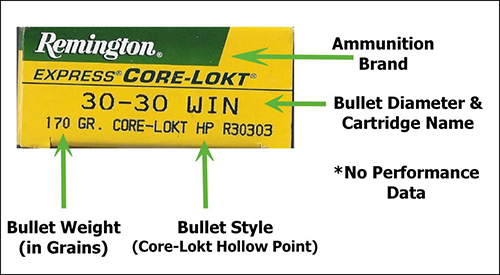
Ammunition Brand:
Ammunition is a branded product made by several different companies. This means the name of the manufacturer is often, but not always, a dominant feature of the label. Many shooters develop a brand preference once they learn which ammunition functions best in their particular firearm, so which brand you buy can be important if you are purchasing a gift for someone else.
Bullet Diameter & Cartridge Name:
The diameter of a bullet, or how wide it is across its circular base, is used as a defining feature of the cartridge name to make quick ammo identification easy. Similar calibers are usually grouped together on dealers’ shelves. Bullet diameter is usually represented on a box using one of two measurement systems: Caliber or Millimeters.
Caliber, the more common measurement for ammunition developed in the United States, is a decimal point representation of hundredths of an inch. If a bullet has a 0.300" diameter, it would be said to be a 30-caliber bullet. The actual bullet size is not always the same as how it's represented in the cartridge's name. For example, the .44 Magnum revolver cartridge is actually loaded with 0.429" bullets. Why is it called a .44 then? Who can say. The most important thing for the new ammunition buyer to understand is that the cartridge name on the box matches the cartridge name on the gun. You can sort out the details of cartridge history design later as you gain more experience. Sometimes bullet caliber is displayed to two decimal points (.38 Spl., .44 Mag., .45 ACP) or to three decimal points (.223 Rem., .357 Ruger, .327 Fed.).
The other measurement system used for bullet width is Millimeters. This tends to be applied to cartridges developed overseas. Bullet diameter in Millimeters can be displayed as a whole number (9 mm, 10 mm) or as a decimal point (7.62 Tokarev, 6.5 Creedmoor).
Most of the modern ammunition available today will be loaded with bullets ranging from the very small .17 Caliber bullets to large .50 Caliber projectiles. Why is the bullet diameter so important? A cartridge with a bullet that is too large for the gun will not fit into its chamber, while a cartridge with a bullet that's too small will rattle around the barrel as it flies down the barrel and produce rotten accuracy. More importantly, loading the wrong cartridge into a gun may cause it to literally explode. There are no approximations when it comes to ammunition. The caliber numbers on the box must match the numbers on the gun exactly.
The full name of the cartridge may, or may not, have more to it than the bullet caliber. For example, the 9 mm Luger cartridge is often shortened to just 9 mm, or the word following the caliber is abbreviated to conserve space on the label. Cartridge names often include the name of the individual who invented it (.475 Linebaugh), the gun company that developed it (.30-.30 Winchester), or a descriptive term (.221 Fireball).
Bullet Weight:
In most cases, bullet weight is represented in Grains. This is an archaic unit of measurement that's not commonly used any more. It takes 437.5 Grains to equal an Ounce, and the larger the number of Grains listed on the box, the heavier the bullet will be. Grains can be spelled out completely on a label, or abbreviated (Grain, Gr, gr, gr.). However it's represented, the letters G and R will be in there somewhere. Shooters pay attention to how light or heavy a bullet is because the weight changes the performance down range.
Bullet Style:How a bullet is shaped, and what it's made of, will affect how it behaves when striking an intended target. There are far too many bullet style abbreviations to list here, especially since manufacturers keep developing new ones. But here are a few common abbreviations used for handgun and rifle ammunition:
- FMJ (Full-Metal Jacket): A lead bullet wrapped, or "jacketed," in a thin covering of copper or brass along the top and sides, leaving the base exposed. Jacketed bullets can have a rounded or flat-nose shape. Copper is soft, but it doesn't melt like lead does at high velocity, so the jacket makes the bullet much stronger and allows it to travel much faster. These bullets are commonly used in practice grade ammunition.
- TMJ (Total-Metal Jacket): The same idea as a Full-Metal Jacket, but the base of the bullet is covered in copper as well.
- JSP (Jacketed-Soft Point): A bullet with the sides jacketed in copper, but the lead nose of the core is left exposed in order to allow the bullet to expand when it hits the target. These tend to be used for hunting.
- SJHP (Semi-Jacketed Hollow Point): The same design as the Jacketed Soft Point, but a cavity, or "hollow" is cut or molded into the nose of the bullet. The combination of the exposed lead and the hollow point cause the bullet to expand more rapidly. These bullets are commonly used for self defense and hunting.
- JHP (Jacketed Hollow Point): This is the most popular type of self defense and hunting bullet on the market. Imagine a Full Metal Jacket bullet that has a hole drilled in the nose, so that the jacket covers the whole bullet, but there is a cavity in the nose. Several designs are available, all of which are intended to allow the bullet to expand rapidly.
- FRAN (Frangible): A relatively recent addition, these bullets are made of compressed metallic dust. They look like Full Metal Jacket bullets, but they are supposed to disintegrate back into dust when they hit a solid target. This disintegration is intended to reduce the chances of ricochet or over penetration. These are popular for use at indoor ranges and as training rounds.
*Performance Data:
Some companies may add a bit of performance data on a label to keep things interesting. For example, some pistol ammunition is marked with a "+P". This indicates the cartridge inside generates more pressure than some handguns are designed to handle. You might also see bullet velocity (1,050 fps) and bullet energy (269 ft./lbs.) information listed on the label. Velocity and energy information are not usually needed to identify a correct cartridge for your gun, but it’s helpful to know what the extra numbers and markings mean.
The Black Hills ammunition label below is from a center-fire handgun ammunition box. The same information presentation is used for center-fire rifle ammunition as well:

Earlier it was mentioned that ammunition companies like to have their boxes stand out, so one of the things they do is move around and change the abbreviations for the information on the labels. Here is the Black Hills Ammunition .38 Spl. box again, but shown with other brands as well:
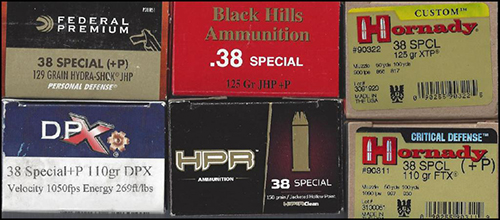
Each of these labels display the manufacturer, caliber and cartridge name, bullet weight and bullet style, but with some variations. Most read from the top down, but HPR places their name and the cartridge information side-by-side. The Black Hills box shows the bullet caliber with a decimal point, the others delete the decimal and rely on the word Special to let buyers know what the cartridge is. The Hornady boxes abbreviate the cartridge name (SPCL) while the others spell it out completely. The blue and white box in the lower left corner is from Cor-Bon, but they chose to let their label colors do the talking and emphasized the DPX bullet style instead of their company name. The Cor-Bon box is the only one with velocity and energy data, but four boxes are marked as +P.
Take a look at the two Hornady boxes on the right. At first glance, they look nearly identical. However, subtle differences in the labeling provide important information. The top box, with the yellow Hornady Custom label bar, is from a different line of ammunition than the black bar Critical Defense line, which means they use different bullet styles. The Custom box does not have a +P mark, while the Critical Defense load does. This means the Custom load should be safe to fire in most well maintained .38 Special revolvers, while the Critical Defense load is limited to those guns rated for P+ ammunition. The Custom round has a heavier 125-gr. XTP bullet style, while the other is a lighter 110-gr. FTX. In other words, the two Hornady loads are the same in the sense that two cups of coffee are both filled with coffee, but one is a Latte while the other is an Espresso.
When I was working at a sporting goods store in college, I sometimes met with customers who arrived with partial ammunition information, which made filling their needs a challenge. They would say, "I'm looking for some Magnum ammunition," or "I'm trying to find some .45 ammunition." It's important to know the complete name of the cartridge because different cartridges can share the same bullet diameter or naming elements. Take a look at the following photo:
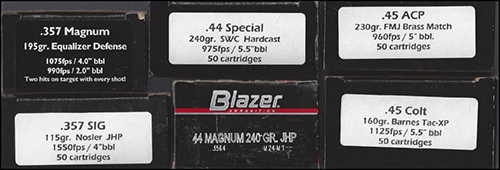
On the left are two cartridge boxes labeled with .357 bullet diameters, with two .44s in the middle, and two .45s on the right. The boxes are also similar in size and labeling. Now take a look at the cartridges each contains:

Despite their similar name elements, these cartridges have little in common with each other. The .357 Mag. and the .44 Mag. have different diameters. The term "Magnum" is an indicator that these cartridges are larger than, or derived from, a similar cartridge. This is the relationship between the .44 Mag. and .44 Spl. The .44 Spl. was developed first, and then the cartridge was lengthened a bit and packed with more powder to form the more powerful .44 Mag. load. The .357 Mag. is a revolver cartridge, while the .357 Sig is what's known as a "bottle neck" semi-auto cartridge. The .45 ACP is a semi-auto cartridge commonly fired in 1911-style semi-auto pistols, while the venerable .45 Colt can be found in old fashioned, cowboy-action shooting revolvers.
If you are buying a gift for a shooter, and all of this ammunition box label information is a bit too much to take in or remember, then talk to the person for whom you're buying ammunition. Ask them to write down exactly what they want (manufacturer, cartridge name, bullet weight, bullet style). Or, use that snazzy cell phone camera to take a picture of the labels on the boxes of ammunition they already have. That way you can just show it to the clerk and avoid any confusion.
If you are new to shooting, then now is the time to get to know your firearm better. You can begin the process of exploring how different ammunition brands, bullet weights, and bullet styles perform in your gun. When breaking in a new gun, it’s best to buy just one box each of several different brands until you find the brands that are the most accurate and reliable in your firearm.