Here’s a not-so-far-fetched scenario you might want to consider: You awaken in the middle of the night to a noise that doesn’t belong in your home. Prudently, you grab your shotgun and cell phone. Suddenly, you hear the screams of your daughter coming from her bedroom. You rush toward the room and are confronted with a bad guy using your daughter as a human shield. The bad guy starts to point his gun at you. What are you going to do?
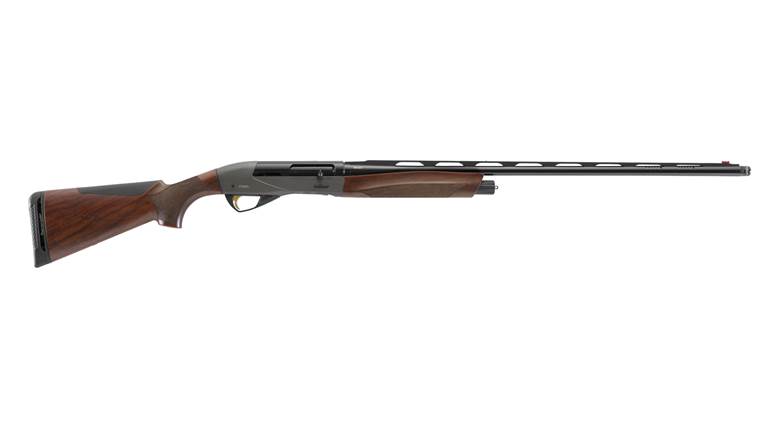
The Boy Scout motto is “Be prepared.” In that vein you may practice diligently with pistol and carbine, but most do not train a great deal with the shotgun, which is a pity. The shotgun may not be suited for taking out a 200-yard threat, but at in-home ranges it can be utilized as a precision tool—provided that you know its behavior intimately at those distances.
Of course, the way to get that familiarity is to train for it, and that means rounds downrange. Unfortunately, for this kind of familiarization, you will need to shoot the same ammo you plan to utilize when it’s real—no light practice loads. We’ll examine whether to use bird shot or buckshot as your “for real” ammo at another time, but if you plan to use 1 1/4 ounces of No. 6s, or eight or nine 00 buck pellets, that’s the ammo you should use for this training.
Like rifles, every shotgun is an individual when it comes to patterns with a given load and its point of impact. I have found that the best way to pattern a close-range shotgun load is with cardboard. Paper is too flimsy to capture the true essence of the pattern. You’ll need enough cardboard to shoot a minimum of seven rounds—doubling, or even tripling that amount would be better because of a larger sample size. Whether you choose to shoot individual targets or put them all on one huge piece of cardboard is up to you.
For this exercise, I recommend having an aiming point so that you can determine the impact point, vis-à-vis your point of aim. This is a great argument in favor of an adjustable rear sight on your home-defense shotgun. A felt-tipped marker will produce an excellent aiming point.
Using your home-defense shotgun with “for real” loads, shoot at least one round (better two or three at individual targets) at 3, 5, 7, 10, 15, 20 and 25 yards. Measure both pattern size and any deviation between point of aim and point of impact. If you were smart enough to shoot multiple rounds at each distance, take an average of the results. Record—even photograph with each distance clearly marked on it—the results of each target. If you have an adjustable rear sight on your scattergun, zero it at 7 to 10 yards—the most likely distance you’ll have a deadly encounter.
Now you can start training for that encounter with a bad guy holding a loved one as a human shield. Set up the targets at various ranges and learn how much to hold off the shoot target in order to secure a hit without harming the no-shoot target. Typically, at most home-defense ranges, the point of hold is on the outboard side. There will be a range at which it is imprudent to attempt this shot, and the only way to determine that for you and your shotgun is to shoot it enough at various distances.
The home-defense shotgun has garnered some impressive euphemisms: intimidator, great equalizer, street howitzer and such. Relatively few are aware of its precision capabilities. But having that knowledge could come in handy when you need it most.