8/29/2012
The term handgun “stopping power” generally relates various opinions about the ability of handguns to create ballistic wounds sufficient to incapacitate a target. Using muzzle velocity, caliber, bullet weight and energy, there have been multiple attempts to create formulas to rate handgun stopping power. The problem is that these theories are tied to mortality; the notions are based on the handgun’s ability to kill. From a hunting standpoint, that makes sense, but when looking at the role of a defensive handgun, it’s at least partially of no consequence.
The goal of the hunter is to kill as humanely as possible. The goal of an armed citizen using a defensive handgun is to stop an attacker as fast as possible. As similar as killing and stopping may sound, they are two very different things. It’s true that if you kill something you have stopped it, but unlike a hunter who can shoot an animal and let it run off a short distance to expire, a defensive handgun user needs to stop an attack immediately.
Causing immediate death with any firearm is difficult, achievable almost only by a shot to the cranial vault that destroys the brain and nervous system. That is difficult to accomplish in a dynamic situation. It is why law enforcement officers, soldiers and civilians train to shoot center mass of the available target; it increases hit probability. As a result, that is where the debate of handgun stopping power is centered.
What handgun/ammunition combination will do the best job of stopping an attack when a bullet is placed center mass of the attacker? The operative word here is stop, not kill. If an attack is not halted immediately, death might be the ultimate result, but it might arrive too late to matter.
Animals, and that includes humans, die when their brains run out of oxygen. As a law enforcement officer, the first murder I investigated was perpetrated with a .17-cal. pellet rifle, proving to me that about any bullet through any vital organ can kill. But it can take from 10 seconds to 10 minutes to occur. In 10 seconds an attacker can carve you up like a Christmas turkey. What’s needed is a combination that’s very likely to make an attacker stop doing the thing that is endangering you, immediately.
Jim Cirillo, a New York City cop who survived many gunfights, once wrote, “The only one-shot stops I ever saw were a .38 Special Super Vel hollow point and a 12 gauge slug. Both shots were to the brain.” Two other cops, Evan Marshall and Ed Sanow, authored three books examining one-shot stops from defensive handguns. Their work is shrouded in controversy for several reasons, but something that cannot be ignored is that they found multiple instances with every common defensive handgun cartridge where one-shot stops had occurred. Keep in mind their study was about one-shot stops, not one-shot kills. It is most important to recognize that Marshall and Sanow did not find a single cartridge that had not produced multiple one-shot stops.
How could that be? How could small caliber, pipsqueak guns stop attacks? The answer is simple; pain and fear. Police officers know that pain compliance is an important tool. They are issued batons and pepper spray to bring that about. But you don’t have to be a cop to know that. Few things control human behavior like pain. Smack your thumb with a hammer hard enough and you’ll immediately stop what you’re doing, and even the toughest cage fighter can be stopped with a solid hit to the groin, kidney or liver.
The key to immediately stopping an attacker with a handgun is either through the conscious fear that you’ll shoot him or through the conscious or unconscious fear and/or pain the shot inflicts. Fear and pain are why things such as pepper spray, batons and less-lethal rubber bullets are effective too. Regardless of how determined someone is to doing harm to someone else, if the aggressor is hurt badly enough he or she will stop. So, the logical approach to handgun stopping power would seem to be to use the combination capable of causing the most pain.
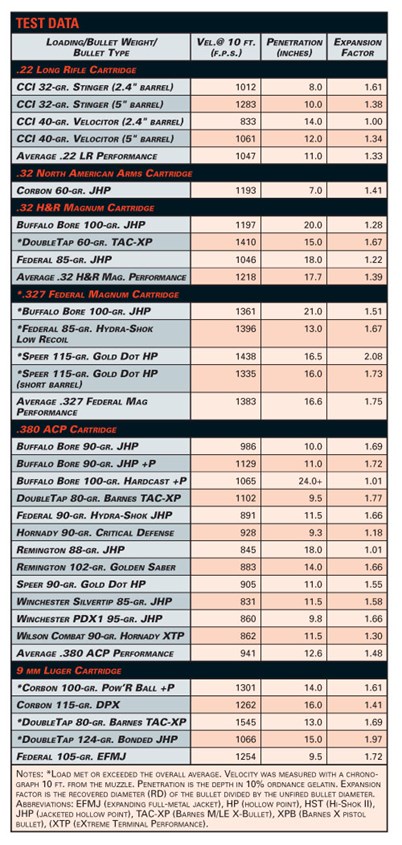
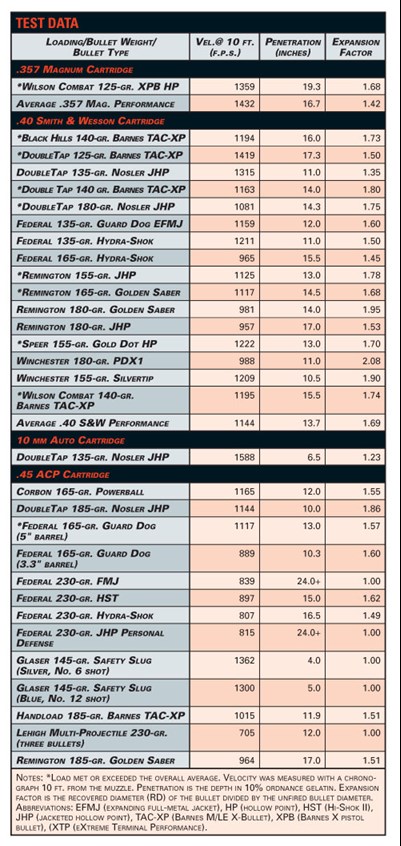
The problem with pain is that there is no way to measure the amount any combination might produce. It would seem that those loads that make very wide and nasty, but sometimes shallow wounds, such as Corbon’s 165-gr., .45 ACP +P load, would hurt the most; it will literally chew up the first 6" of a gelatin block. Loads like that damage a great deal more tissue than those that punch a neat hole all the way through a bad guy like a 230-gr., .45 ACP full-metal-jacket (FMJ) load, which can penetrate 3 ft. in gelatin. The data collected by Marshall and Sanow seem to support that conclusion. So do the results of the controversial Strasbourg Tests, in which multiple goats were shot while being electronically monitored.
That all makes sense, but by itself can be a foolhardy approach because pain is not experienced the same by everyone and pain can be blocked by adrenalin and drugs. Soldiers and police officers who have battled through pain become heroes, bad guys that do the same become wanted. It’s likely that the adrenaline in your attacker will be high and it’s possible he could be under the influence of a mind altering drug. Pain and fear are effective but might not be enough.
So what is the answer? Some like to base conclusions on caliber, bullet weight and energy. So let’s consider those. The caliber of the unfired bullet matters very little since bullets radically change shape in the first several inches of penetration. And, after dynamic expansion has occurred, the wound created varies minimally regardless of expanded bullet diameter. Jim Cirillo stated in his book, Bullets, and Gunfights, Lessons and Tales from a Modern-Day Gunfighter, “The forensic experts I have questioned while attending many post mortem examinations stated that they could not tell the difference between a .32 caliber round nose bullet and a .45 caliber round nose if both passed through the body, since both only make small wound channels as they pass through tissue.” My testing has confirmed this; in 10 percent ordnance gelatin their wound channels are indistinguishable.
What about bullet weight and energy? Energy, kinetic energy, is a product of bullet weight and velocity, but two bullets can have the exact same energy and create substantially different wounds based on how they work, how they expand and their path in tissue. Realistically, it makes no sense to base performance on the potential to do work—kinetic energy—if that work is not done. With regard to bullet weight alone, Finn Aagaard, a much respected gunwriter and very experienced big game hunter once wrote, “Given sufficient penetration, what does any additional bullet weight add to killing power? Nothing, absolutely nothing.”
This leaves us with the more logical approach of basing stopping power on terminal performance—what occurs after bullet impact—not external ballistics. Impact velocity, bullet expansion and actual penetration would seem to be the pragmatic guide to the determination of effectiveness.
A bullet that expands creates a larger wound cavity. The more expansion, the more tissue that is damaged, destroyed or traumatized. Multiple tests have shown a correlation between large wound cavities and bullets that expand at least 1.5 times their unfired diameter. However, over-expansion and/or fragmentation to the point the bullet loses a lot of weight limits penetration and penetration is important. The problem is that deep penetration without expansion is notorious for slow incapacitation. Hunters and gunfighters will confirm this and the reason is that bullets that penetrate really deep and expand very little damage small amounts of tissue and cause minimal pain. Still, if we hope to penetrate the vitals as a failsafe to the possible lack of our attacker’s ability to feel pain, “sufficient penetration”—like Aagaard alluded to—is important.
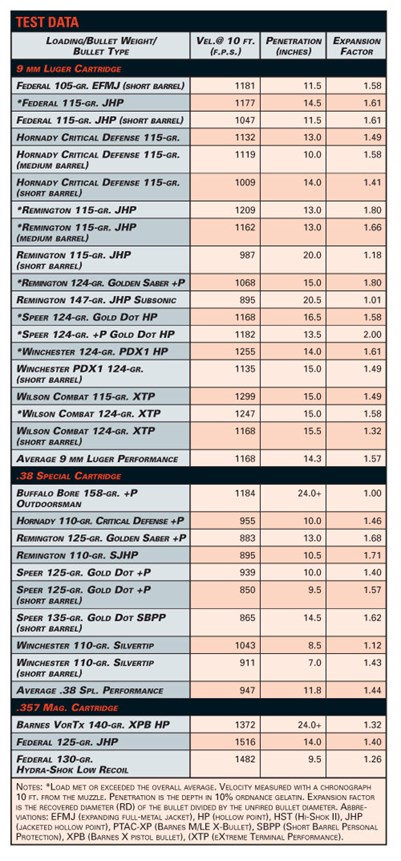
And then there’s impact velocity. When you combine high impact velocity with expansion, wound cavities get very large. This should not come as a surprise. The .38 Spl. and the .357 Mag. shoot the same caliber bullet, but the .357 Mag. pushes it much faster and has a much better record for stopping bad guys. When comparing their performance in 10 percent gelatin using similar bullets, the difference is obvious.
So, should you carry the combination you think will cause the most pain or the one you think will penetrate through to the vitals no matter the shot angle and regardless of what gets in the bullet’s way? Common sense should tell us that the failsafe, penetration, is our first priority; if pain fails to stop the attack—and it might—we have to rely on the bullet’s ability to drive through vital organs. The ability to inflict the maximum amount of pain should be our second goal. This makes choosing the handgun/bullet combination simple—you want the combination that penetrates to a sufficient depth and damages the most tissue in the process.
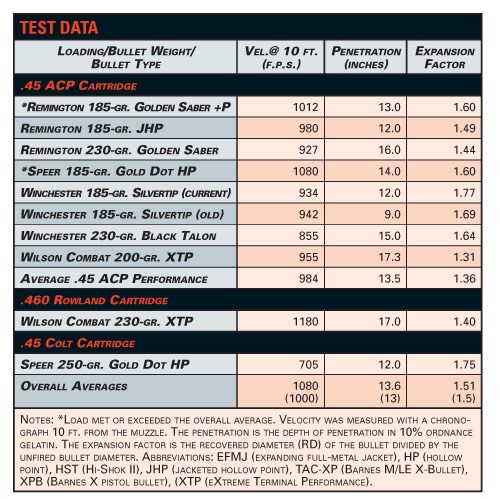
Test Data: