On Easter Monday, April 24, 1916, scattered groups of men of the Irish Volunteers and Irish Citizen Army, as well as women of the nationalist auxiliary organization, the Cumann na mBan, assembled at their mustering points throughout Dublin. Most of them were unaware that, instead of meeting for a routine maneuver, they were embarking on an armed uprising against the British Crown. Due to a series of mishaps and intrigues, only a fraction of the Volunteers’ nominal strength actually reported for duty. While some were in the green uniforms of the Irish Volunteers or the Citizen Army, the majority of them were in civilian clothes, and they carried an amazing assortment of firearms.
The Easter Rising of 1916, or as it is sometimes known, the Easter Rebellion, marked a significant shift in Irish-British relations, and is considered by many to be the first stroke of the popular uprising that severed Ireland from the British Crown in 1922. Time and space here do not allow a detailed discussion of the causes of the Rising, but a short introduction is necessary to understand the reasons for the variety of small arms carried in this battle.

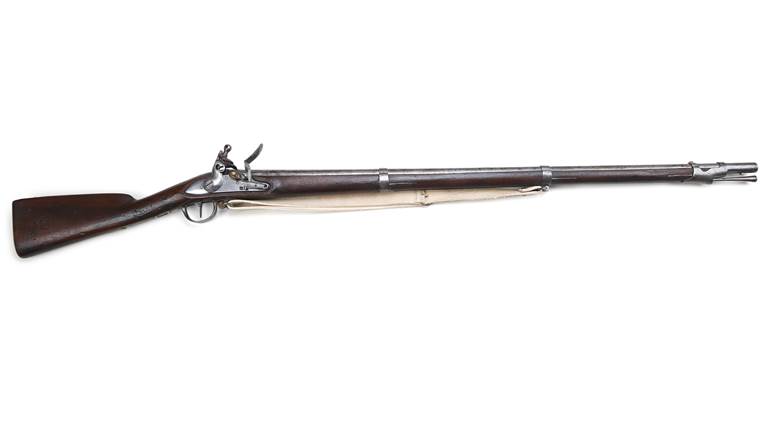
A few years before the outbreak of World War I in 1914, the British government pledged to return a semblance of Home Rule to Ireland, after a hiatus of more than 100 years. The northern province of Ulster, populated mainly by Presbyterians who had emigrated from Scotland some 300 years earlier, feared domination by the other three overwhelmingly Catholic provinces, and pledged to oppose Home Rule by force, equating it with “Rome Rule.” In a daring smuggling operation, the newly formed Ulster Volunteer Force armed itself with modern Austrian Mannlicher rifles, obsolescent German Model 1888 “Commission” rifles, and obsolete Italian Vetterli rifles.
The Irish Volunteers (pledged to fight for Home Rule), who had been smuggling in small lots of arms, followed suit when they landed two small boatloads of antiquated Model 1871 German Mauser rifles in Ireland. Arms smuggling on both sides continued right up to the point when Great Britain declared war on Germany in August 1914, resulting in a wide array of shoulder arms and handguns coming into Ireland. Under a mutual agreement, the Home Rule controversy was temporarily shelved for the duration of the war, and both the Ulster Volunteers and the Irish Volunteers (immediately renamed the “Irish National Volunteers”) volunteered en masse for service with the British Army. However, a small number of the original Irish Volunteers (retaining their original name) refused to fight for the government they considered as oppressors.

In the first two years of the war, while Irishmen of the 10th (Irish), 16th (Irish), and 36th (Ulster) divisions were fighting worldwide for the British Empire, the Irish Republican Brotherhood, a secret radical organization, was negotiating for German assistance in support of a nationalist revolt. The Germans were skeptical of Irish success in a revolt, and aside from sponsoring an “Irish Brigade” of trained machine gunners (made up of a very small group of Irish POWs) and promising to furnish a boatload of 20,000 captured Russian Model 1891 Mosin-Nagant rifles, 10 Maxim machine guns, and several million rounds of assorted ammunition, the German Foreign Office did not give the proposed uprising much support. The Brotherhood had also infiltrated the Irish Volunteers and, on Easter weekend, the IRB, in spite of the capture and loss of the German arms ship and with orders countermanding the planned Irish Volunteer maneuvers across the country, still managed to assemble a force of about 2,000 men and women in Dublin.
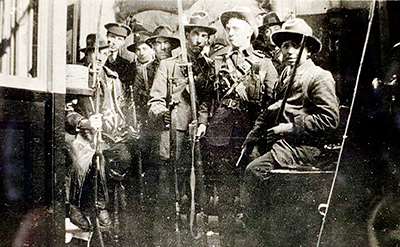
The insurgents seized a number of large buildings and key sites throughout the city, and they posted units to intercept any British troops coming from the different military barracks sited across Dublin-as well as reinforcements expected to arrive from Great Britain. In the center of the city, the rebels took the General Post Office, the largest building and communications nerve center of Dublin, as well as the Four Courts building on the Liffey River. They fell short of seizing Dublin Castle, but took City Hall and a number of other public buildings. Farther out, the Citizen Army dug trenches in St. Stephen’s Green, a city park, and the Irish Volunteers set up garrisons in businesses, such as bakeries, biscuit factories, pubs, and hotels, as well as in private homes and schools, to contest the expected British reaction.
British reaction was cautious, often confused, and uncoordinated during the first few days, although troops of the Dublin garrison did make some significant headway against rebel-held positions. By mid-week, British troops had landed from England and, after suffering grievous losses at Mount Street Bridge, started to tighten the cordon around the center city. Amid the chaos of looting, arson and widespread hunger caused by the upheaval, the British Army, using the standard British small arms and field guns of the World War I period, finally forced the surrender of the rebels on Saturday, April 29, 1916.

Of all the arms surrendered by, or captured from, the rebels, the “Howth” Mauser rifle is perhaps the most emblematic of the Rising. In July 1914, the Irish Volunteers managed to land some 1,500 Model 1871 11 mm single-shot, bolt-action German rifles from two small sailboats-one carrying the majority of the arms at the port of Howth, and the other at Kilcoole, further to the south-which were then distributed in Dublin and throughout the southern three provinces. The rifles had been acquired (ironically, by nationalist Protestants) from an arms dealer in Hamburg, Germany, who had earlier supplied the Ulster Volunteers with their arms. Through an agreement with the Irish Volunteers, the small Irish Citizen Army gained a complement of the Mausers, and posed with them in a number of well-known photographs. The rifle fired a center-fire necked cartridge with a .43-cal. lead bullet-a cause for the British to accuse the rebels of using “Dum-Dum” expanding bullets, which had been outlawed some years earlier by international convention.
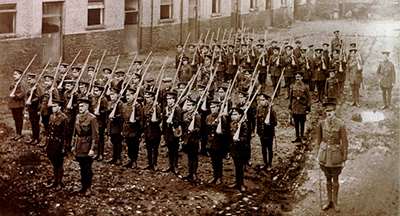
Some British soldiers referred to the Howth rifles as “Elephant Guns.” Indeed, the recoil was memorable, and many rebels had never had the opportunity to fire their rifles prior to the Rising. One lad, while defending the Mount Street Bridge, was knocked unconscious when he fired his first shot! As was the case throughout the Rising, Howth Mausers were interspersed with any number of other types of shoulder arms, leading to a logistical nightmare in terms of ammunition supply.
Other types of rifles were fairly evenly distributed among the rebels, but some were used only to a very limited extent. The insurgents carried various models of Lee-Enfield rifles and carbines, the most prized, of course, being the then-current British service rifle, the Short, Magazine Lee-Enfield (SMLE). While a very few of these rifles had been obtained covertly prior to the Rising, usually through bribing a British soldier into claiming his rifle as “lost” (the going price was five pounds sterling), some others were captured during the weeklong fight and put to good use. With its 10-round magazine capacity, potent Mk VII .303 British cartridge and slick action, the SMLE was one of the most telling arms in the hands of the insurgents.
However, more common was the older Boer War-period Long Lee-Enfield, and those rifles also played an important role. James Grace, having smuggled in a Long Lee on his return from Canada in 1913, used the rifle to great effect in the storied defense of 25 Northumberland Road. Extant pre-Rising photographs show entire squads of the Irish Volunteers being armed with Long Lees, and they certainly were in evidence in the final defense of the General Post Office.
Also chambered in .303 British, Martini-Enfield carbines and rifles saw action with units throughout the city. Originally designed for the far less-powerful Mk VI ammunition, the Martini-Enfields could fire the hotter Mk VII cartridge, but sometimes with disastrous results. One of the Martinis used in the defense of Clanwilliam House at Mount Street Bridge blew up after repeated firing, although the house’s garrison had requested a supply of Mk VI ammunition earlier from its parent battalion at Boland’s Bakery. Robert Monteith, a former British NCO who had landed from a German submarine as part of the ill-fated arms landing on the west coast of Ireland, advised the local Limerick Volunteers not to use Mk VII rounds in their Martinis. Although many Irish historians cite the use of “Martini-Henry” rifles, they often use the term interchangeably with “Martini-Enfield.” However, the use of .577/450 arms cannot be discounted, as, undoubtedly, some of these antiques were more than likely pressed into service.

Souvenir Boer War captured rifles and carbines were among the arms found by the British after the battle. Most were Model 1895/1896 Mauser rifles and short rifles in 7x57 mm, and some even had the distinctive stock carvings favored by the Boers. At least one Danish Krag-Jorgensen rifle, another “bring-back” from South Africa, was included in the lot. Ernie O’Malley, one of the few chroniclers at the time who actually had an interest in rifles-and knew what he saw-relates that he and his friend carried a souvenir German 7.92x57 mm Gewehr 98 service rifle and that they had used it to take potshots at British troops during the battle.
In early 1914, a shipment of Italian bolt-action repeating rifles arrived in Ireland. Members of the Irish Parliamentary Party had imported the Vetterli-Vitali Model 1870/87 rifles, and they were distributed to those units of the Irish Volunteers in Dublin and Ulster which had strong links to the party and which later formed part of the Irish National Volunteers. The republican rebels later procured some of the rifles. This obsolete Model 1870/87 rifle was chambered for the 10.35x47 mm rimmed blackpowder cartridge and utilized a unique wood and sheet-metal charger to load the four-round magazine.
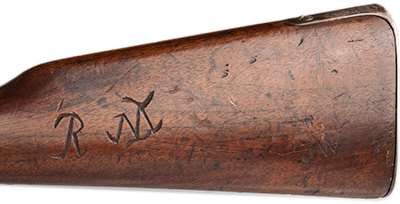
Curiously, a stylized directional arrow was printed in black ink on the wooden top of the clip, so that the soldier would know in which way to load the cartridges. While there are extant photographs of Vetterlis being carried in formations, most of these show them in the hands of the Irish National Volunteers, the group that split off and supported the British war effort in 1914. Moreover, an Irish military historian, Pádraig Óg Ó Ruairc, notes that almost all of the veterans of the period who mentioned the Vetterli stated that the rifles were used only for parades, as the Volunteers did not have ammunition for them. However, ammunition was available in Ulster, so a few Vetterlis probably saw service in the Easter Rising. One Vetterli rifle had been on exhibit for many years in the former “1916 Room” at the National Museum of Ireland, with a label identifying it as one used during the fight, and its image can be found in many books on the Easter Rising. There are other examples in the collections of the new national military museum at Collins Barracks and at Kilmainham Gaol Museum in Dublin, including a few Vetterli-Vitalis in relic condition, with one having “1916” carved on its stock.
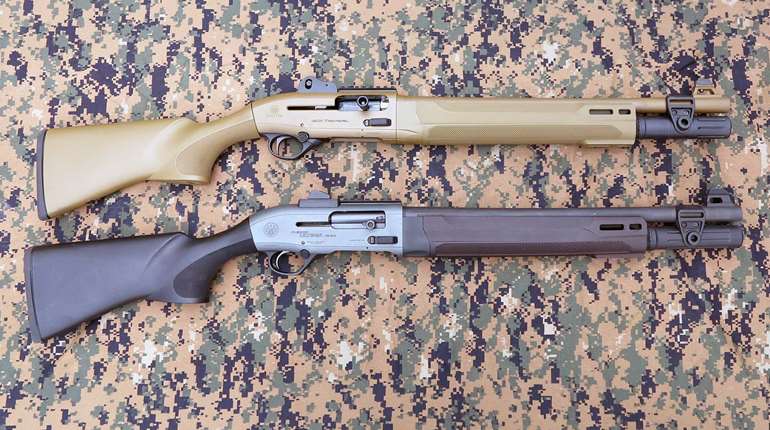
Finally, both double-barreled and especially single-barreled shotguns were seen among the ranks of the insurgents. The Volunteers had set up clandestine ammunition factories where, in addition to making hand grenades, shotshells were reloaded with cast lead slugs. Interestingly, the rebels also made makeshift bayonets for single-barreled shotguns in a locomotive works. The knife-bladed bayonets clamped onto the shotgun barrels with crude wing nuts and, according to a veteran of the fight at Roe’s distillery, at least one of the improvised bayonets had been made from a set of garden shears.
As can be imagined, many of the insurgents did not have bayonets, nor were they well-trained in the use of the ones that they had. As related by Max Caulfield in his excellent account of the action, The Easter Rebellion, Capt. Simon Donnelly (one of Commandant Eamon DeValera’s men at Boland’s Bakery) said about the men in his company, “I never had any faith in the men acquitting themselves well in a bayonet charge, especially in the dark.”
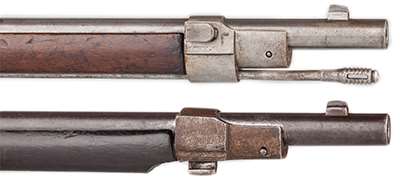
Nonetheless, there was some desperate hand-to-hand fighting at several points in the city, and the British troops advanced on many rebel positions with bayonets fixed. As had been the case with the Ulster Volunteer Force, the Irish Volunteers obtained French Model 1874 Gras rifle bayonets and altered them to fit the other rifles in their arsenal. Those bayonets were reconfigured to fit the German Commission rifles and Vetterlis in Ulster, the Irish Volunteers altered them, along with French Model 1866 Chassepot bayonets, to fit “Howth” rifles. Some of the insurgents armed with Long Lee rifles had the appropriate Model 1888 knife bayonet.
If the “Howth” rifle is the emblematic shoulder arm of the Easter Rising, then the C96 “Broomhandle” Mauser pistol-carbine, with its distinctive shoulder stock holster, must be afforded the title of “most remembered” handgun. While it is not known just how many of these pistols were carried in the uprising, at least three instances of their use have secured them a place in Irish history, prior to their widespread service in the ensuing War of Independence (1919-1922) and Irish Civil War (1922-1923). Known throughout Ireland as “Peter the Painter” (after a Latvian revolutionary whose gang used them to great effect during London’s “Sidney Street Riot” in 1911), many of the pistols used during the Easter Rising were chambered in 7.63x25 mm, although they had also been available in 9 mm Parabellum since 1912. Padriac Pearse, the leader of the Rising, surrendered his C96 Mauser at the end of the week-long fight.
Although she also carried a .455 Smith & Wesson revolver, as well as a small .32-cal. S&W revolver, Countess Markievicz, the colorful second-in-command of the Irish Citizen Army forces at St. Stephen’s Green and later in the Royal College of Surgeons, carried a 7.63x25 mm broomhandle, and used it to silence a British machine gun crew on the roof of the nearby Shelbourne Hotel. Cathal Brugha, later a driving force in the War of Independence, used his “Peter the Painter” very effectively in his epic defense of the South Dublin Union, a fight in which he suffered numerous wounds. His gallant action kept the attacking British at bay, while he bellowed out the nationalist song, “God Save Ireland.”
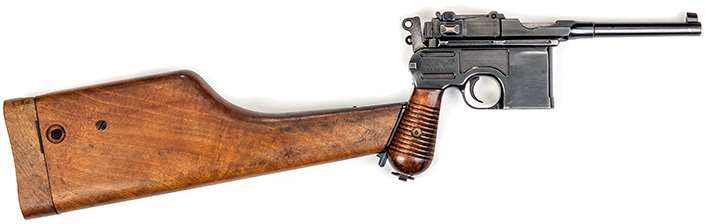
The most incredible tale of the broomhandle’s effectiveness in the hands of an experienced marksman is that of Lt. Michael “Mick” Malone during the battle of Mount Street Bridge. Using a Mauser borrowed from his commanding officer, DeValera, he and James Grace accounted for scores of British “Sherwood Foresters” who were passing their stronghold at 25 Northumberland Road, heading for the center of the city. While Grace had his Long Lee Enfield rifle, as noted earlier, and a magazine-fed semi-automatic pistol, Malone only paused using his Mauser pistol when the barrel heated up, and then took up his “Howth” gun. In one instance, Malone, reputed to be one of the best shots in the Dublin Brigade, knocked over 10 British soldiers in 10 shots with his pistol. In all, the 17 Irish Volunteers engaged in the extended battle at the bridge killed or wounded some 240 British soldiers.
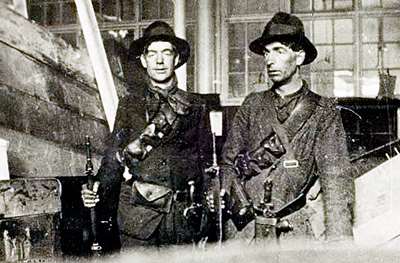
Pistols and revolvers of all types, makes and calibers are mentioned in existing accounts of the battle, and many more simply refer to “revolvers” and “pistols,” regrettably interchangeably in many instances. It is safe to say that Webleys, Colts, Smith & Wessons, and Belgian, Spanish, and other revolvers were used, as well as Colt, Mauser, Browning, Webley & Scott, and souvenir Luger semi-automatics, in addition to the “Peter the Painter” Mausers. Many of these same types of handguns would later see action in the War of Independence (also known as the “Black and Tan” war) a few years later.
The wide variety of arms in the Easter Rising was a result of a disarmed populace trying to end foreign domination by using whatever firearms it could find. This same motley array of armament would plague the men and women who would fight another war, just three years later, in their successful attempt to make “Ireland, once a province, be a nation once again.”
The author thanks Lar Joye of the National Museum of Ireland, Niall Bergin of the Kilmainham Gaol Museum, Pádraig Óg Ó Ruairc, Maj. Richard Keogh, U.S. Army (Ret.), and Robert M. McDonough for their assistance in the preparation of this article.