2/28/2013
Every area of interest, particularly if it’s the least bit technical, has its own specialized vocabulary. For example, when the Global Positioning System (GPS) came along and I decided to get a receiver for field use, I had to learn the precise meanings of a number of esoteric terms and abbreviations, which often have different meanings than in our everyday world. For example, an “active leg” isn’t something that twitches while you sleep and a “last fix” has nothing to do with illicit drug use. Specialized technical terms serve the purpose of compressing very complex ideas into one or two words. Consequently, one must either learn the jargon or remain ignorant to what is being discussed. Likewise, one cannot fully understand the workings of sports optics (binoculars, spotting scopes and telescopic sights) without knowing about diopters, erecting systems, exit pupils, parallax and so forth.
Aberrations: Optical abnormalities present in lens systems, which, though correctable, cannot be completely eliminated. They include: chromatic aberration, spherical aberration, coma, distortion, curvature of field and astigmatism.
Achromat: Also known as an achromatic lens. A lens consisting of two or more elements, usually of crown and flint glass, that has been corrected for chromatic (color) aberrations with respect to two selected colors, usually blue and red.
Angular Measurements: The performance characteristics of optical instruments are often expressed as angular measurements. Field of view is measured in degrees; windage and elevation adjustments are calibrated in minutes of angle or fractions thereof; resolution is measured in seconds of angle; and the center-to-center spacing of dots on mil-dot reticles equals one milliradian (mil.).
Degree of Angle: A unit of angular measure equal to 1/360 of a circle. One degree subtends 62.83 inches at 100 yards or 52.36 feet at 1,000 yards.
Minute of Angle (m.o.a.): A unit of angular measure equal to 1/60 of a degree, or 60 seconds. One minute subtends almost exactly 1 inch (1.047") at 100 yards, 2 inches at 200 yards, 3 inches at 300 yards, and so forth—making it a criterion for firearm accuracy.
Second of Angle (s.o.a.): A unit of angular measure equal to 1/60 of a minute or 1/3600 of a degree, which subtends 0.01745 inches at 100 yards. Resolving power is usually stated in seconds of angle.
Mil: A unit of angular measure that is subtended by one unit of length at a distance of 1,000 units of length, such as one meter at a distance of 1,000 meters. The spaces between dot centers on mil dot reticles subtend 3.6 inches at 100 yards, 7.2 inches at 200 yards, 10.8 inches at 300 yards and so forth.
Apochromat: Also known as an apochromatic lens. A lens system in which the three primary colors (blue, green and red) have been brought to a common focus through the use of special optical glasses, thus eliminating practically all chromatic aberration. Abbreviated terms used to designate instruments with apochromatic optics include: ED (Extra-low Dispersion), HD (High Definition), FL (Fluorite) and APO (Apochromatic).
Binocular: adj. Relating to, used by, or involving both eyes at the same time, as in binocular vision. n. A pair of telescopes mounted side-by-side, usually by means of a centrally located hinge, so that the eyepiece spacing can be adjusted to match the viewer’s interocular distance. Binoculars are rated by their magnifying power followed by the objective diameter in millimeters (e.g., 8X 42 mm). The basic types of binoculars include:
• Galilean Binocular (opera glasses): Lacking prisms, these small binoculars—consisting of convex objective lenses and concave ocular lenses—are generally unsuited for hunting or other long-range viewing because of their narrow fields of view and low magnifying powers, which range from about 2.5X to 4X.
• Porro Prism Binocular: This classic binocular design has a Z-type configuration that positions the objective lenses farther apart than the eyepieces, significantly increasing the viewer’s stereoscopic depth perception.
• Reversed Porro Binocular: Though similar to conventional Porro prism models, this binocular has the prisms rotated so that the objectives are closer together than the eyepieces. This is characteristic of compact binoculars, although some full-sized binoculars now position the objectives as close together as possible. In either case the stereopsis is decreased.
• Roof Prism Binocular: This type is recognizable by having its objective and eyepiece lenses in a straight line. The stereopsis is then equal to that of the viewer’s unaided eyes as enhanced by the magnification. Although, some roof prism binoculars, particularly those having Abbe-style roof prisms, do have the objectives slightly offset.
Center Focus: Refers to a type of binocular with a centrally located focusing control that adjusts both eyepieces of a binocular simultaneously. Such binoculars usually have an individual diopter adjustment for one eyepiece to compensate for vision differences between the viewer’s two eyes.
Coated Optics: Optical elements having refractive or reflective surfaces that have been coated with one or more layers of either dielectric or metallic materials that serve to reduce or increase reflections, eliminate phase interference, decrease external fogging or protect the surfaces from abrasion. Magnesium fluoride, silicon oxide, zinc sulfide, aluminum and silver are a few of the most commonly used coating materials. The primary coatings include:
• Antireflection Coatings: These coatings, whether single layer or multilayered, reduce reflections from optical surfaces, thus increasing the percentage of the available light transmitted through optical instruments. The results are improved image brightness and contrast.
• Reflection Coatings: These coatings improve the reflectance of the various types of mirrored surfaces used in optical instruments. Any light lost in the process of reflection reduces an instrument’s image brightness.
Phase-Correction (P) Coatings: When applied to the roof surfaces of roof prisms, phase-correction coatings reduce the image-degrading affects of destructive interference that occur when out-of-phase light waves from the opposite roof surfaces reunite to form images.
Collimation: The process of aligning the optical axes of optical systems to coincide with the mechanical axes of surfaces of an instrument. Binoculars pose a special problem because both optical systems must be pointed in precisely the same direction; otherwise the viewer will experience eyestrain or worse, double imaging.
Collimator: An optical device consisting of a well-corrected objective lens with a reticle at its focal plane. An example being the lens systems used in optical bore sighters.
Diopter: A measurement unit that expresses the refractive power of a lens. A lens with a focal length of 1 meter has a refractive power of one diopter. Lenses with shorter focal lengths have greater power in diopters. Accordingly, a lens with a focal length of one-quarter meter has a power of four diopters. The refractive power of converging (convex) lenses is positive; the refractive power of a diverging (concave) lens is negative.
Diopter Scale: A focusing scale—such as on the eyepieces of binoculars—which serves to indicate the degree of convergence or divergence of the light rays emerging from the instrument.
Erecting System: Lenses or prisms that serve to erect the inverted (upside down and laterally reversed) image formed by objective lenses. All telescopic sights and many telescopes use lenses to erect the image, while binoculars and prismatic spotting scopes use either Porro or roof prisms. Astronomical telescopes don’t need and, therefore, seldom have erecting systems.
Exit Pupil: This is the small disk of light seen when looking at the eyepiece lens of an optical instrument that is held at arm’s length and pointed toward a bright background. Though the exit pupil may appear to be within the eyepiece, it is actually located behind the eyepieces at the point where the eye must be positioned to see the full field of view. Exit pupil diameters, in millimeters, are calculated by dividing the objective diameter by the magnification, e.g. a 10X 50 mm binocular has 5 mm exit pupils.
Eyepiece (ocular): The lens or lens group between the final image in a visual optical instrument and the viewer’s eye. It serves to magnify that image, thereby determining the magnifying power.
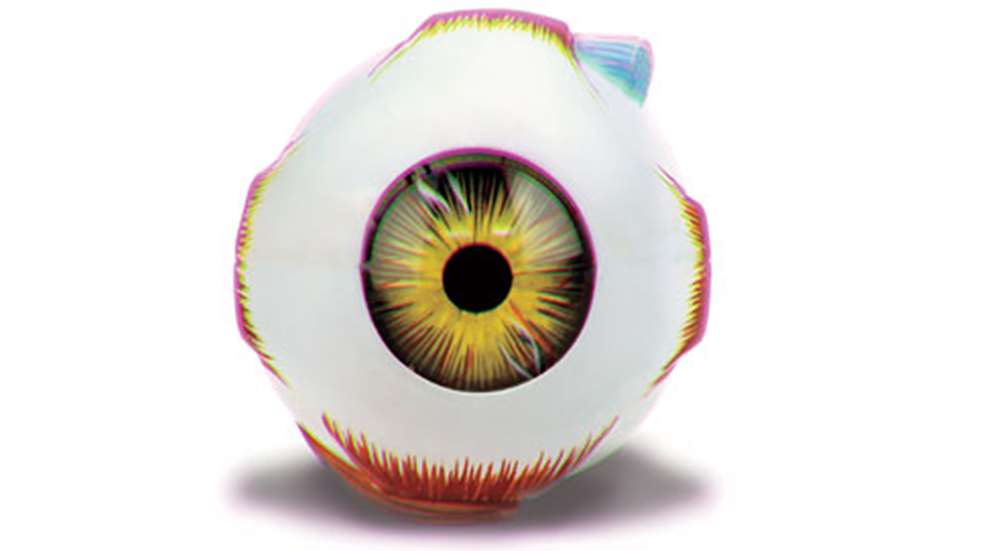
Eye Pupil: The apparently black circular opening in the iris of the eye that permits light to pass through the eye lens to the retina. The human eye pupil dilates automatically from a diameter of about 2 mm in bright sunlight to 7 mm in the dark.
Eye Relief: The distance from the ocular (rear) lens of an optical system to a point at which the user’s eye can see the full field of view. “Long-eye-relief” binoculars and spotting scopes allow users to see the entire field of view while wearing eyeglasses. Telescopic sights used on hard-kicking firearms must have especially long eye relief to reduce the likelihood of the ocular striking the shooter’s eye or face.
Field of View (FOV): The maximum width of the areas that can be seen through the eyepiece of an optical instrument, as measured either angularly in degrees or linearly in feet or meters at specified distances. For example, a 10X binocular with a six-degree angular field has a linear FOV of 315 feet at 1,000 yards. For conversion purposes, one degree equals 52.36 feet at 1,000 yards.
Field, Apparent: The angular subtense of the FOV as it appears to the eye as the result of magnification. Apparent field is calculated by multiplying the true angular field by the magnification. Accordingly, a 10X binocular with a six-degree true field has a 60-degree apparent field.
Field Stop: An aperture located at the image plane of an optical instrument that determines the extent and shape of the field of view, which is usually round in viewing optics and either square or rectangular in cameras.
Focus: To adjust the eyepiece or objective of an optical instrument so that the image appears sharp and well defined to the observer. Changes in viewing distances usually require changes in focus.
Individual Focus: A type of binocular focusing system in which each eyepiece is adjusted independently each time the instrument is refocused.
Interpupillary Distance (IPD): The distance between the exit pupils of a binocular instrument. This usually is adjustable so as to accommodate the observer’s interocular distance, a normal range being from 55 mm to 75 mm.
Image (real): An optical reproduction of an object formed by a lens or mirror. A real image can be captured on a screen of film.
Image (virtual): An optical image as seen directly by the viewer’s eye is said to be “virtual” because it doesn’t exist where it appears to be. A virtual image cannot be captured on a screen or film. The images seen in a plane mirror, which appear to be located behind the surface, are likewise classified as virtual.
Image or Focal Plane: A plane at right angles to the principal axis of a lens or mirror on which the best image of an object is focused.
Light-Gathering Power: A term used to describe the capacity of objective lenses to receive light. Light-gathering power can be calculated as the square of the objective’s diameter in millimeters. For example, doubling the diameter of the objective, quadruples the light gathering power.
Light Transmission: The percentage of light passing all the way through an optical system relative to the amount that entered. This can range anywhere from as low as 50 percent for instruments with uncoated optics to about 95 percent for those with high-quality, multilayer anti-reflection coatings.
Magnifying Power: This is the ability of an optical instrument to make objects appear larger. An instrument that makes objects appear eight times higher and eight times wider is said to have eight-power or 8X magnification. It is designated by the number preceding the “X” in optical specifications, i.e., a 10X 42 mm binocular makes objects appear 10-times larger.
Monocular: adj. Of, relating to, or intended for use by only one eye. n. Usually a small handheld telescope that resembles one half of a binocular.
Object: Anything that is observed through or imaged by an optical system.
Objective: The optical element (front lens) that receives light from viewed objects and forms the first or primary image in an optical instrument. The number following the “X” in optical specification numbers is the objective diameter in millimeters, i.e., a 10X 42 mm binocular has 42 mm objectives. Larger objectives gather more light, relative to their surface areas, and have better resolution, relative to their diameters.
Parallax: Parallax is an optical phenomenon that exists in telescopic sights when the image plane of the target—the location of which varies longitudinally within the scope depending on the target distance—does not fall exactly on the reticle plane. This is seen as a relative motion between the target and the reticle when the eye is moved from side to side in the exit pupil. Low-power scopes are adjusted at the factory to be parallax-free at one specific distance, such as 100 or 150 yards for riflescopes, 75 yards for shotgun scopes and 50 yards for rimfire scopes. Scopes with magnifications exceeding 10X usually have special focusing adjustments that eliminate parallax and simultaneously assure maximum image sharpness by refocusing the target image to precisely coincide with the reticle plane. These adjustments are located either on the scope’s objective bell, called “adjustable objective” (AO), or on the adjustment turret, called “side focus.”
Prisms: As used in binoculars and spotting scopes, prisms serve to erect the inverted image formed by the objective lenses while simultaneously folding the light path, permitting the instruments to be made much shorter than if erecting lenses were used. The commonly used types of prisms are porro prisms and roof prism, neither of which has a commanding advantage. Porro prisms, with their Z-type configuration, are less expensive to manufacture. Therefore, quality being equal, Porro prism instruments tend to be better buys. Roof prism instruments, with their in-line configuration, tend to be more compact and slightly more shock-resistant.
Refraction: The bending of light rays as they pass from a medium of one density into a medium of a different density, e.g., from air to glass or vice versa. The extent to which a ray is bent depends on: 1), the angle of incidence, and 2) the difference in density between the two mediums.
Relative brightness: Also called geometrical luminosity factor. The ability of an exit pupil to transmit available light, which is calculated as the square of the diameter in millimeters. Accordingly, an instrument with a 2.5 mm exit pupil has a relative brightness of 6.25, while a 7 mm exit pupil has a relative brightness of 49, which corresponds to the maximum dilation of the pupil of the human eye.
Resolving Power (Resolution): The ability of an optical instrument to reproduce the points, lines and surfaces in an object as separate entities in the image. Resolution is measured in seconds of angle using a target containing a series of sets of lines at progressively smaller spacing.
Reticle: Aiming indicators, measuring scales, dots, posts or other distinct points placed on the focal planes of telescopes. In telescopic sights, reticles are used as aiming indicators that sometimes double as stadia-type rangefinders, an example being mil-dot reticles. Binoculars and spotting scopes may also be equipped with rangefinding reticles.
Reticle Focus: Not to be confused with the eyepiece focusing on binoculars and spotting scopes, this adjustment on eyepieces of telescopic sights exists for the sole purpose of making the reticle appear sharp to the shooter’s eye. It should not be used for focusing the image of the object being viewed.
Stereoscopic Vision (stereopsis): The three-dimensional perception of depth that results from the spacing between the eyes that allows objects to be seen from two slightly different points of view, which is a primary advantage of binocular vision.
Telescope: An optical device made up of lenses or mirrors, usually with a magnification of greater than unity (1X), that renders distant objects more distinct, by enlarging their images on the viewer’s retina. Terms used to describe various types of telescopes include:
• Catadioptric Telescope: A telescope that uses a combination of mirrors and lenses to focus an image of a distant object at a focal point.
• Reflecting Telescope: Also called a reflector, a telescope that uses a reflecting objective (mirror) to focus an image of a distant object at a focal point. Large astronomical telescopes are usually of this type.
• Refracting Telescope: Also called a refractor, a telescope that uses a conventional objective lens to focus an image of a distant object at a focal point. Small astronomical telescopes, practically all spotting scopes, telescopic sights and binoculars are refractors.
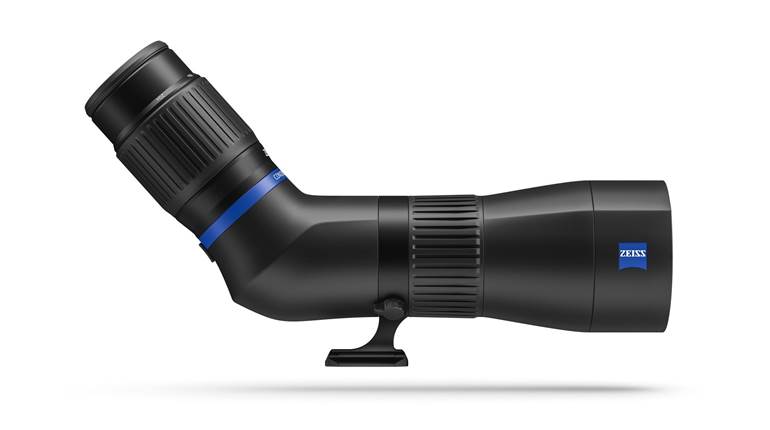
• Spotting Scope: Originally, a telescope used at shooting matches to spot hits made on distant targets. Currently, the common name for small telescopes used by shooters, hunters, bird watchers and other outdoor enthusiasts.
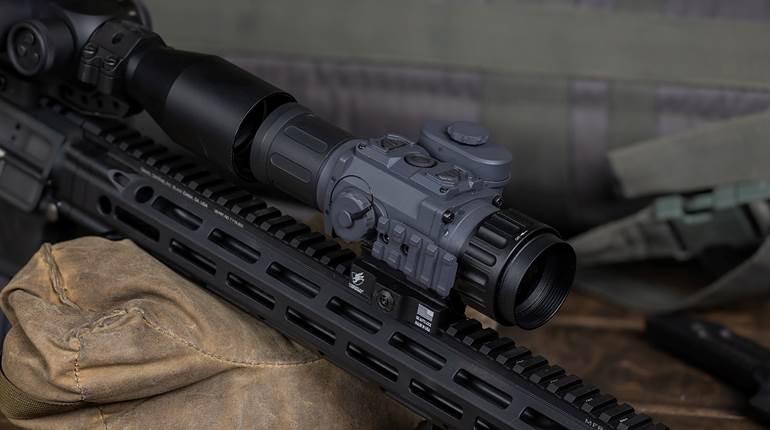
• Telescopic sight: A small refracting telescope equipped with a reticle and used as a sighting device for a firearm. Common names include handgun scopes, shotgun scopes and riflescopes, depending on the type of firearm used.
Twilight Factor: A numerical guide for comparing the low-light performance of optical instruments, which takes magnification into account. To calculate twilight factor, multiply the diameter of the objective lens by the magnification and extract the square root of the product. Note that twilight factor does not take into account optical qualities, such as light transmission, resolution and image contrast.
Variable Optics (zooms): An optical system of variable focal length, used to change the magnifying power within a predetermined ratio, such as three-to-one or four-to-one, an example being a 3-9X riflescope.