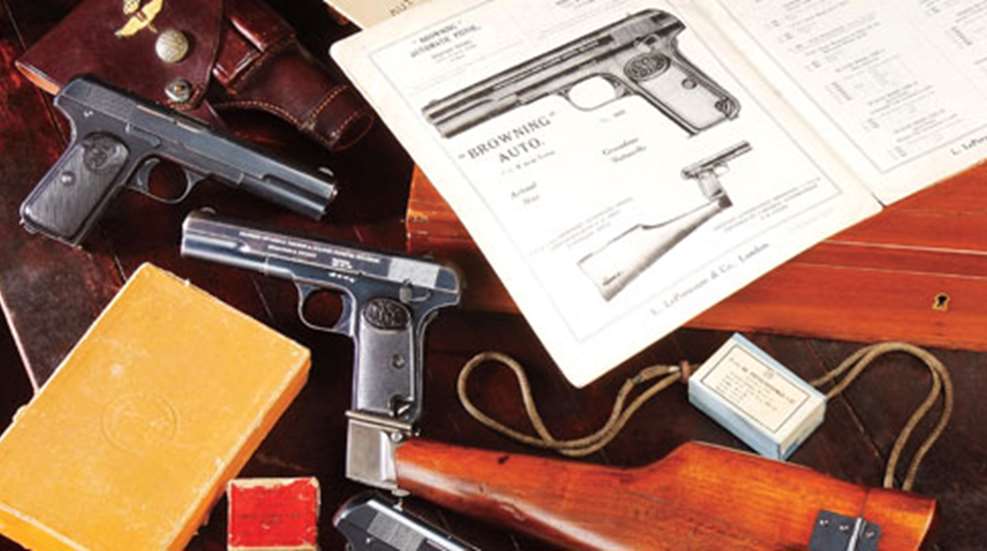
Fabrique Nationale (FN) started producing its first handgun in January 1899. The compact 7.65x17 mm FN Browning Model 1899 was extremely reliable and became an instant success. Within a few months, the Model 1899 was entered in Belgian military trials, and, less than a year later, the Belgian military adopted a modified version commonly known as the FN Browning Model 1900. The Herstal company found itself producing two similar pistol models. As this was inefficient, FN stopped production the Model 1899 within 18 months of introducing the Model 1900.
The Model 1900 was entered in various foreign military trials. Although there were few objections to its functioning, most review boards cited the relatively anemic 7.65 mm cartridge.
In 1901, despite tremendous sales of the Model 1900 pistol, FN asked John Browning to design a large-frame military pistol capable of firing a more potent cartridge.
At the same time, Colt representatives were reporting large numbers of FN Model 1900 sales to their home office in Hartford. Colt, which was experiencing comparatively modest success with its large-frame Colt Browning Model 1900 pistol, wanted to introduce a compact pistol to improve sales in the United States.
Due to these parallel demands, John Browning found himself with requests for two pistols intended for two different markets. The result was two Browning prototypes, which were both shown to FN and Colt as per the inventor’s agreements with the companies. Both manufacturers reviewed the prototypes and selected specific features from each prototype, which were later included in their respective production models. It should be noted that the FN Browning 1903 was never a copy of the Colt Model 1903, as is so often reported. Both handguns evolved from separate prototypes in response to specific demands of the North American and European markets.
Colt immediately began production of its Model 1903 for the American commercial market, and its 7.65 mm cartridge became known in the United States as the .32 ACP (Automatic Colt Pistol).
Fabrique Nationale, aware that large-frame military pistols had few commercial prospects in Europe, was reluctant to invest in the production of a large inventory of pistols in the absence of a funded military contract. As a result, production of the FN Model 1903 was initially limited to a relatively small number of sample and test pieces.
The sample pistols were shipped between FN and its representatives worldwide. Sweden and Norway showed an interest, but the Norwegians requested 500 guns for field trials. Aware of the risks involved with large-scale sample production, FN initially refused to build the 500 guns for Norway, but Sweden agreed to conduct its trials with samples of the pilot series. In the trials, the FN Model 1903—while less accurate than the Luger—proved to be significantly more reliable than the other entries in Sweden’s arctic conditions.
At long last FN received an order from Sweden for 10,000 pistols, and production began in 1907. As expected, Sweden requested some minor changes that were incorporated into production. These included a redesigned slide release lever and sights. The pistol was adopted as Sweden’s official sidearm and received the military designation “m/07.” As soon as production started other orders materialized: The Ottoman Empire purchased 8,000 pistols for law enforcement; similarly, the Imperial Russian government placed multiple orders for various law enforcement agencies. Commercial sales were better than expected, especially in the British Empire where larger and more powerful handguns were favored.
The Model 1903 was known by a number of names. These included: Modèle de Guerre (War Model), Grand Modèle (Large Model, compared to the Model 1900) and Modèle 1903. Internally the pistol was often referred to as Modèle Suedois or Swedish Model, referring to the first order.
The Model 1903 is a high-quality, large-frame blowback-operated pistol firing the 9 mm Browning Long (9x20 mm) cartridge and fed by a seven-round magazine. The pistol was offered by FN with an optional shoulder-stock and an extended, 10-round magazine in an attempt to compete with Mauser and Luger. Customers could also order tangent sights, so long as the order exceeded 500 pistols. None of the military tangent sights were ordered, but a number of customers did opt for the shoulder stock. Fabrique Nationale numbered all the parts, including the magazine. Government orders for stocked pistols were supplied with numbered shoulder stocks, while commercial stocks were left unnumbered.
Fabrique Nationale actively marketed the pistol as the official sidearm of the Swedish military. Despite this, it did not sell as well as expected. In the years preceding World War I, FN sold a mere 38,000 Model 1903 pistols. In contrast, FN sold that many Model 1900s in less than two years.
There has been a good deal of speculation as to why the Model 1903 did not achieve higher sales figures. Most often it has been incorrectly attributed to the blowback design or the non-standardized cartridge, but none of the trials reports make negative mention of the blowback design. Also, at the time there were no standardized military cartridges. Pistol designs, as well as ballistics, were individually tested without much prejudice, with the emphasis being on their individual performance.
The low sales figures resulted from a combination of factors, including: the delay in production; the loss of a potential Norwegian contract; and the fact that most modernizing armies had already selected a pistol by the time the model became available.
World War I And Husqvarna Production
All production came to a halt at FN with the German invasion in August 1914. Many completed pistols were carried out of warehouse by FN employees and hidden to deny them to the invaders. No Model 1903 pistols were assembled during the war at FN; parts remained in the factory for the duration of the war.
Sweden, which had relied on FN to produce the Model 1903 prior to the war, found itself without a source for new pistols. Not knowing how long the war would last, Sweden decided to produce the pistol domestically. The first Husqvarna pistols were produced in 1917. The first Husqvarna pistols were marked “Browning’s Patent.” FN protested in 1918, as it had been the sole authorized user of the Browning name since 1907. The Swedes reacted and changed the slide legend to “System Browning.” This did not satisfy FN either, so the Browning name was entirely removed.
The Swedes were limited to producing the pistol solely for domestic use under their licensing agreement with FN. Although the pistol was manufactured in Sweden for both military as well as commercial sales, many Swedish officers preferred the FN-made pistols. FN continued to sell pistols on the Swedish market. The Swedish military made no distinction between the FN- and Husqvarna-made pistols; both models were referred to as “m/07.” The designation refers to the adoption year, not the manufacturer.
The Interbellum
Demand for military pistols after the First World War was almost non-existent due to a large surplus market. Despite this, the newly formed nation of Estonia chose to make the Model 1903 its official military sidearm. The smaller FN Browning Model 1910 was adopted for law-enforcement use. Estonia updated its equipment in the mid-1930s and the pistols were sold as surplus to Spain, where they were used in the Spanish Civil War. Additionally, FN sold the Model 1903 to both Paraguay and El Salvador.
Production of the Model 1903 ended in 1927 with plans to introduce the High Efficiency pistol—the forerunner of the Hi-Power. Some small quantities of pistols remained in the warehouse until the mid-1930s.
Columbia inquired as to the purchase of Model 1903s in the 1930s, but FN was unable to fill the contract from existing stocks—and was unwilling to restart production. As a result, the contract was diverted to Husqvarna. An exception was made to the licensing agreement, and the Colombian contract was filled from Sweden.
By the end of 1927, FN had produced 58,442 Model 1903 pistols, making it the smallest production run of any FN Browning pistol in history. In contrast, the Swedish Husqvarna production totaled an estimated 89,230 pistols and lasted until 1942. Swedish volunteers and Finns used both the FN and Husqvarna pistols against Soviet forces in the Finnish Winter War.
Collector Information
All FN Browning 1903 and Husqvarna 1907 pistols were originally chambered in 9 mm Browning Long (9x20 mm). When imported from Sweden, many were modified in the United States to fire 9x17 mm (.380 ACP) cartridges as the original ammunition was almost unobtainable. Although the conversion is ballistically safe, the smaller 9x17 mm cartridge does not feed reliably from the magazine.
The Husqvarna and Swedish-contract FN Model 1903 pistols are the most common in the United States. Swedish arsenals refurbished the pistols through the years, and one of the steps was to sandblast the pistols before re-bluing, resulting in an unattractive matte-blue finish. All FN Browning Model 1903 pistols and many of the Husqvarna pistols were originally finished with a high-polish, rust blue finish. Husqvarna’s quality and finish was equal to FN’s; this is especially noticeable on early pistols.
Because the FN Model 1903 was considered a military sidearm, FN never placed much emphasis on embellishing the pistol. Three engraving styles were available, and a nickel finish was also available on special order. Few customers took advantage of these options, and original engraved or nickeled pistols are exceedingly rare.
Husqvarna never made any shoulder stocks or slotted pistols. FN’s production of slotted pistols is estimated between 25 and 30 percent of the entire production run. Production numbers of shoulder stocks is estimated to be less than those for slotted pistols, as not all slotted pistols were sold with shoulder stocks.
Due to relatively small production numbers and low survival rate, some of the rarest FN Model 1903 contract pistols include those listed below (in order of scarcity, top is rarest).
Imperial Russia: Railroad Police contract, less than 100 pistols are estimated to have been delivered without shoulder stocks in 1911;
Imperial Russia: Moscow Metropolitan Police contract, as many as 3,113 pistols may have been shipped with shoulder stocks between 1908-1914;
Imperial Russia: Gendarmerie contract, multiple orders shipped between 1908-1914, an estimated 8,000 pistols were shipped with shoulder stocks;
El Salvador: 1927 contract standard pistols without shoulder stock;
Paraguay: An estimated 324 pistols without shoulder stocks were shipped in 1927;
Ottoman (Turkish) Empire: Gendarmerie contract, approximately 8,000 delivered without shoulder stocks with orders spanning 1908, 1910, 1911 and 1914; additional small orders were delivered after World War I;
Estonia: Military contracts; approximately 4,616 pistols delivered slotted for shoulder stocks; orders filled in 1922, 1923, 1925 and 1926;
Sweden: Initial 1907 contract for 10,000 pistols supplied without shoulder stock; additional orders followed throughout production years.
Collectors interested in the function and quality of these pistols should seek out unaltered specimens firing the original 9 mm Browning Long cartridge. Ammunition is now readily available, with Swedish ammunition being some of the best.
Special thanks to:
Adam Firestone, Anders Jonasson and the John M. Browning Firearms Museum, Ogden, Utah.
Most Popular