There are so many Russians, and our country so small, where will we find room to bury them all?” -Anonymous Finnish soldier
Not many people in the United States remember when the Soviet Union cruelly invaded its tiny neighbor Finland in November 1939. It is not the kind of subject that the highly sanitized and “politically correct” history departments of our nation’s public schools are willing to discuss anymore. Our current generation of school children has no memory whatsoever of the power and the ambition that once drove the Soviet Union. But after World War I and the Russian Revolution, in that terrible era of war and suffering, any country sharing a border with the Soviets would dread the threats, being followed by unreasonable demands, and culminating in the attack that was sure to come. There is surely a lesson to be learned by examining how a tiny nation of dedicated riflemen defended their country against one of the largest armies the world has ever known.
Just two months after the Nazis invaded Poland from the west and the Soviets attacked the Poles from the east, Stalin turned his attention north to Finland. The Russians claimed they needed a 20-mile wide buffer zone to “protect” Leningrad, home city of the communist revolution. Ultimately what they wanted was nearly all of Karelia, the Hanko Peninsula, the Rybachi Peninsula reaching into the far north of the Arctic, and four islands in the Gulf of Finland. All this territory had been hard-won by the Finns in their bloody war of independence from Bolshevik domination in 1918.
By 1939, the Soviets had already bullied Estonia, Latvia and Lithuania into castrating “mutual assistance” pacts with their Russian neighbor. Throughout the autumn of 1939, Finnish diplomats tried to forestall the inevitable and keep the Russians talking. By Nov. 13, 1939, diplomatic relations had broken down. On Nov. 30, the Soviets invaded. On Dec. 14, the League of Nations expelled the USSR from its ranks for their unprovoked invasion of Finland. Not that the ineffectual League’s actions made any difference; the snow was already tinted red with blood.
A Stumbling Red Colossus
Nearly a half-million Red Army soldiers, supported by almost 2,000 tanks and hundreds of artillery pieces attacked Finland’s southern and eastern borders. The disproportionate numbers of the opposing forces are staggering. Along the vital Karelian Isthmus, more than 120,000 Soviet troops (with almost 1,500 armored vehicles) assaulted positions manned by a little more than 21,000 Finns (and fewer than 30 anti-tank guns).
But the Soviets were disorganized and wholly unprepared. They were also hampered by a strange combination of overconfident, often incompetent, leaders operating without a clear strategy. The Red Army troops ranged from some of the better units within the Soviet forces to thousands of recent conscripts, barely trained and without the slightest preparation for the rugged terrain in which they were about to fight. The Soviet troops arrived without skis, without snow camouflage, and sometimes without proper winter clothing. Even if they had only been on a winter camping trip to Finland they would have been in significant danger from the extreme weather conditions. But the Russians had come to fight, and their inept leaders (those that remained after several years of Stalin’s brutal purges of Red Army officers) frequently blundered them into Finnish guns with no regard for casualties. In many cases, Soviet officers employed Napoleonic-era tactics against a determined Finnish opponent armed with 20th century arms. The resulting slaughter of Russian troops brought no tears from Moscow, and little change in strategy or tactics either. The world was about to learn how little the Soviets valued human life.
“A Most Honorable Annihilation”
Finland had little choice but to play for time. At the beginning of the war, Finland’s reserve stocks of ammunition were already dangerously low, having barely two months worth of rifle and machine gun cartridges available to the troops. With such limitations in mind the Finns hoped that global sentiment would be in their favor, with intervention coming from one or more of the Western powers before the country was completely overrun. In fact international opinion quickly rallied to Finland’s defense, but tangible military aid never came close to equaling the outpouring of good sentiments.
Neighboring Sweden maintained its neutrality but managed to provide aircraft, some artillery and small arms (including the Swedish 6.5x55 mm variants of the Browning Automatic Rifle) as well as a number of volunteers. Sensing the oncoming of a brutal and ultimately unwinnable bloodletting, Finnish commander Baron Carl Gustaf Mannerheim braced for “a most honorable annihilation.”
The Finnish Army was small but well practiced in the small-unit tactics that would serve it well. Their style was informal, but not undisciplined. What the Finns lacked in parade-ground spit and polish they more than made up for in superior fieldcraft and fighting spirit, or sisu. The volunteer Finnish Civil Guard (Suojeluskunta or SK) kept its ranks in top physical condition, with strong emphasis on cross-country skiing and marksmanship.
Finnish Army units were often composed of men from the same region, drawing strength from their familiarity with each other as well as their officers. Regional pride drove many Finnish units to perform miraculous feats in the field. On one occasion, a small strike force of two under-strength companies slipped across frozen Lake Tolvajarvi in a night raid against an entire Soviet battalion, caught clustering around its bonfires. After the Soviet sentries were silently dispatched with knives, the Red Army battalion was decimated in less than five minutes with accurate rifle and light machine gun fire. The only Finnish casualty of the raid was its commander, Lt. Col. Pajari, who suffered a mild heart attack on the return trip.
One small blessing for the Finns was that most of their small arms shared the same ammunition as their Soviet opponents. The more Maxim guns and Mosin-Nagant rifles they captured, the more guns and ammunition they had to use. The Finnish defenders gained copious amounts of their supplies the hard way-they took them off the dead bodies of their enemies.
More Soviets Than Bullets
The disparity in the numbers of troops and supplies available to the combatant forces soon made itself apparent. So too did the fatalistic nature of the Red Army, with its inexorable, almost zombie-like advance into the muzzles of Finnish guns. At the Russian crossings along the perfectly flat Taipale Peninsula, Finnish machine gunners mowed down one Soviet human wave attack after another. Thousands of Red Army soldiers fell to individual Maxim guns, whose gunners eventually went mad when the knowledge of the incredible amount of blood on their own hands sank in. Machine gunners fired until their water-cooled barrels boiled over despite the winter frost, while the snow before them turned red as hundreds, then thousands of fallen Soviet troops simply piled up into grotesque mounds. The brutal cycle of death repeated itself again and again as the Maxim guns chattered out 7.62x54 mm R slugs at 500 rounds per minute, even when the gunners broke down, the guns continued their deadly work unabated-and still the Russians came on.
It appears as though Moscow’s cruel calculations came true with unerring accuracy. Even if each Finnish marksman struck down a Soviet soldier with every shot, Stalin still had more men to sacrifice than the Finns had bullets to fire. And the fatalistic Red Army soldiers were ready, willing and perfectly able to walk, stumble or crawl over the backs of their fallen comrades to achieve their objectives. They feared their own commissars more than they did the crack of a Finnish marksman’s rifle or the death rattle of his Suomi submachine gun. The Bolsheviks continued to pour into Finland.
Advanced Small Arms Designs
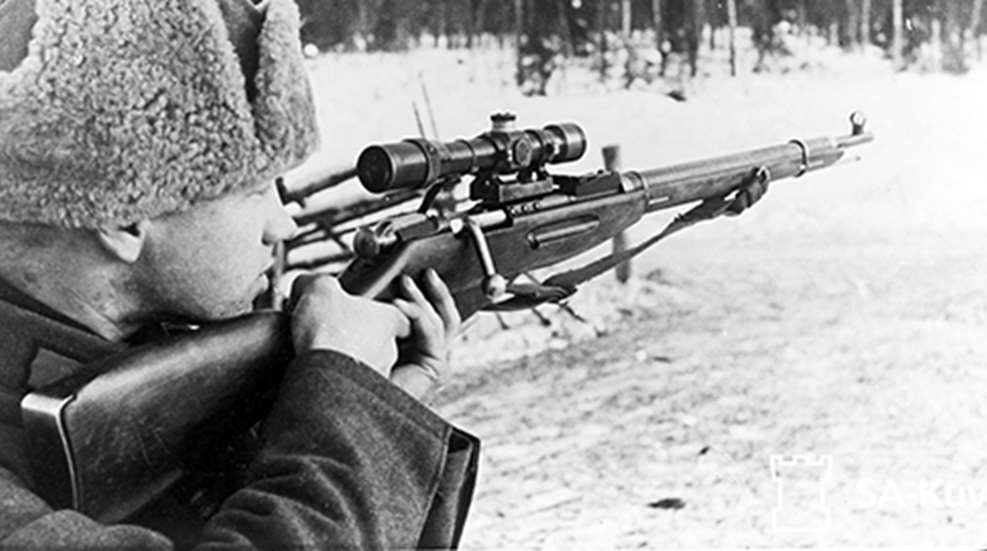
Finnish and Soviet troops used the same basic rifle, all variations in one form or another of the bolt-action Mosin-Nagant Model 1891, chambered in 7.62x54 mm R. Finnish ordnance experts had improved the design in their own factories, creating the Model 1891-24, Model 27, Model 28 and the Model 28-30-all of which offered superior fit and finish (no pun intended), and greater accuracy to the original Russian rifle. Finnish marksmanship was noted before the Winter War, and became legendary afterwards. Individual Finnish snipers achieved incredible scores in a “target rich” environment. One Finn sniper was credited with more than 200 kills in the short three-and-a-half month period of the Winter War.
The Finns had advanced small arms design and manufacturing capabilities for such a small nation. Their secret weapon was the self-taught gun designer Aimo Lahti. His incredible portfolio of successful designs includes more than 50 firearms, highlighted by the Suomi Model 31 SMG, the Lahti-Saloranta Model 26 light machine gun, the Lahti Model 35 semi-automatic pistol and the massive Lahti Model 39 anti-tank rifle.
The Suomi Model 31 9 mm Luger SMG gun saw its combat debut in the Winter War. The Suomi’s innovative 71-drum magazine had a huge impact on Soviet submachine gun designs in World War II. Weighing nearly 11 pounds unloaded, the Suomi is exceptionally heavy for a 9 mm SMG. But stories of its accuracy are legendary, and Finnish troops unleashed a hellstorm of Suomi fire against Soviet troops in the Winter War. Suomi SMGs were in relatively short supply, and it was a badge of distinction among Finnish troops to be a Suomi gunner.
One of Lahti’s other inventions making its combat debut during the Winter War was the air-cooled Lahti-Saloranta Model 26 light machine gun. Chambered in 7.62x54 mm R, and using a 20-round magazine, the Model 26 was one of the first true light machine guns ever designed. While heavy (26 pounds) and rather complicated, it was accurate and reliable. With limited numbers of the Model 26 available, the Finns supplemented their stocks and made good use of captured Soviet DP-28 light machine guns. The Degtyaryova Pekhotny or DP-28 was simple and relatively reliable, and thousands of them fell into Finnish hands.
The Soviets and Finns also shared similar designs in their heavy machine guns. The venerable Maxim gun was the backbone of the Finnish machine gun units. The Finns updated the action in their Maxims (dubbed the Model 32) to accept metallic link belts, increased the rate of fire and improved the sights. Another interesting Finnish innovation was the “snow cap,” a large flip-top opening on top of the water jacket that allowed the gunner’ to easily replenish the water cooling supply with handfuls of snow.
A Costly Soviet Victory
The Winter War ended in March 1940 with the signing of the Moscow Peace Treaty. Finland was forced to cede 11 percent of its territory to the Soviet Union along with 30 percent of its economic assets. The Soviets did not succeed in accomplishing their objective of a complete take-over of Finland. Not that they cared, but in addition to suffering humiliatingly heavy losses and military failure, the Soviets also lost their place among the League of Nations. Finland remained a sovereign nation, albeit with less territory, and certainly enhanced its international reputation. It was cold comfort though, and with the German invasion of France just two months away, the world’s attention would no longer be focused on Finland’s plight.
The Winter War proved a costly victory for the Soviets. The Red Army lost approximately 126,875 dead or missing, 264,908 wounded and approximately 5,600 captured. In addition, they lost about 2,268 armored vehicles. The Finns suffered greatly to preserve their freedom. In the four months of combat, Finnish losses numbered approximately 26,662 dead and more than 39,000 wounded. A tiny nation of riflemen had held off the communist Red giant. The massive battles of World War II quickly obscured Finland’s sacrifice, and by the summer of 1941 the United States and our Allies were forced into an uneasy alliance with the Soviet Union, at least until the day that the Axis was defeated.
National Archives photos; courtesy of armorplatepress.com.