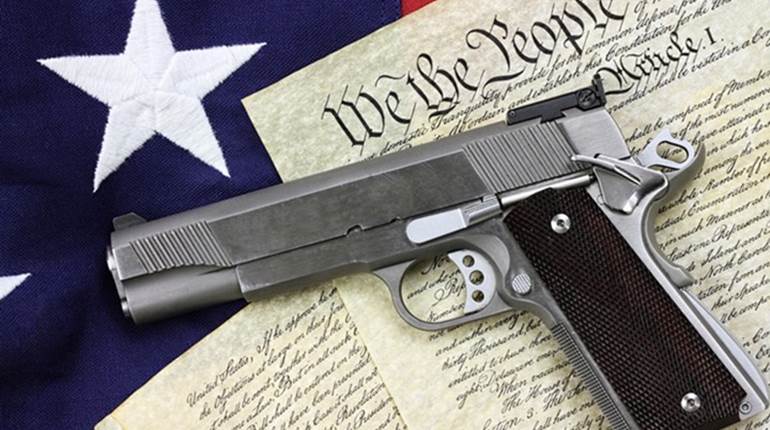
Sandy Koufax pitches a perfect game against the hapless Cubs while Gemini 4 astronaut Ed White executes the first space walk above the Earth. The Beatles play the first “stadium concert” in New York; Lyndon Johnson is sworn in for a full-term as president; and the first Colt M1911 Government Model is “combat customized.”
The year is 1965, and the funeral of Sir Winston Churchill captures far more attention than the ministrations of Swedish gunsmith Armand Swenson. His remarkable modifications to a Colt Government Model, however, are proving to be a watershed event in the development of the M1911. Swenson created the custom combat .45.
Custom tuning of the M1911 is not new, but, prior to Swenson, gunsmiths such as Bob Chow, Jim Clark and Al Dinan had focused solely on accuracy work for NRA Bullseye pistol competition. Along with lightening triggers and installing adjustable sights, the Government Model had never been customized specifically for combative purposes—a genre that later came to be known as “custom combat” gunsmithing—until a handful of pistolsmiths in Southern California began modifying the big slab-sided pistol for down-and-dirty use.
The late Armand Swenson remains the foremost of these pioneering pistolsmiths and the man who defined the custom combat .45 for evermore. A former state champion Golden Gloves boxer, the barrel-chested Swede worked a day job at Boeing. His hobby was building custom hunting rifles using surplus Mauser 98 actions and stocking them with elegant pieces of walnut. Swenson loved guns and he was a gifted craftsman—a rare combination. His other passion was speed. Armand designed high-speed racing boats in his off-time.
And back in 1965, things were indeed happening fast in Southern California. In a sleepy mountain resort called Big Bear, Jeff Cooper was holding “combat shooting” matches in the South West Combat Pistol League.
Ray Chapman was one of the top shots, using an M1911 against the likes of Jack Weaver, Thell Reed and Elden Carl. The exigencies of fast, close-range shooting in a sport with no alibis (unlike NRA Bullseye shooting where a jam wasn’t penalized) led to a need for a rather specific list of custom work to be performed on the Government Model.
Arnold “Al” Capone of King’s Gun Works in Los Angeles became a favorite of the local combat shooters, and it might well be argued that the first custom combat M1911s were built by Al Capone and one of his hired hands, a gunsmith who would receive great acclaim in his own right as the inventor of the long-slide M1911, Jim Hoag.
Meanwhile, word spread about Armand Swenson after several of his custom Mauser rifle customers brought their M1911s to his Gardena, Calif., shop. There the friendly Swede, who called everyone “Laddy,” readily took to the Model O. His modifications were not only eminently functional but also aesthetically pleasing. A Swenson gun from the 1960s looks just as dashingly serious today as it did then. In fact, no other custom M1911 has ever achieved such a distinctive “look” as a Swenson .45, a style so influential that pistolsmiths 40 years later still mimic the Swede’s trademark touches.
Combat Custom Features
Consider this beast we call the custom combat M1911. Many of Swenson’s customers were soldiers and Marines deploying to Vietnam. One of them, a West Point graduate who would become one of the foremost experts on military small arms before his untimely passing, was Chuck Karwan. Karwan, then a young lieutenant, carried a Swenson-modified Colt on his Vietnam tours.
What did a professional soldier such as Karwan and an active competitor such as Chapman both demand in a Colt pistol? Three qualities were most important: handling, reliability and durability. First and foremost was handling.
Swenson checkered the front strap at 30 lines per inch to give the shooter a better purchase with sweaty, wet or, yes, bloody hands. If checkering works on highly figured walnut stocks, why not on a pistol?
To prevent the reciprocating slide from pinching the web of the shooter’s hand, the tang of the grip safety was bobbed and radiused. (Later, enlarged grip safeties were made, known as “beavertail” safeties for their resemblance to an aquatic rodent’s tail.)
Swenson developed an ambidextrous thumb safety featuring enlarged levers for faster, more positive access to enable the pistol to be operated with the left hand only. He patented his invention, the first such design. Today any right-sided thumb safety is referred to generically as a “Swenson safety.”
In order to enhance the ability of the shooter to fire quickly and accurately, Swenson installed adjustable “K sights” pirated from Smith & Wesson K-frame revolvers. Later, Swenson developed the “Swen-Sight,” a high-profile fixed sight with a large, serrated blade. The tiny Colt stock front sight was always replaced with a dovetail serrated ramp front sight that Swenson machined individually.
Facilitating a secure, two-handed grip—as advocated by Cooper and perfected by Weaver—Swenson welded the front of the trigger guard into a square, then he finished it by hand-filing it to shape and checkering it. Chapman and, later, Ross Seyfried won combat shooting world championships using M1911s with squared trigger guards for better purchase by their left-hands’ index fingers.
For those with large hands, a long trigger was installed and the pull was adjusted to a crisp 4 pounds. Often a flat mainspring housing with a lanyard loop replaced the arched style that came standard on Colt Government Models.
To make reloading the pistol easier in the heat of competition or the chaos of combat, Swenson beveled the inside edges of the magazine well. Looking at early Swenson pistols today and comparing them to the gigantic magazine funnels on today’s M1911s, we’d think of the beveling as mild, but back then it was a novel innovation.
To increase accuracy, before the day of aftermarket match barrels, Swenson installed a rivet on the left slide of the slide to hold a small steel pad brazed to the inside of the slide that he filed to fit against the side of the barrel hood. This created tension on the barrel where it mates to the slide’s breech face, stabilizing the barrel and centering it. Swenson called it a “barrel tensioner.” Of course, the link was properly fitted, and an over-size bushing was made to fit the slide.
Turning to reliability, the ejection port was lowered to prevent fired brass from deforming at the mouth, an all-too-common occurrence on factory Colts and a sure sign that brass was not being ejected cleanly. Extended ejectors, like those found on the then-recently introduced Colt Commander Model, were installed and the extractor was tuned for the correct amount of tension on the case rim.
To make the Government Model more durable Swenson drew on his experience at Boeing, where he had learned that metal corrosion and abrasion can be dramatically reduced with a finish known as hard chrome. Indeed, the U.S. Army had learned the same lesson and was hard-chroming barrels on M16s. The matte hard-chrome finish on M1911s is one more Swenson innovation.
A fourth category of custom work on this new entity known as a custom combat .45 finally came: good looks. The aesthetic appeal of a hand-tuned M1911 came into its own on Swenson’s cluttered workbench in Fallbrook, Calif., where he had moved from his original Gardena shop. Using a new rat-tail file (the process ate one new file per gun), Swenson stippled the top of the slide by hammering the file into the steel with a round brass bar. The rat-tat-tat-tat of the file being smacked by the bar created a subdued stippling that Swenson smoothed by bead blasting.
He cleaned up the edges with a fine line that he called a French border. The term stuck and years later pistolsmiths such as Richard Heinie and Steve Nastoff accented their slides with what they, too, called a French border.
Combat Special
Carrying on through the late ’60s, Swenson, Hoag and Capone were soon joined on the East Coast by two more talented pistolsmiths who saw the writing on the wall: Austin Behlert and Al Dinan. Both of these ’smiths had developed solid reputations as bullseye specialists, tuning the Colt .45 for target work.
But the next major advance in the custom combat M1911 came once more from California in the shop of a German immigrant named Frank Pachmayr. Already well known for his custom hunting rifles and shotguns—Pachmayr-customized Model 21s are still stunningly beautiful—Pachmayr employed two talented gunsmiths named Tom Dornhaus and Craig Wetstein in his Monrovia shop. (A decade later, Dornhaus went on to partner with Mike Dixon to form the ill-fated Bren Ten company.) It was these two talents, Dornhaus and Wetstein, who together produced the next major evolution of the custom combat .45, the Pachmayr Combat Special.
The year was 1972. The gun featured a two-tone finish of hard chrome on the frame and a mirror-polished blue slide. Swenson’s trademark S&W K-sight was upgraded to a “melted” Bo-Mar adjustable sight, the installation so perfectly blended into the slide that it looked as if the metals had melted together.
Pachmayr’s new pistol included Swenson’s stainless steel ambidextrous thumb safety and a beavertail grip safety patterned after the style made by Jim Hoag. The top of the slide was serrated longitudinally, an aesthetic touch evolved from Swenson’s stippling. Another striking feature: a set of matte-black rubberized grips that would go on to make Pachmayr’s name synonymous with “grips.”
By 1976, Jeff Cooper’s original combat shooting club, the South West Combat Pistol League, had formulated a book’s worth of rules, and the discipline had spread internationally. A conference was held in Columbia, Mo., to form the Int’l Practical Shooting Confederation (IPSC). Cooper was elected the chairman, giving rise to his derisive nickname, Chairman Jeff, for his penchant to issue unilateral decisions and enforce them with draconian intransigence.
The year prior, 1975, a “world championship” combat shooting match had been held in Switzerland that was won by Chapman, an athletic American who had competed in Cooper’s early combat matches. At the time, IPSC did not exist, but at the Columbia Conference the match was retroactively designated as the IPSC World Championship, and Chapman thereby found himself its first world champion.
Cooper appealed to Frank Pachmayr to donate a Combat Special as the winner’s prize. Pachmayr agreed and went on to sponsor Chapman as a competitive shooter; however, Chapman actually won his world title with a Jim Hoag Master Grade pistol, not a Pachmayr Combat Special as some sources erroneously indicate. It was only after he received his prize and subsequent sponsorship that he shot a Combat Special in matches.
Another Cooper protégé, however, did win an IPSC World Championship with a Pachmayr Combat Special. In 1979 a man, about whom it was jokingly said “makes once-fired brass for a living,” won the world championship in South Africa with his Pachmayr-tuned Colt: Ross Seyfried.
The Torch Passes
By the late ’70s and early ’80s, the custom combat Government Model had evolved into what I call its Second Generation. The pioneering work of Swenson, King’s Gun Works, Hoag and Pachmayr constitute the First Generation, but a whole new breed of enterprising pistolsmiths-cum-businessmen took up the torch.
The foremost of the Second Generation was an Arkansas watchmaker who took to tuning M1911s first as a hobby, then as a part-time business and finally as the most successful producer of aftermarket parts and customized pistols. His name was Bill Wilson. The formal moniker of Wilson’s business and the name that was stamped on his guns was “Wilson Combat,” a sign that the genre had a national following.
Wilson took what the First Generation had started and applied solid marketing and brand development, building custom pistols as “house guns” like Pachmayr’s and King’s, but also manufacturing parts, magazines, barrels and accessories. Wilson guns were—and still are—renowned for their value and quality.
In 1981, John Shaw won the Second Chance Bowling Pin Shoot with a specially modified Colt called the Bowling Pin Model, built by Jim Clark of Louisiana. The gun featured a steel cone slipped over the barrel with a large block on the end, machined to the same shape as the slide. The “pin gun,” as it became known, led to other attempts to control the recoil of full-house .45 ACP handloads with various recoil-dampening devices (bowling pin shooters had to knock pins from a 4-foot wide table, requiring very stout handloads). This led to ported barrel extensions called compensators.
The first compensator to gain prominence was made by Charlie Kelsey of Devel Corp., arguably the greatest visionary of the Second Generation pistolsmiths. The Devel Gammon was the first .38 Super made for combat shooting and Devel’s combat conversions of the Government Model remain classics of the genre.
With the introduction of Clark’s pin gun and the compensator, an arms race began in combat shooting circles. The M1911 became more and more exotic with various compensator designs. No longer could the gunsmithing work be considered “combat customizing,” because the guns had evolved to be far too cumbersome, finicky and downright odd to ever be functional in a steamy jungle, a wind-blown desert or any other far-off land where war might pop up. The Second Generation had run its course.
Third Generation
The pendulum swung back to the classic form of the custom combat .45, like that of the Swenson era. A backlash arose against the ever-more expensive and exotic “raceguns” found at IPSC matches, an abomination Cooper dismissed as “Rooney guns.” If a shooter didn’t own a high-capacity M1911 on an STI frame with an Aimpoint or C-More sight, he simply wasn’t competitive.
In 1994, Illinois pistolsmith Richard Heinie—whose immaculately hand-built custom .45s resemble pristine Hoag Master Grades—initiated a match called the Single-Stack Classic as a sort of Tea Party revolt against the excesses of raceguns found in IPSC competition. In 1996, Bill Wilson founded the Int’l Defensive Pistol Ass’n (IDPA). The custom combat M1911 was back in vogue.
The trend was accelerated by federal legislation that prohibited the manufacture of magazines holding more than 10 rounds. Suddenly eight rounds of .45 ACP in an M1911 made sense again. Those of us who had continuously carried John Browning’s immortal design wagged told-you-so fingers.
We can pinpoint the beginning of the Third Generation of combat M1911s to the day Kimber introduced its “custom quality” line of pistols. The year was 1995, and the place was the SHOT Show. The prototype Kimbers were actually built by a custom pistolsmith on sourced slides and frames, then stamped Kimber. Production didn’t begin until a year later in March 1996.
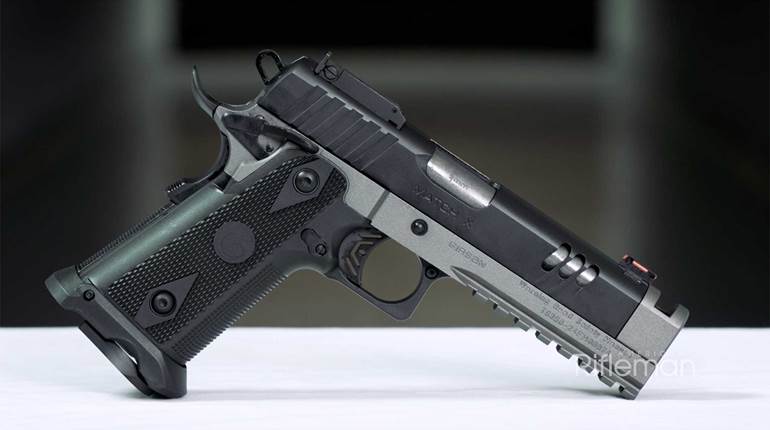
The Kimber pistols exhibited classic styling. The guns incorporated every modification and upgrade that distinguished an archetypical hand-built custom combat M1911. Now, however, a Swensoneque .45 was available over-the-counter in gun shops nationwide.
As the M1911 market expanded, Kimber was joined by none other than Bill Wilson, who began offering the same level of quality as his custom-order .45s but on a production basis. Several of Wilson’s top gunsmiths subsequently left to open NightHawk Custom, also offering custom combat M1911s on a production basis.
Ed Brown Products, headed by one of the more talented Second Generation pistolsmiths, also began producing ready-to-go custom combat .45s. Les Baer, another Second Generation pistolsmith, opened a shop in Illinois after leaving the Springfield Armory Custom Shop.
Springfield then hired Dave Williams to head its Custom Shop and began incorporating a lot of the hand-touches characteristic of a custom-built M1911 on a line of production pistols. Today the Illinois-based company offers an upgraded array of pistols based on its Custom Shop’s input.
This is the Third Generation—custom-quality M1911s in the Swensonian mold, now available out-of-the-box. There are still talented pistolsmiths such as Hilton Yam who are making hand-built custom combat .45s, but it’s no longer necessary to go through the expense or wait for a handmade M1911.
This story can’t end without noting that two of the First Generation pistolsmiths are still plying their trade. Jim Hoag of Canoga Park, Calif., is still building Hoag Master Grades and the occasional Hoag Longslide. Now in his 70s, the grandmaster still handcheckers every frame and fits every barrel just as he did back in the day.
Also of note is Paul Liebenberg, who took over building Pachmayr Combat Specials after Dornhaus and Wetstein left the company. Liebenberg operates Pistol Dynamics in Florida where he offers a Liebenberg Combat Special patterned after the originals he built while at Pachmayr. As a matter of fact, I’m commemorating the 100th anniversary of the M1911 in my own way—I sent a Commander and a Government Model to Liebenberg to be made into a matched set of Combat Specials.
The custom combat M1911 was, is and shall be the pinnacle of John Browning’s immortal fighting pistol.
Most Popular