Rifles

Cover & Concealment

You should always know where available cover and concealment is located in your area.

6/1/2012

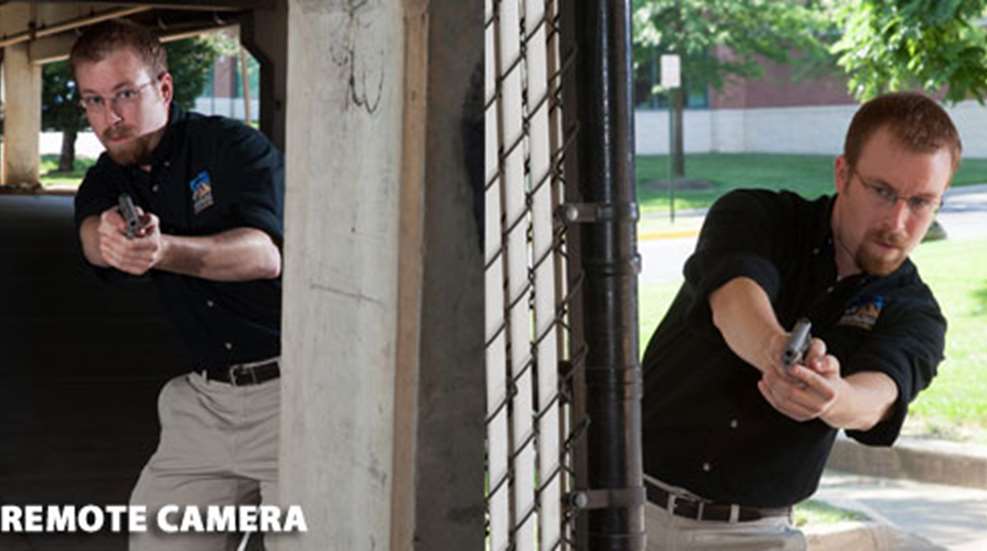
For the defensive shooter there is a distinct difference between concealment and cover. Concealment is anything that will help you hide, but does not stop bullets. Examples that quickly come to mind are bushes, shrubbery and shadows. An alert citizen, who sees potential trouble while it is still a ways away, might step behind concealment so that he or she is not seen while observing and making a determination about the potential threat. 

In many cases, when you realize a threat is near, the best move is to exit the scene as quickly as possible. By using concealment effectively, you may get away from the threat without being seen and without the bad guys knowing exactly where you went. If they don't know where you are, or where you went, it's pretty difficult to get an effective shot at you.

Cover, on the other hand, is anything that can be expected to stop bullets. You should be continually aware of the objects around that can serve as cover. In fact, if you go about your life in an alert fashion, you realize that you are rarely very far from effective cover.

Once you observe an actual threat, your first thought should be about how to get away from it. If this proves impossible, you should move to the nearest cover, make use of it and get ready to fight. Spotting potential cover should be a continuous part of being in Condition Yellow and an integral part of Condition Orange and Red. The ability to quickly identify cover and make use of it greatly increases a person's ability to survive a deadly attack.

However, it is important to realize that there are many kinds of cover. Some cover, like brick walls, large trees and the front end of automobiles, will stop just about any bullet that a criminal is likely to throw your way. Other cover, such as furniture, interior walls and large home appliances, may only stop bullets from weaker cartridges. It is critically important to know the difference.

Upon being seen taking cover, the crooks will likely expect you to rise up over the top of your cover to return fire. This can be a real mistake. It might make a whole lot more sense to go prone and lean out around the side of cover when engaging your attackers.

Finally, you should survey your home, work place and anywhere else that you spend time to determine the available concealment and cover. This is far better than waiting until guns start going off to try to find a safe place. When faced with a violent attack, it is important to stack the odds in your favor as much as you possibly can. Making use of effective concealment and cover is an effective way to accomplish this goal.

Share |

Comments

ADD YOUR COMMENT

Enter your comments below, they will appear within 24 hours


Your Name


Your Email


Your Comment

15 Responses to Cover & Concealment

Jacqueline wrote:
July 08, 2012

I always get concerned when I hear someone use the term Mozambique. Yes, we all know what it means ... two to the chest and one to the head ... but the term itself makes me uncomfortable. In the same way that this same drill is called a body armor drill. Think about it .. who wears body armor. Cops do! Consider this ... you are in front of a jury defending yourself for the fatal shooting of an intruder and when asked to describe what happened, you describe to the jury how performed a Mozambique. Two to the chest one to the head. If I were sitting on that jury my first inclination would be that you had already committed to the head shot before you even fired the first round into the chest. Excessive force? Maybe. As an instructor of defensive shooting, I train my students to use the term 'failure' as opposed to 'Mozambique'. When we train, we train with the failure drill. Should any of my students ever find themselves in the unfortunate position of defending themselves in front of a jury being asked why they shot the assailant in the head, I would much rather have them be able to confidently say "I was shooting to stop the threat. I shot him twice in the chest and he FAILED TO STOP, so I shot him in the head." Failure Drill, Body Armor Drill, Mozambique Drill ... they all mean the same thing to us as professionals. But to a jury they are very very different. And that's my two cents for what it's worth :-)

jimmyjet wrote:
June 08, 2012

D. Navaille, Take your NRA hunter training back to the rod and gun club. The rest of us will stick with those who are experienced in tactical shooting. "And remember to hand your shotgun, with the safety engaged, to someone else before climbing over that wire fence".

Chris wrote:
June 08, 2012

The answer is as always: Jeff Cooper's Mozambique shots, two hits to the chest, and one hit to the head. Chris

Jim Wilson wrote:
June 07, 2012

I'm sorry, some of your comments have just lost me.

w provence wrote:
June 06, 2012

I don't agree with the bird shot. If the person deserves to be shot, then do it right with a load that will stop them and use only one shot. When you use cover, most people crowd to close to the cover. Stay back from it 2 or 3 feet. Your still just as protected and your able to move and shoot better. Practice, practice, practice. Two in the chest and one in the head solves most people's problems...........

P.Johnson wrote:
June 06, 2012

I'm a 2nd level black sash Shaolin Kung Fu instructor, and definitely hit the legs. It is a prime target for hand to hand combat, take the roots out from under the "tree" first! The assailant won't be able to chase or manuever if there legs are taken out from under them. Eyes are better, but harder to hit initially. Want to distract an assailant, throw a handful of pocket change or gravel/sand at their face. Instinct is to close their eyes or throw their hands up, which buys you time to gain cover or retreat for defensive offense.

Eric wrote:
June 05, 2012

I'm guessing that D.Navaille is referring to some of the advice given in the "comments" section and not from Sheriff Wilson. Specifically, the advice on birdshot as a defensive load and the technique with which to use it. True, in the confines of a small structure, pretty much any round from a shotgun is going to stop most attacks, but you can't just point in the general direction of the threat and expect to hit anything. Even with no choke at all you're going to get maybe a 12" spread in something the size of an average room. I think too much TV has been watched by some commenters. Give me well placed 00 buck in a 12 ga for my ideal home defense manstopper.

reader wrote:
June 05, 2012

'coming at you with a bullet resistant vest'? I think your best option is a real estate agent, not a handgun. If your surrounded by thugs that have the resources to get bullet proof vests, your best bet is change domiciles. :) But good advice on popping out with side cover rather than the top.

reader wrote:
June 05, 2012

I think I'll take the sheriff's, a proven entity, advice over some guy who can say whatever he wants on his credentials. Especially since Wilson's advise is good and right.

D. Brown wrote:
June 05, 2012

@ D.Navaille... And? You left us hanging. What was bad advice? Can you offer any better advice? Thanks for at least giving us your credentials.

D.Navaille wrote:
June 05, 2012

Very bad advise here. I am a NRA pistol, rifle ,shotgun and Personal Protection instructor with 20 yrs experience.

Kathryn Barstow wrote:
June 05, 2012

Thank you very much for the information.

Melvin Haber wrote:
June 04, 2012

I'm not sure what gun you are talking about, but the "birdshot" I know for handguns is snake shot and it won't cycle the slide on most semi-auto's. I guess what the take away is here, is practice, aye? Or always have a revolver on hand... which I do and it is loaded exactly the way you are suggesting. Do like the leg suggestion.

Chris Mackay wrote:
June 04, 2012

I have used airsoft competition as a cqb and self defense training tool for years during an ambush scenario I would return fire while going prone and rolling to cover. During debrief I was always told this tactic made me very hard to hit. In the military I was taught to fire twice and roll while prone we used 10 meter separation so we always had room I found stqudents reluctant to prone out you instantly become a small target if your assailant is impaired they may loose sight of you briefly because of drug induced myosis

V. Albanese wrote:
June 04, 2012

I am a firm believer in using birdshot shells in the first two rounds of any defensive handgun; then regular solids for the remainder. The reason: if you hit your attacker in the face with a round of birdshot, that will effectively stop the attack. And, you won’t have to take careful aim. Once you stop the attack, you can control the situation with your solid rounds. As the article states: if you are behind cover, your attacker will expect you to come over the top to fire; so you should lay prone and fire around the cover. Take it one step further: don’t take time to raise your head and aim for the attacker’s torso -- you might miss or he might have on a bullet-resistant vest. Instead, keep your head down and fire your birdshot right at his lower legs. Nobody wears bullet-resistant leg guards! That’s an easy target, and it should knock the attacker right off his feet, where you can then control him with your solid rounds. Guaranteed, if you get a few pieces of birdshot in the attacker’s shins or ankles, he won’t get much closer to you.