3/21/2013
In the early 1900s, China’s firearm industry was years behind Western technology. Faced with an immediate and enormous demand for small arms, and eager to free themselves from foreign dependence, China’s arsenals looked for any advantage to accelerate its industrial revolution—and found it in the Mauser C96 Broomhandle.
Although the Chinese were the first to invent and use gunpowder, it was not until the Middle Ages, after gunpowder had been imported into Europe, that it was used in the arms industry. The first firearms were primitive in both China and Europe, but only the Europeans appreciated the importance of improving existing designs. By the last quarter of the 19th century, as Western powers began to consolidate their territorial and economic gains in Asia and Africa, China’s isolationist policy had left its armament industry in a technological abyss.
Initially, that was not perceived as a problem. Conventional wisdom had previously equated military superiority with having the most combatants; so, given China’s extraordinary population, the country had placed little emphasis on modernizing its arms. But China’s loss in the Sino-Japanese war (1894-1895) to Japan and the emergence of the Warlord Period (1916-1928) made it clear that its indigenous industry needed a kick-start.
Domestic Manufacturing
One of the first resuscitative efforts involved buying equipment and technology from the West. The Hanyang Arsenal purchased machinery from the German firm Ludwig Loewe to make Mauser Model 1888s (the Hanyang Model 88); Shanghai Military Factory (later renamed the Kiangnan Arsenal) bought its equipment first from the United States and later from Britain. In the Shanxi Province, the equipment for the Taiyuan Armory came from Germany.
An alternative to buying from Western nations was to simply copy their firearms. It was easier to copy and modify a successful design than to develop a completely new arm. In most cases, the arsenals imported technical advisors to train the local work force. The Chinese copied the Maxim machine gun, the Czech ZB-26 light machine gun, the Bergmann submachine gun, the Japanese Arisaka rifle, the German Mauser 98k (known as the Chiang Kai-Shek rifle) and others.
Although a variety of handguns had made their way into China, the military and warlords were most impressed with semi-automatic pistols. Virtually all were viewed as having some martial application, including pistols chambered for the 7.65 mm (.32 ACP) cartridge. As guns and ammunition in that chambering were plentiful, it is not surprising that the Chinese made and modified some of the more frequently encountered types. The FN Model 1900 was a particular favorite. Sometimes the gun was enlarged to fire 7.63 mm Mauser, sometimes the frame was slotted for a shoulder stock, and a seemingly infinite number of changes were directed to the cosmetics and markings that often included a proliferation of FN and Mauser logos. To be sure, the Chinese were responsible for a number of domestically designed guns, some with very unusual morphology, but only a few were made in large quantity.
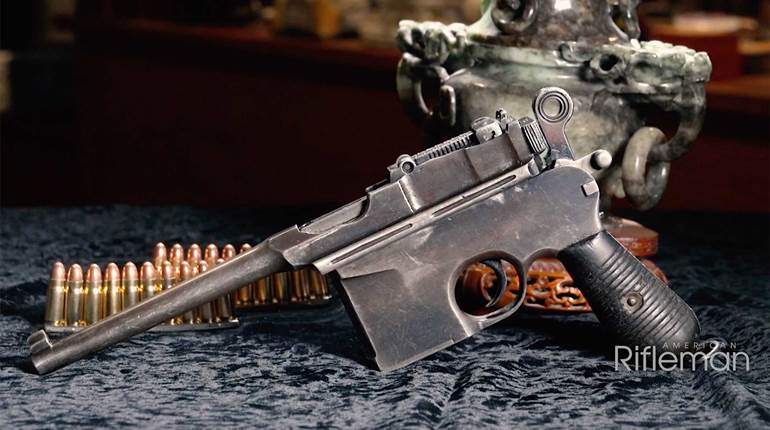
The Chinese were particularly enthused with the Mauser C96 “broomhandle” in 7.63 mm Mauser, a gun that could be used as a traditional pistol or, when fitted with its detachable stock, as a short-barreled carbine. The cartridge was potent and the guns very reliable. Best of all, as handguns had been specifically exempted from the Arms Embargo of 1919, the C96s could be legally sold by any of the countries (except Germany) that had signed or supported that legislation. From 1916 to 1936, about 300,000 such Mausers made their way into China. Some were surplus from World War I; the majority were newly manufactured. The most frequently sold variations included the Wartime Standard Commercials, the early and late postwar Bolos, and the 1930 Commercials.
By 1927, the Spanish firms of Astra and Beístegui Hermanos had introduced comparable guns and were carving their own niches into China’s market. Their initial semi-automatic offerings were followed by selective-fire versions, then by pistols with 20-shot integral magazines, and later, by guns with detachable magazines. In 1931, after Mauser unveiled its M712 Schnellfeuerpistole, the Chinese could choose from a selection of competitively priced and state-of-the-art broomhandles.
Given the widespread distribution of those pistols, it is not surprising that the Chinese began to make their own versions. Copies of all types were manufactured: Astra, Beístegui Hermanos and Mauser. As might be expected, the majority were modeled after the Mauser.
For the most part, the Chinese broomhandles were made in factories, referenced as arsenals, that were under government or warlord control. Author and researcher Anthony Chan mentioned that in 1916, China was home to 29 arsenals. Of those, only eight had the machinery to produce armaments and ammunition. The remainder functioned to effect simple repair work and storage. During the following few years, as the needs of the warlords increased, additional facilities were established and the existing plants enlarged. By the early 1920s, the number in Sichuan alone had reportedly grown to 134.
Most arsenals failed to mark their arms with an identifier. Hence the very real question about such guns can be “who made it?” Furthering the confusion, many arsenals deliberately obfuscated the origin of their guns. This absent identification coupled with incompetently applied and deliberately faked markings, almost always with Western letters and proofs, limits their categorization to little more than a pictorial listing.
Several of the larger arsenals that used identifiers were the Hanyang Arsenal, the Taku Naval Dockyard Arsenal and the Taiyuan (Shanxi) Arsenal. Although their production was small by Mauser’s standard, each arsenal made a number of pistols that, through the years, evolved to yield distinct variations.
The Hanyang Arsenal
The Hanyang Arsenal was founded in 1892 as an armory dedicated to manufacturing Mauser 1888 bolt-action rifles. During the early 1900s, it was one of the largest arsenals in China and the only one that could purportedly make enough small arms to sell to neighboring provinces. Its importance in 1916 was underscored by its operating budget. The Hanyang Arsenal had a budget of $1,000,000 a year; the next three largest arsenals had budgets between $500,000 and $600,000.
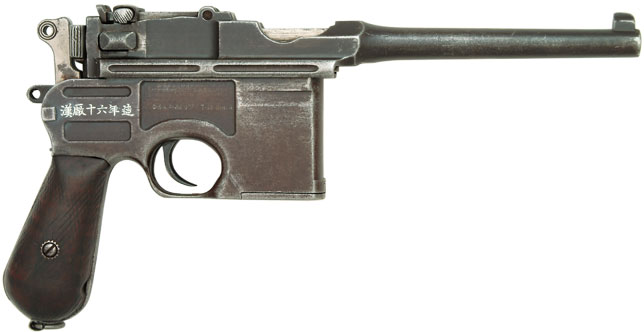
Although the Hanyang had been founded to manufacture rifles, it was also the most prolific manufacturer of Mauser C96-type pistols. Most were marked with a single line of characters along the right side of the frame that referenced the Hanyang Arsenal and the year of production whose reference date (year one) was 1911, the first year of the Chinese revolution. For example, in 1927 the markings translated “Hanyang Arsenal, 16 Year Made.” Available data suggests that approximately 16,000 such arms were manufactured between 1922 and 1929. While some early pistols were made as Bolos, the vast majority were full-size guns that were very similar to the Wartime Standard Commercial Mauser.
The accompanying table lists the highest and lowest recorded serial number for a given year. As should be evident, while peak production occurred between 1926 and 1928, annual production never exceeded 4,000 guns.

The Taku Naval Arsenal
The Taku Naval Yard, located at the mouth of the Peiho (Hai) River, began manufacturing arms in 1891. By 1917, the arsenal was making copies of the Maxim machine gun, whose production was followed by copies of the Czech ZB-26, Bergmann submachine guns and, later, Mauser C96-type pistols.
Virtually all the Taku C96-type pistols had a large ring hammer and a short extractor. Basically, there were two types: Type I had a milled panel frame with arsenal markings on the right side. Those pistols were made between 1925 and 1928 and consecutively numbered from 1 to about 1000. Type II was a flatside pistol made between 1928 and 1933. Recorded serial numbers suggest the second series of guns was numbered from 1-3500. Exceptions to both types included carbine versions.
Taiyuan (Shanxi) Arsenal
The Taiyuan Arsenal was established in 1898, in the Province of Taiyuan, to make Mauser rifles, carbines and ammunition. Its initial efficiency was poor, prompting a shut down in 1904. Although the plant was reopened in 1906 and the manufacture of rifles was resumed, the facility largely served as a site for arms repair and was renamed the Shanxi Armament Repair Center in 1914.
By 1926, after a reorganization and expansion, the Shanxi Arsenal was manufacturing Maxim and Vickers machine guns and small arms ammunition. Technical advisors, hired from Germany, helped to oversee the arsenal’s 8,000 workers, who were capable of producing 1,500 rifles, 500 Mauser C96-type pistols, and 2.4 to 3.6 million rifle cartridges per month.
The first C96-type guns were conventionally dimensioned and chambered for the popular 7.63 mm Mauser cartridge. All reported examples had Chinese characters in a Mauser-type logo on the left side of the frame. A two-line factory name, ROC (Republic of China), and a date were applied to the right side of the frame. Examples have been noted with 1926, 1927 and 1928 dates. If the quoted figure of 500 Mauser-type pistols per month was accurate, Taiyuan’s annual production should have been close to 6,000 and, assuming that the guns were made for at least two years (mid-1926 to mid-1928), approximately 12,000 pistols should have been completed. Surveyed serial numbers suggest otherwise; total production was much smaller, probably fewer than 2,000.
By 1927 the Shanxi Arsenal was building guns chambered to fire the .45 ACP. Starting with a copy of the Thompson Model 1921 submachine gun, the firm went on to build a companion pistol, namely the Model 17 Handgun (named after its year of introduction—the 17th year after the 1911 revolution) in 1928. The massive and well-marked gun, matched to a proportionately enlarged shoulder stock, proved very popular.
Most Model 17s had identifying markings placed on each side of the frame: the model reference was applied to the left side panel while the Taiyuan Arsenal reference and year of manufacture appeared on the right side. The earliest guns were marked with traditional characters. By 1929 the pistol name and arsenal reference were rewritten, using Zhuan Xu font characters, and made substantially larger. Frames were marked in that manner until the 8000 serial range, which was reached in 1931. Subsequently assembled guns had only the Model 17 designation on the left side panel.
Production of the Model 17 likely continued into 1932. The precise year production stopped is unclear for, as previously indicated, the arsenal ceased dating the guns in 1931. The highest recorded serial number for a Model 17 was 8555, suggesting a total production of just under 9,000 pistols.*
Several years later, in 1936 and 1937, the Taiyuan Arsenal assembled a limited number of pistols in 7.63 mm. Most were of standard configuration though a few, presumably of later assembly, were selective-fire. The few reported serial numbers ranged from 1 to 250.
While a review of China’s indigenous handgun production highlights a fascinating page in that country’s history, a number of seemingly straightforward questions remain insoluble. Language issues aside, the lack of proper identification remains a real stumbling block. Furthermore, as pistol production was a sidebar for most arsenals, production was relatively small and, in most remaining records, given only an oblique reference. Heavy use through many years, a low survival rate, and the even smaller number of recorded examples make for difficult extrapolations, all of which provide fertile soil for further exploration.
Arsenal background largely derived from Anthony B. Chan’s "Arming the Chinese: The Western Armaments Trade in Warlord China, 1920-1928." Serial data courtesy of Maj.-Gen. Lew Curtis, U.S. Air Force (Ret.).
* In the early 1980s, collector demand in the United States for Taiyuan .45 ACP pistols had driven prices to unprecedented levels. Perceiving the potential for an easy profit, a group of Chinese businessmen reproduced the gun with markings patterned after the late Model 17s. The new guns were quietly introduced as “refinished originals” for $2,000-$2,500, ostensibly selected to have excellent bores and with replaced parts. The subterfuge was soon discovered. The most obvious telltale sign lay in the markings. Original Model 17s had roll die characters whose lines were of unequal width and frequently tapered at their end. The new guns had pantographed characters. While details differed from one pistol to another, lines were of uniform width and invariably ended with a blunt tip.
After discovery, their price dropped in half. To bolster interest and mislead the still-naïve, some were then distressed to appear aged. The antiquing was performed so skillfully that the novice’s best clue to determine originality is to carefully examine the panel markings.