There’s a great old story of a Texas Ranger at a fancy social event. A matron, noting the cocked-and-locked .45 on his hip, asked, “Are you expecting trouble?” His reported reply, “No ma’am. If I was, I would have brought my rifle.”
I think this pretty well reflects the feelings of most law enforcement officers. A handgun is handy, but limited in power, accuracy, and range. As a 31-year badge carrier, I certainly share this opinion. Working one of the “heavy” squads at the FBI’s Washington Field Office, the Remington Model 870 was my frequent companion.
The need for additional firepower was recognized early on in the Bureau. Even before the official blessing of Congress for agents to carry firearms in 1934, steps were being taken to obtain shotguns, rifles, submachine guns and even tear gas guns. In a 1933 memo to Director J. Edgar Hoover, shortly after the Kansas City Massacre on June 17, 1933, several Midwest supervisors wrote of the critical need for additional firepower for their agents. Hoover acted quickly, calling on his firearm experts to determine what was required. A three-man committee-including well-known firearms instructor and shooter T. Frank Baughman-recommended that, in addition to the .38 Spl. Colt Police Positive revolver, the Springfield rifle, in .30-’06 Sprg., a 12-gauge “automatic” shotgun with cylinder bore and 20-inch barrel, and the Thompson submachine gun be acquired.
Five Thompsons were “borrowed” from Federal Laboratories in Pittsburgh. Purchase orders for 20 more went out shortly after and eventually the Bureau purchased or otherwise acquired from military stocks, more than 800 Thompsons. Almost all of these guns were Model 1921 “overstrikes,” converted to the slower and more controllable rate of 600 rounds per minute as Model 1928s. Most were fitted with vertical fore-grips and Cutts compensators. Later, hard carrying cases were designed and purchased.
Memos dated May 1935 included drawings and measurements for a proposed case for the Thompsons. The Kansas City Trunk Co. was suggested as the manufacturer at a cost of $7.18 each, but a request for bid also went to the Virgil Weeks Trunk Co., also in Kansas City, Mo. Records do not indicate which one received the initial order of 55 cases. These cases held the Thompson, four 20-round stick magazines, one 50-round drum magazine, a cleaning rod and a spare parts kit. The cases and accessories are very desirable collector’s items today.
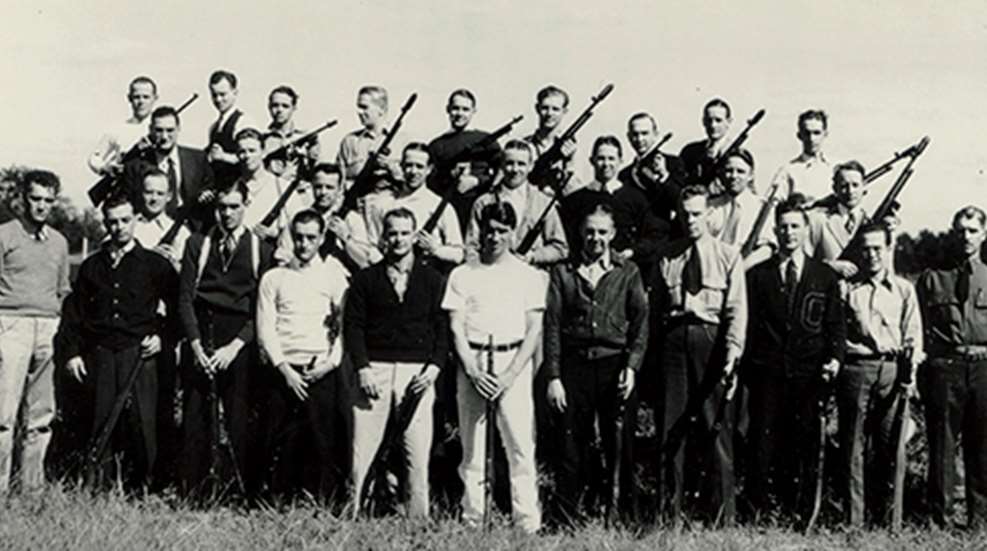
The committee recommended “automatic” shotguns, and a memo dated June 30, 1933, ordered the purchase of 21 “Automatic Shot Guns, 12 Gauge, either Remington or Winchester, Cylinder Bore, 20-inch Barrel, to be fired with Buckshot Shell.” The quantity would allow one shotgun per office, excepting Honolulu. A July 14 memo stated the shotguns would be shipped to each office from Bridgeport, Conn., indicating Remingtons were purchased. Early photos of FBI firearm training show agents shooting pump shotguns, most likely Remington Model 31s. Some of those had long barrels rather than the 20-inch barrels recommended. But one undated photo shows an agent holding what appears to be a Remington Model 11 with the shorter barrel. Recently, I asked Walter Walsh, a Special Agent who joined the FBI in 1934, if he recalled any semi-automatic shotguns. He said he only remembered the slide-action type. A hard carrying case, similar to the one for the Thompson, was designed and built for the Model 31 shotgun.
Baughman’s committee also requested 21 “Springfield Sporter Rifles, N.R.A. type, 30-06 calibre, with 20 inch barrels.” The .30-’06 rifles were purchased in several models, including the Model 1903 Springfield, the NRA Sporter model with receiver sight and the Remington Model 30-S were eventually purchased and used. In addition to the bolt guns, the Winchester Model 1907 in .351 Winchester Self-Loading (WSL) and the Remington Model 81 in both .30 and .35 Rem. were acquired.
Although the Colt Monitor, the civilian version of the Browning Automatic Rifle, was not initially recommended, by 1935 several were purchased for field use. By then, several period gangsters were using BARs, usually stolen from National Guard armories. “Rusty” Gibson had one in Chicago in 1935 when Walter Walsh shot and killed him with an issue Winchester .351 WSL.
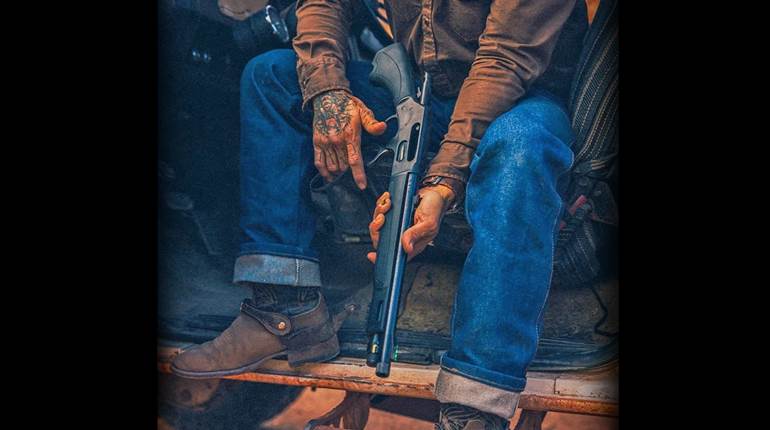
The Remington Model 31 was introduced in 1931. It was adopted by the Bureau around 1935. It was still around in limited numbers when I entered duty in late 1973, but the Model 870 was already in widespread use in the Bureau and the 31s were shortly phased out. I remember that the 31 was a bear to disassemble and reassemble for cleaning. The 870, on the other hand, was very easy to take apart and the double action bars afforded extra strength. The FBI developed a modification to prevent jams if a shell being loaded into the magazine was allowed to slip under the shell lifter. I believe Remington adopted that modification for all its subsequent 870s. The Bureau has used the 870 in several configurations, including both 14- and 20-inch barrels. A stop plate was designed and built at the FBI Academy Gun Vault to fit under the magazine cap of the 14-inch version, so the shooter’s hand couldn’t slip in front of the muzzle. Making this plate at the gun vault was time consuming and, finally, they were acquired from Sage Int’l, which still sells them today.
The FBI still uses the 870. The present version has a matte-black finish, composite stock and most are 3-inch magnums. Neither folding stocks nor extended magazines are used. Youth stocks are put on some models used by slight-statured agents. Most of the guns have 14-inch barrels, and some are being retrofitted with recoil-absorbing stocks, SureFire fore-ends with lights and a shell holder on the left side. Although the guns are 3-inch magnums, the issue round is the 2¾ inch, 00 buck with nine pellets.
Around 1971, FBI headquarters ordered the destruction of the majority of the Thompsons in the field. The various field offices were allowed to keep a small number for tours and shooting demonstrations, and a few were kept at Quantico for use on the popular FBI Tours in Washington, D.C. This destruction order was found to be premature, as there was no official replacement designated. The Bureau was then without operational submachine guns. The shortage caused a scramble for temporary replacements, and a number of substitutes were acquired. A large number of M3 and M3A1 “grease guns” were picked up from the military and many were retrofitted at the Quantico Gun Vault with thumb safeties. They were, of course, in .45 ACP, but I recall one arriving in 9 mm Luger. The gun vault already had one in .45 ACP in its collection with a curved barrel for use by tankers. Several MAC 10s in .45 ACP were also picked up. I know, as I had an interesting experience with one.
As a SWAT team sniper at the Washington Field Office, I wasn’t expected to do much room clearing, but early one morning in 1979, I was called into the boss’s office. Two of us, the only team members around that early, were to be driven to a mansion in the District, assure it was clear and hold it until late that night when other team members arrived. The Special Agent in Charge (SAC) stated that no M16s were to be carried. At that time, it was thought that their penetration and range was too dangerous for urban use, and this mansion was in a rather upscale neighborhood. As my sniper rifle wasn’t much good for room clearing, I was handed a .45-cal. MAC 10 and three magazines. I had never fired one before. We arrived at the mansion and started to clear the home. My partner cycled a shell into his 14-inch 870, and I put the safety on the MAC, inserted a magazine and pulled the bolt to the rear. It didn’t catch. So there I was, holding the bolt back with 30 rounds on standby. “Mike,” I whispered to my partner, “Take the magazine out of this thing.” He did and, after a quick study, I discovered that you cannot cock the bolt on a MAC 10 with the safety engaged. Who knew? Guess that shows you should do some training with a system before using it operationally.
The FBI finally adopted, in my opinion, what was at that time the finest submachine gun in the world, the Heckler & Koch MP5. We had already had experience with the short version of this gun, the Kurtz, and the SD, the suppressed model. The Bureau acquired the single-fire model, the SFA2, as well as the selective-fire version. The gun was accurate, reliable and easy to fire. The gun’s one drawback was it didn’t lock open after the last round. To help overcome this, 9 mm tracer ammunition was made available to some SWAT team members who wished to add them to the bottom of their magazines as an advanced warning that they were about to go dry.
In 1994, the FBI adopted a new model of the H&K, the MP5/10A2, in 10 mm Auto. It used the same “10 mm light” load as the Smith & Wesson Model 1076 pistol as the gun was not designed for the full-power 10 mm round. This model has since been pretty well removed from the field, and the AR family-M16s and M4s-have replaced it as an entry weapon. This changeover to Gene Stoner’s baby didn’t come easily. As mentioned previously, it was thought that the 5.56x45 mm NATO had too much range and penetration for urban use. It took a lot of testing to convince the powers that be otherwise.
Special Agent Bob Taubert, then assigned to the unit responsible for training the FBI’s field SWAT teams, pushed for the change. When I talked with him recently, he gave full credit for the initial push to two Southwestern law officers, cousins Jack and Rick Furr. They, in turn, give credit to Clint Smith of Thunder Ranch fame, who was an early proponent of the AR as an entry weapon. Taubert finally convinced the Firearms Training Unit to test the ballistic performance of the .223 Rem. against the two SMG rounds then in use, the 9 mm Luger 147-gr. JHP and the 10 mm 180-gr. JHP.
Ballistic Research Facility personnel ran the rounds through the complete FBI protocol. When the smoke cleared, it was apparent that the .223 Rem. rounds penetrated less than the handgun cartridges. Except for the longer range of a missed round, the AR system was found to be a safer and more effective round to use in close-quarter combat.
The switch from submachine guns to the M16 and M4 was then rapid and complete. The MP5 in both calibers was replaced both in training and in the field. Today, new agents in training at Quantico use M4s with “iron” sights and modified to fire semi-automatic only. In the field, investigative agents use an M4 made by Rock River Arms with an adjustable-length stock, EOTech sight on a Dominator mount with a SureFire M73 light. The rifles are semi-automatic only. The field SWAT teams are using mostly Colt M4s capable of both semi- and full-automatic fire with PLR1 lights by Streamlight. A very few MP5s in either 9 mm or 10 mm are still out there but are seldom put into operation, and new agents in training at the FBI Academy, Quantico, are no longer trained on the system.
The Bureau often follows technical developments of the military, even more so in its SWAT teams. It will be interesting to witness their changes in arms in the future.
Note: The author is a retired 31-year law-enforcement veteran with more than 20 years with the FBI. He spent more than half of that time as an instructor at the FBI Academy at Quantico, Va., teaching firearms, arrest techniques and street survival. His opinions in this article are not necessarily those of the FBI.
Photo courtesy of the Federal Bureau of Investigation