Countless young hunters shoot rifles chambered in .243 Win. to take untold numbers of deer, antelope and more than a few elk each fall, despite assertions from big-bore advocates that the .243 is marginal, at best, for smaller big-game animals. How do they do it? Perhaps it’s because the .243, which is based on the .308 Win. necked down, can be handloaded with a variety of bullets and propellants that allow practice on targets and hunting of small game during the off-season. With that preparation, youngsters are quite able to place a bullet in the correct spot come fall, which is foremost in killing game.
Best Bullets
When the .243 Win. was introduced in 1955 it was loaded with 80- and 100-grain bullets. In the years since, an abundance of bullet styles and weights have been introduced. Hornady alone sells 10 .24-cal. bullets ranging from 58 to 105 grains, and Berger markets 12 bullets ranging in weight from 60 to 115 grains.
The lightest bullets, like Nosler 55-grain Ballistic Tips and Hornady 58-grain V-Maxs, are rather recent arrivals that direct fire and brimstone on varmints at upward of 4000 f.p.s. That high velocity results in a couple inches less bullet drop at 400 yds. than 55-gr. bullets fired from a .22-250 Rem.; however, the .243 Win. requires eight to 10 grains of additional propellant compared to the .22-250 Rem. to attain that advantage. All one summer day I shot Sierra 55-grain BlitzKings from my .243 Win. Copper Model 22 at prairie dogs. The barrel became hot enough to start a grass fire, and at the end of the day I felt like I had abused the poor rifle. To make up for it I tenderly soaked and scrubbed its bore with solvent like it was a soothing liniment. The cumulative recoil was hard on me, too.
That collective recoil makes the .243 a cartridge better for a slower shooting pace. Heavier 70- to 85-grain bullets don’t shoot quite as fast or flat as the lighter ones, but they do carry more freight for marmots, fox and coyotes. A .243 rifle mounted with a medium-power scope does not need the 3300 f.p.s. or so possible with these bullet weights because a marmot peeking over a rock at much over 250 yards is difficult to see through a four-power or even a 2-7X variable scope. Nor does target practice at 100 to 200 yards. A 70-grain bullet with a muzzle velocity of 3100 f.p.s. shoots sufficiently fast and accurately with the mild recoil appreciated by skinny shoulders padded only by summer T-shirts.
When big-game season arrives after that practice a bullet must penetrate about 7 inches on a broadside shot to pierce the lungs and reach the ribs on the far side of a deer. Under full steam, handloaded 100-grain bullets optimistically reach 3000 f.p.s. from a .243. Factory-loaded .243s claim 2960 f.p.s. with that weight bullet. At that modest speed that amount of penetration is easily accomplished with 100-grain bullets of standard construction. My wife has punched quite a few .24-cal. 100-grain Sierra Pro-Hunter and Hornady InterLock bullets clear through mule deer and antelope.
At a Texas high-fenced ranch I commented to the manager about the abundance of red deer eating the protein feed intended for the whitetailed deer. He said every year he uses his .243 to trim back the red deer that easily weigh three times more than a whitetail. He shot 20 of the big deer last year using factory-loaded 100-grain bullets. “Broadside shots,” he said, “nothing to it.”
Controlled-expansion bullets remove any doubt as to whether the .243 is suitable for big game. In fact, the trend is toward lighter weights with these bullets, such as the 80-grain Barnes Tipped Triple Shock and Hornady GMX and Swift 90-grain Scirocco II that shed little weight on impact with game. They provide a tad faster velocity for a slightly flatter trajectory than heavier bullets.
Propellant Picks
The .243’s large case capacity compared to its bore diameter and long bullets for their weight dictate the use of relatively slow-burning propellants. My Cooper .243 produced rather ho-hum velocities shooting 70- to 85-grain bullets with propellants such as Accurate 4064, Benchmark, Varget and VN140. Velocities did perk up shooting comparatively slow-burning propellants such as W760 and Big Game. Nosler 70-grain Ballistic Tips reached 3450 f.p.s. with 45.0 grs. of Big Game and Hornady 75-grain V-Max bullets 3386 f.p.s. with 45.5 grains of W760.
Heavier bullets reach their highest speeds with even slower-burning propellants. IMR 4350 is always a good choice in the .243 paired with 90- to 100-grain bullets. From a 22-inch barrel 41.0 grains of IMR 4350 propels 100-grain bullets about 2900 f.p.s., always with admirable accuracy. Velocity is consistent, too. Extreme spread of velocity was 8 f.p.s. over five shots with Hornady 95-grain SST bullets and 41.0 grains of IMR 4350. A friend calls IMR 4350 “old guy’s powder” because it has been on market for more than 70 years and performs so well in a variety of cartridges. Other propellants suitable for heavy bullets include Reloder 19 and 22, IMR 7828 Super Short Cut, N560 and even H1000. How fast these propellants push bullets depends on the bullet. Nosler 100-grain Partitions had a muzzle velocity of 2923 f.p.s. from 45.5 grains of IMR 7828 SSC fired from my Cooper .243. A half-grain less of the propellant shot Sierra 100-grain Spitzer Boat Tails at a velocity of 2840 f.p.s. The Sierra bullets varied only 26 f.p.s. through 10 shots.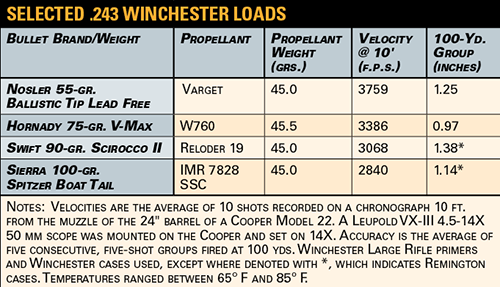
That’s a perfect muzzle velocity to expand the Sierra bullet, with its exposed lead tip and thin copper-alloy jacket, out to several hundred yards against the ribs tight behind a deer’s shoulder. Hunters young or old can make that killing shot if they practice first with their .243 Win.