This article was originally published in the November 2003 issue of American Rifleman.
"All we have available right now is a No. 1. Tropical," Ruger's Director of Press Relations Margaret Sheldon told me when I asked for a rifle in .458 Lott. Last year Hornady and Ruger teamed up to legitimize Jacque P. Lott's wildcat cartridge—one that delivers more velocity, energy (and recoil) than the .458 Winchester Magnum. I was heading to the Alaska Range for grizzly in a few months, and I didn't want to take any chances with a big bear that can make one re-evaluate one's position on the food chain. Besides, the .458 Lott as a from-the-factory proposition was big news, and this was the perfect opportunity to cover it for the magazine with some practical field experience.
There was silence from my end of the phone as I recalled a conversation with my friend and American Rifleman Contributing Editor Jon Sundra—a gunwriter with more than 40 year's experience who has, literally, "been there and done that" all over the world. I've shot and hunted a lot with No. 1s and consider myself pretty fast with a reload. But Jon's words, spoken around the fire at a hunting camp a few years ago, played back in mind: "When I was young, I took the 'Big Five' with a No. 1. There were some pretty tense moments, especially on [Cape] buffalo and elephant. I'm glad I did it, but I'm older now, and I won't do that again." He added, "No matter how good you are, there are just times your fingers turn into fat sausages and you can't do things as quickly as you usually do."
It seems to me more folks would get into less trouble if they listened to guys like Jon. While many enjoy the challenge—and thrill—of hunting dangerous game with a single-shot, I'll admit up front that I am not one of them. I admire those who do, but I prefer another two ready rounds in case something goes wrong.
"Any chance of getting the Model 77-based Magnum?" I asked.
"Let me see. They haven't started them yet, but let me know when you are leaving," replied Margaret.
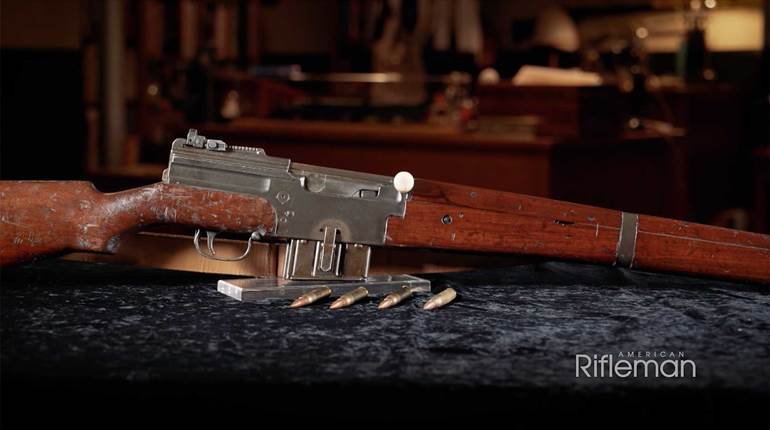
Two weeks before I was to leave, a bolt-action Ruger Magnum with ".458 Lott" stamped on the barrel arrived in my office.
Looking At The Man & The Numbers
The .458 Win. Mag., based on a belted .375 H&H case that gently tapers from 0.513" ahead of the belt to 0.483" at the case mouth and with a .458" bullet, was introduced in 1956 by Winchester along with a Model 70 dubbed the "African." It was intended to offer the ballistics of the .450 Nitro Express and .470 Nitro Express through an affordable bolt-action platform. Factory tables, likely exaggerated at the time, originally quoted the .458 as moving a 510-gr. bullet at about 2130 f.p.s. through 24" barreled rifles.
That discrepancy played a role in the creation of the .458 Lott. Reaction today from those who knew him paints a disparate picture of the colorful, contrary character who was Jacque P. Lott. A gunsmith, big-game hunter and one-time technical editor of Guns & Ammo, some called Lott a "wonderful guy," a "renaissance man" and a "great friend," while others didn't hold such a high opinion. One of the latter quipped of the cartridge: "It's unpleasant, just like the man who made it."
Regardless of positive or negative comments concerning his character or virtues, Lott has left his legacy when it comes to the cartridge that bears his name. Lott hunted Africa often, in particular dangerous game. A 1959 potential life-ending (his life, that is) safari gone wrong with a wounded Cape buffalo and a .458 Win. Mag., which didn't penetrate the shoulder as deeply as he believed it should, eventually set Lott in search of .458-cal. cartridge with more power and penetration than was offered in the factory .458 Win. Mag. with 500-gr. bullets. He wrote on big magnums quite a bit, and in a 1971 article on the .458-cal. ".460 G&A" wildcat introduced before his own, he wrote "[It] is designed to produce all the qualities needed by an optimum .458-caliber elephant rifle, falling as it does about midway between the .458 Winchester and the heavy recoiling .460 Weatherby." At the time, the .458 Win. Mag. was listed 2130 f.p.s. at the muzzle and the .460 Wby. Mag. at 2700 f.p.s. with 500-gr. bullets, both from 25" barrels.
What Lott was looking for was a .500-gr., .458" bullet moving out in the 2200-2300 f.p.s. range from a 22" barrel. By the early to mid 1970s (most sources state 1971), he had created it himself. The Lott's case is based on the .375 H&H magnum case, just like the .458 Win. Mag., but the Lott's case length is 2.800" as opposed to the 2.500" of the Win. Mag. Except for the 0.3" extra length it's the same case—with the attendant increase in powder capacity that provides—and all the other dimensions are the same. While there are other magnums firing .458" projectiles, such as the .450 Ackley, .460 G&A and .450 Watts, to name but a few, the Lott caught on with handloaders and wildcatters as it was simple matter to have the chamber of a .458 Win. Mag. rifle reamed deeper to accept the Lott.
As a matter of fact, one of the virtues of the Lott is—if the maker says it's okay, and they usually do—you can fire .458 Win. Mag. out of a .458 Lott rifle safely. As .458 Win. Mag. is much easier to find than .458 Lott in remote parts of the world, that's a significant advantage. Think of the .458 Lott and .458 Win. Mag. as the .357 Mag. and .38 Spl., respectively, of massive dangerous game cartridges.
The performance difference between .458 Lott and .458 Win. Mag is summed up in Frank C. Barnes's Cartridges of the World, Sixth Edition as such: "The .458 Winchester is advertised as developing 2040 fps with the 500-grain bullet, fired from a 24-inch barrel. In practice it doesn't actually do much better than 1900 fps. The .458 Lott will do an honest 2300 fps+ from a 22-inch barrel."
Factory Loading The .458 Lott
"We wanted to do something different and exciting without being 'me too' when it came to a 'new' magnum," Steve Hornady, president of the company that bears his name, told me. "The Lott was already established and had both a good reputation and good following, so it just made sense." With the Lott, Hornady set out to "make a cartridge that is what the world wanted from the .458 Winchester—or what many had hoped the .458 Winchester promised to be when introduced." Current factory ballistics with a 500-gr. bullet on the .458 Win. Mag. run from 2040 to 2080 f.p.s. at the muzzle, with the exception of Hornady's Heavy Magnum load topped with a 500-gr. FMJ- RN, which is listed at 2260 f.p.s. from a 24" barrel. But that load cannot, under any circumstances, be safely duplicated by handloaders.
The current Hornady .458 Lott factory loadings both include 500-gr. bullets, but one is a round- nose Interlock with a soft-lead tip and a copper jacket and the other is a full-metal-jacket round- nose with a brass jacket and a lead core. According to factory data, they both leave the muzzle at 2300 f.p.s. with 5,872 ft.-lbs. of energy, and at 100 yds. the Interlock is moving at 2022 with 4,537 ft.-lbs. of energy while the FMJ is at 2028 f.p.s. with 4,567 ft.-lbs. of energy. At 200 yds., the round-nose is moving at 1776 f.p.s. with 3,502 ft.-lbs. of energy, and the FMJ is at 1777 f.p.s. with 3,506 ft.-lbs. of energy. For comparison's sake, a soft-point 180-gr. .300 Win. Mag. leaving the muzzle at 2967 f.p.s. generates a "mere" 3,510 ft.-lbs. of energy at the muzzle.
Shooting factory loads through the Ruger Magnum over our Oehler Model 43 chronograph, the Hornady 500-gr. FMJ load had a muzzle velocity of 2151 f.p.s. and a muzzle energy of 5,138 ft.- lbs. The 500-gr. Interlock moved out at 2290 f.p.s. at the muzzle with 5,826 ft.-lbs. of energy. In comparison, I fired Federal's Premium Safari load with a 500-gr. solid as well, and it delivered a muzzle velocity of 2078 f.p.s. and 4,797 ft.-lbs. of energy at the muzzle. To put things in perspective, the difference in energy between the .458 Lott Hornady Interlock loading and the .458 Win. Mag. Federal load at 100 yds. was 798 ft.-lbs., or roughly the disparity in energy between a .308 Win. and a .300 Win. Mag. when both are loaded with the same 150-gr. bullet.
For handloaders, Hornady's embracing of the Lott ensures a steady supply of cases of known quality and consistency (a problem in the past), factory-tested loading data in its Hornady Handbook of Cartridge reloading, Sixth Edition, and the continued availability of the firm's Series II rifle dies in .458 Lott.
Chickens & Eggs
For years, custom gunsmiths reamed out the chambers of .458 Win. Mag. rifles to accommodate the Lott, and D'Arcy Echols & Co. and A-Square both built factory rifles in it—the latter advertised and introduced .458 Lott ammunition to the Sporting Arms and Ammunition Manufacturing Institute (SAAMI) as well before A-Square closed its doors. You could also order a Model 70 Custom Safari Express or African Express in the Lott, but the $3,000 to $4,500 or so price tag still put them in custom gun realm. Until a major rifle maker and a major ammunition maker combined to bring the Lott to the masses as a factory proposition, the Lott continued as a wildcat.
When it came to introducing the .458 Lott, Steve Hornady basically said to Bill Ruger, Jr., "Well, if you do the rifle, we'll do the cartridges," and Bill Ruger, Jr., essentially replied with the same sentiment: "We'll do the rifle, if you do the ammunition." It was that simple, except for the engineering, obviously, but the deal was done, and the Lott would no longer suffer ignominy as a mere wildcat.
Ruger had expressed interest in the .458 Lott as early as 2000, and a more "American" looking line of "Large-Action" rifles, based on the Magnum, without the barrel rib and fore-end cap was almost introduced in 2000-2001 in 7 mm STW, .338 Rem. Ultra Mag, .375 H&H, .416 Rigby and .458 Lott. These rifles were far from handsome and never reached the market. The only remnants of Ruger's first introduction of the .458 Lott are a few prototypes and a four-page sales flier.
The February 2002 Ruger and Hornady introduction pulled Jacque Lott's legacy out of the wildcat category and made it a legitimate factory proposition. Hornady took over SAAMI standardization of the cartridge from A-Square, and Ruger announced two rifles chambered for it at the same time. Ruger offers both its single-shot No. 1 Tropical and the bolt-action Magnum in the Lott. Weatherby followed suit by bringing out the cartridge in its Dangerous Game Rifle in October 2002.
Not A Casual Endeavor
After shooting about 60 rounds with the rifle over the course of a week to zero it from the bench and then practice shooting from field positions and off of my Stoney Point Professional shooting sticks so I'd have some muscle memory and know what to expect, I'll admit it hurt. I'm not particularly recoil sensitive, but the .458 Lott, except for the most masochistic of us, is not a recreational cartridge suitable for an afternoon of causal plinking off the bench. It is task-specific cartridge, and that purpose is knocking down and keeping down the biggest and most dangerous creatures on earth. From the bench, even with a PAST pad and a shooting jacket on, it's nothing short of brutal. Off-hand and leaning into it, it's not too bad, and I was able to put three shots within an 8" circle at 50 yds. in 5.1 seconds. After that 60 rounds of .458 Lott, I vowed to shoot it only twice more in Alaska—once to check my zero upon arrival and once to drop a bear in its tracks. At least I got the first part right.
After I returned from Alaska—and after my colleague Abe Walsh used the rifle in Africa to take a big Cape Buffalo—the rifle was fired at 100 yds. for accuracy and velocity with the two factory Lott loads as well as Federal's Premium Safari 500-gr. Solid loading and the above-mentioned Hornady .458 Win. Mag. Heavy Magnum using a Zero Coil device from the bench. After shooting 80 or so more rounds of Lott, the Federal .458 Win. Mag. loads seemed mild in comparison.
A Native Word For "No Bears Until May"
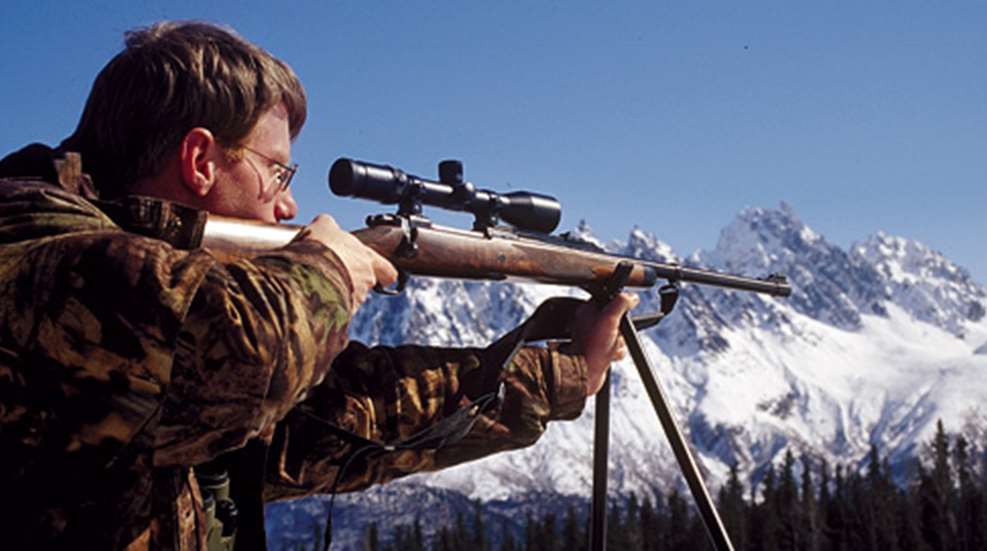
For the field test of the Ruger Magnum and .458 Lott cartridge, my friend Cameron Hopkins, former editor of American Handunner and now a vice president with Surefire flashlights, headed out to Jim Harrower's excellent Stoney River Lodge in the Alaska Range mountains in pursuit of bear. It depends on whether you follow Safari Club or Boone & Crockett as to whether to call the bears where Harrower guides big grizzleys or small browns; regardless they are still big bears. On arrival, as promised, I shot the gun again to check my zero.
Cameron, who's a bit shorter than I, but not at all recoil shy, stepped up, leaned in and touched it off. He was wearing thin glove liners to keep the chill off, and his strong hand literally came right off the wrist in recoil. Then Cameron's guide Arno, a German who is living his dream hunting, trapping and guiding in the Alaskan wilderness stepped up, leaned in and fired. It rocked him back, and he said in one of the most poignant examples of Teutonic understatement, "This is very powerful." Odds are his loose fillings agreed.
For the hunt, I was paired with Mark Bressler, who has guided in Montana or Alaska for most of his life.
After nine days in a small tent in temperatures ranging from -10 F to 50 F, I decided he's as agreeable a guy as you will ever hunt with. Mark and I hunted hard day in, day out, covering a lot of ground and glassing the valley along the way. We covered between six and 10 miles a day, moving up and down the Mekans river valley. By day six, I asked Mark if knew what "Mekans" meant in the native language. He replied in the negative. I suggested that it means, "No bears until May." As we were hunting the first half of April, it didn't bode well. While hunting, I carried that rifle up mountains (to likely-looking, but unsuccessful spots) through icy glacial streams and up and down the rough country of the Mekans valley.
All told, thanks to the Uncle Mike s Sidekick sling—which has just the right amount of bounce and rigidity—carrying that 10 1/2-lb. rifle wasn't so bad. The gun balances well in the hands and comes up fast. Mind you, if I has known there weren't going to be any bears, I likely would have carried a lighter rifle. Before going, I coated all the metal work with MetalSeal and applied a couple of coats of Birchwood-Casey's stock seal to all the internal and external surfaces of the stock. Taking a wood-stocked gun to a place where it rains for weeks at a time is asking for trouble if it's not sealed. Thankfully, the snow, fog and driving rain wasn't as bad as some Alaska trips I've taken. I loaded two of the 500-gr. soft-points, backed up by a 500-gr. FMJ as the last round in the magazine, thinking, if needed, the last round's superior penetration would solve any possible trouble I'd run into. As the point of impact for both loadings was identical out to 100 yds., no separate zero was required. I zeroed the rifle to be 1" high at 50 yds. and dead on at 100 yds. Again, it didn't matter to the nocturnal bears.
Many hunts end that way, and it's no fault of the guide, hunter or outfitter. As a matter of fact, I'll be taking the Ruger Magnum in .458 Lott back to the Stoney River Lodge and the Mekans next fall. Just as I did this spring, I have complete confidence in the rifle and cartridge's ability to stop a big bear dead, literally, in its tracks. As promised after zeroing the gun in, the rifle and I need to fire that second shot in Alaska. There's still some unfinished "business."