If you served as a U.S. sniper in the Vietnam War, no doubt you had high regard for that era’s sniping load: 7.62x51 mm, M118 Special Ball. Incorporating a purpose-designed, 173-gr. bullet, it offered snipers superior accuracy and lethality compared to the standard 7.62x51 mm NATO ball, which had a 147-gr. projectile.
The M118 round, however, was not the most accurate 7.62 mm load then available. That distinction went to civilian ammunition with match-grade bullets, especially the .30-cal., 168-gr. Sierra MatchKing. That open-tip bullet-labeled a “hollow point”-was thought to violate the Hague Conventions of 1899 and 1907 because such projectiles “expand and flatten easily,” causing “unnecessary suffering.” Despite superior accuracy, the open-tip match bullet could not be employed by military snipers.
The M118 cartridge remained the standard U.S. military sniping load long after Vietnam until, in 1985, the Defense Department’s Chief Judge Advocate General for International Law, U.S. Marine Col. W. Hays Parks, took a closer look at match-grade projectiles. An accomplished shooter and handloader, Col. Parks understood that despite its open tip, a match bullet is not a true “hollow point,” which mushrooms upon impact. Actually, as his studies demonstrated, the bullet’s “hollow point” results from the manufacturing process and it impacts much like ordinary ball bullets. Further, he found, the match bullet’s superior precision significantly reduces collateral danger to non-combatants, a fundamental goal of the Hague Conventions. Col. Parks’ findings became U.S. Navy policy, authorizing the combat employment of Federal’s 168-gr. Gold Medal Match round, officially designated the M852 Open Tip Match (OTM) cartridge. Hardly noticed at the time, this was the first step in the remarkable evolution of U.S. sniping ammunition.
Five years later, during Operation Desert Storm, despite the U.S. Army having also authorized the open-tipped M852, few JAG officers knew of Col. Park’s findings. Erring on the side of caution, they forbade its use in combat, citing International Law.
Within a few years, the M852’s legality finally was recognized across the Armed Forces. The more this bullet was fired, however, the more its shortcomings became apparent. Originally designed for 300-meter Olympic competition, the 168-gr. Sierra MatchKing projectile goes subsonic at around 800 meters, degrading its accuracy-a major issue, given the likelihood of future long-range sniping in the Middle East’s deserts. Working together, the Marine Corps, the Army’s Picatinny Arsenal, Lake City Army Ammunition Plant and Sierra Bullets developed a new 7.62 mm load. Designated the M118 Long Range (M118LR) to distinguish it from the earlier sniper load, its 175-gr. streamlined MatchKing bullet-7 grs. heavier than the M852-boosted the ballistic coefficient to .500, which means the round was better able to overcome air resistance, thus retaining velocity and energy at longer ranges.
Other refinements included a match-grade primer, modified case taper and more precise forming and loading procedures. The new M118LR cartridge proved especially accurate, and when fired from the Marine Corps’ M40A3 rifle and the Army’s M24 Sniper Weapon System, grouped one minute-of-angle (m.o.a.) or less-or no more than 10 inches at 1,000 meters. In 1997, Col. Parks’ JAG office reviewed the new cartridge and soon afterward it was approved for combat throughout the U.S. military.
Match Loads Go To War
By the time U.S. forces invaded Afghanistan and Iraq, the M118LR cartridge and its 175-gr. bullet had become the standard sniper round. Praised for its accuracy, the M118LR set new records for 7.62 mm long-range kills in Iraq, with U.S. Army sniper Jim Gilliland taking out a terrorist sniper at a documented 1,375 yds. and close behind, U.S. Marine Corps sniper Matt Orth killing an insurgent at 1,256 yds.
Their shots proved quite exceptional, however, and reports soon emerged of the M118LR suffering from decreased accuracy. Extensively testing the 175-gr. load, the U.S. Navy Surface Warfare Center in Crane, Ind.,found “inconsistencies” between lots. One industry authority attributed it to accelerated wartime production and hurried quality inspections-a claim I could not confirm.
Part of the fix was tightening inspection standards, but that also proved an opportunity to re-examine the entire load. Enter Jeff Hoffman, president of Black Hills Ammunition who’s also a seasoned SWAT sniper. Having previously worked alongside the Navy Surface Warfare Center and aware of the need to improve the M118LR round, Hoffman initiated his own research at no cost to the government. One area for improvement, he believed, was the propellant’s temperature sensitivity. The searing heat of Middle Eastern deserts and bitter cold of Afghanistan’s mountains had to affect burn rates, causing wide variances in muzzle velocity, which would skew ballistic tables and trajectory-synchronized bullet drop compensators.
Firing cartridges heated to 165 degrees, and others cooled to 25 below zero, his ballistics lab found a muzzle velocity variance of 227 f.p.s.; each degree of temperature change caused a 11/2-f.p.s. change of muzzle velocity. At 800 meters that meant a trajectory variance of 58 inches. Hoffman and the Navy evaluated more than 20 propellants and blends to find a temperature-stabilized propellant that varied only 21 f.p.s. between those temperature extremes. In addition, calcium carbonate was added to reduce muzzle flash. When Federal Cartridge began producing the updated 175-gr. load-now called the Mk 316 Mod 0 due to being a Navy development-the Crane Center test-fired five lots at 300 yds.; they grouped an impressive 1.75 inches, or 0.58 m.o.a.
Enter The Magnums
American 7.62 mm sniping ammunition reached a new zenith with the Mk 316 Mod 0 cartridge-but it still wasn’t enough. In mountainous Afghanistan, the Taliban rarely engaged at conventional small arms range, safely firing from more than 1,000 meters and withdrawing before air support could arrive. As expressed by G.I.’s in Afghanistan, U.S. snipers needed “ridge-to-ridge” capability-which meant a longer-range round than the Mk 316 Mod 0.
Both U.S. Army Special Forces and Navy Special Warfare units already had a decade’s experience with a 190-gr., .300 Win. Mag. round, developed by the Navy Surface Warfare Center. Designated the Mk 248 Mod 0, the load increased useful range to 1,200 yds.; however, the U.S. Army’s new requirement called for a round effective to 1,500 yds. to replace the M118LR. The Army planned to mate the cartridge with a new sniper rifle, then in development.
Initial focus was on the .338 Lapua Mag., a robust cartridge widely respected for its long-range performance. In Rapid City, S.D., however, Hoffman was taking another look at the .300 Win. Mag. cartridge. In November 2006, he sent a letter to the Navy’s Crane Center, offering at his own expense to examine how it might be improved. “If we were to load a Sierra 220-gr. projectile at 2800 feet-per-second,” Hoffman theorized, “the supersonic range would be increased to about 1,500 yards.” Further, he suggested, a different propellant could offer temperature stability as demonstrated on the updated M118LR. As well, an additive could reduce muzzle flash.
He acquired a variety of propellants for testing. His Head Ballistician, Glen Hoffman, tested them at temperature extremes of minus 40 to 160° F. Eventually, Hoffman and his Black Hills staff found the right combination of propellant and additives to push a 220-gr. Sierra MatchKing bullet to a muzzle velocity of 2850 f.p.s. with impressive accuracy.
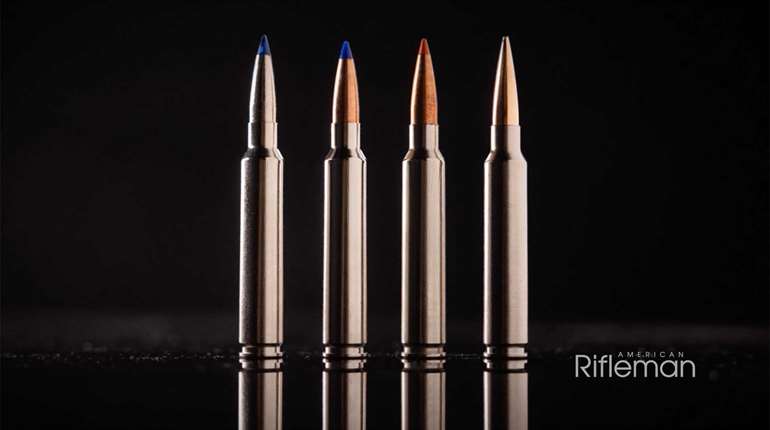
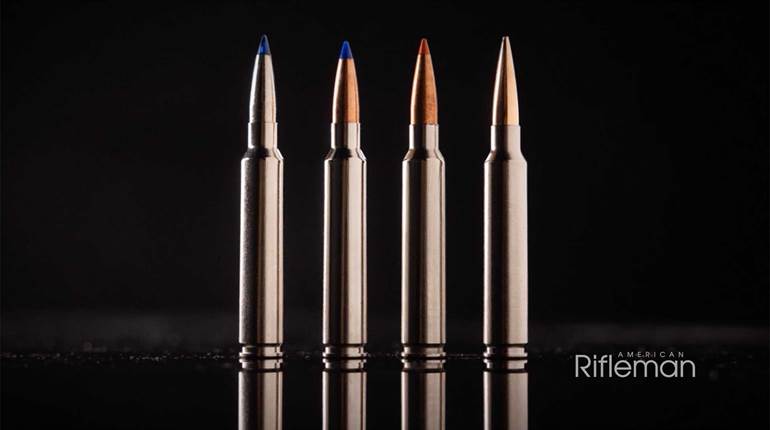
After government testing, that load-the Mk 248 Mod 1-became the new Army sniping round. And true to Hoffman’s estimate, the new round is supersonic to 1,500 yds., where it impacts with 712 ft.-lbs. of energy, just 25 ft.-lbs. less than the .338 Lapua Mag. 250-gr. bullet. The bottom line: the new 220-gr., .300 Win. Mag. load delivers more than double the energy of the M118LR and boosts a sniper’s maximum effective range by 50 percent.
Of significance to the Army, the .300 Win. Mag. load offers “significant cost savings” over the .338 Lapua Mag., while the cartridge is compatible with existing long-action, bolt guns. Thus, the Army’s XM2010 sniper rifle could incorporate the Remington Model 700 action, as it had for the M24 Sniper Weapon System.
Obtaining a batch of Black Hills prototype 220-gr. cartridges, I was able to test this load extensively. Using a Savage 110BA rifle-which offers the same 1:10-inch rate-of-twist and barrel length as the Army’s XM2010-I fired five-round groups at distances of 700, 800 and 900 yds. It performed consistently and impressively. All groups were sub-minute-of-angle, with a 900-yd., five-round vertical spread of just 5.2 inches.
Federal Cartridge won the competitive bid to produce the Mk 248 Mod 1 round and, despite some requests, Black Hills is not planning to offer this load commercially because it exceeds SAAMI standards for overall length and maximum chamber pressure. The first Remington XM2010 sniper rifles and Mk 248 Mod 1 cartridges were delivered to U.S. forces in Afghanistan in January 2011. Thus far, feedback has been excellent.
.338 Lapua Mag. Sniping Ammunition
The .338 Lapua Mag. has seen limited service with U.S. Special Operations snipers since 1993, and was adopted by the British Army in 2007 for its new L115A1 sniper rifle. British sniper Craig Harrison used this combination of rifle and cartridge for his world record sniper kill in 2009, taking out several Taliban at 2,707 yds. in Afghanistan. Typically weighing about 20 lbs., .338 Lapua Mag.-chambered rifles offer less weight and bulk than those in .50 BMG, but still pack considerable terminal energy, especially against materiel targets and barriers. The U.S. Army’s new 220-gr., .300 Win. Mag. load performs nearly as effectively as the .338 Lapua Mag.’s 250-gr. round.
Because there is no “standard” U.S. or NATO .338 Lapua Mag. load, I test-fired a variety of American and European ammunition for accuracy and terminal effect, which included: Finnish Lapua 250-gr. and 300-gr. Match; Swiss RUAG 250-gr. ball, and 250- and 300-gr. Match loads, along with a glass-penetrating cartridge and 260-gr. armor-piercing round; U.S.-made Black Hills 250-gr. and 300-gr. Match loads; and Hornady 250-gr. and 278-gr. ammunition.
All of the 250-gr. loads consistently printed five-shot groups of less than one m.o.a. when fired in my Savage 110BA rifle, with its 1:9-inch rate-of-twist; the 300-gr. groups opened noticeably, suggesting they prefer a different twist-rate. Of particular note, I fired all five RUAG loads at one target as individual shots; except for the ball round, they grouped less than one m.o.a., meaning a single zero could serve these four different loads.
Testing for barrier penetration, all 11 loads breached a sandbag wall at 400 yds. Reflecting their tremendous kinetic energy, when fired at 90 degrees all of the 250-gr. match bullets-which are open-tipped lead-alloy-core projectiles-punctured 0.4 inches of soft steel at 300 yds. And the RUAG AP round’s tungsten-carbide core readily punched through a 1.4-inch steel plate at 100 yds.
Whether fired for accuracy or for terminal effect, the .338 Lapua Mag. rounds performed impressively; although not destined to be the U.S. Army’s new sniper cartridge, it was this 250-gr. load that set the standard for the .300 Win. Mag, Mk 248 Mod 1 load. With the U.S. Marine Corps looking for a new sniper rifle of its own, the .300 Win. Mag. quite likely is in their snipers’ future, too.