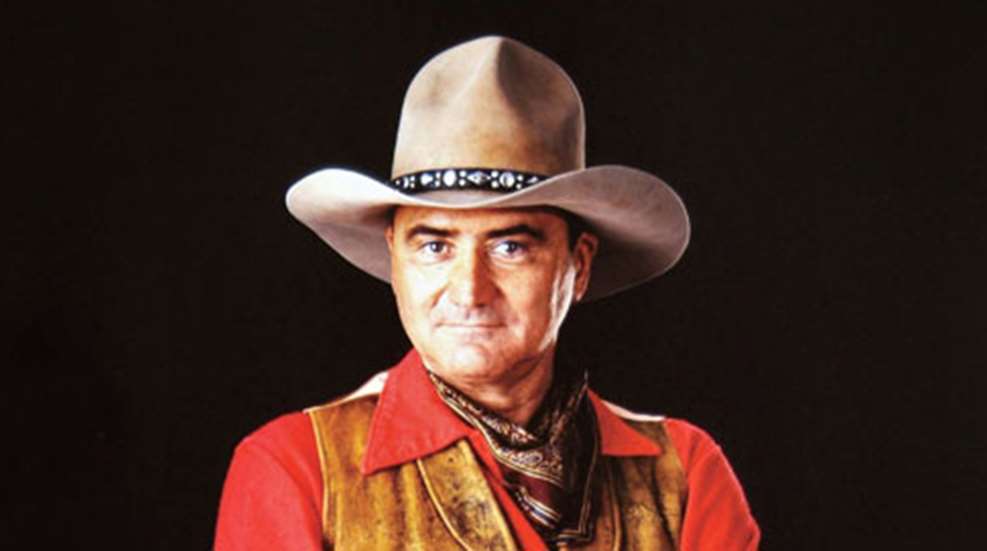
There are only a handful of brand names that are recognizable anywhere in the world, regardless of the language spoken; IBM, Coca-Cola, Rolls-Royce, Ferrari and Bianchi are among them. While it may seem extraordinary that a holster should share international familiarity with legendary names in computer technology, refreshments, luxury and sports cars, there have been more than 40 million Bianchi holsters, gun belts and accessories produced. Not bad for a man who started out handcrafting holsters for sale on his kitchen table in 1958.
John Bianchi’s success story is what the American Dream is all about, but success so often comes with a price, and as those who read Bianchi’s biography, “John Bianchi—An American Legend” will discover, his life has not been without adversity. His story is compelling, much like Bianchi himself when you sit and talk with him. His boundless enthusiasm for his lifelong careers, and we use the plural because he has had several of distinction, has made the Bianchi name legendary.
He actually made his first holster when he was 12. The family had moved from New York City to Monrovia, Calif., following his father’s retirement from the New York City Police Dept. in the late 1940s. “I began handcrafting leather bags, dog collars, whatever I could make,” laughed Bianchi. “I’d just cut it out, no instructions, no guidance. I was hand-stitching everything. I mean, I had no idea what a saddle stitcher even looked like. Based on what I had seen in the movies I made what I thought was a cowboy holster in 1949.” Of course, as Bianchi would learn years later, the Buscadero rigs worn in movies were a 20th century contrivance. Less than a decade later he would be spending his evenings carving out leather holsters on his kitchen table for fellow officers on the Monrovia Police Dept.
Bianchi was fascinated with both the Old West and military history, and when he finally decided there was very little chance of him becoming a cowboy— “I didn’t have a horse,” he quipped—he tried to enlist in the U.S. Army. He was only 15. “It was 1952, shortly before I joined the National Rifle Association, and I walked into the Army Recruiter’s office and said I wanted to sign up.” When the recruiter asked his age, Bianchi firmly avowed, “I’m 17, sir.” John looked down and chuckled at the memory. “He says, ‘You don’t look 17. Go get your birth certificate.’ So I went home, couldn’t find it and went back to the recruiter. He says, ‘You know kid, why don’t you go down to the National Guard, they don’t look as closely as we do at your age.’ So I went, picked up the enlistment forms and brought them home. After a while I talked my dad into signing the papers and I filled in my birth date as 1935 instead of 1937. It was probably the most rewarding part of my youth. I served in the National Guard for two years and when I turned 17 went on active duty in the Army for another three years.”
When Bianchi left the Army late in 1957 he decided to follow in his dad’s footsteps and go into law enforcement, but also stay in the Army as a reservist. That was the first pivotal decision he would make in his life. Forty years later John Bianchi would retire as a major general, but in 2001, following the attacks of September 11, he was called back to duty.
U.S. Army Maj. Gen. Dennis M. Keneally, who assumed command of the California Army National Guard after 9/11, remembers that the first call he made was to John Bianchi. “I asked him to come out of retirement and take command of the California State Military Reserve. I remember thinking, ‘I couldn’t blame him if he said no.’ He had already given more than most. However, not to my surprise, he never questioned my request, he simply responded. The next day he was in my headquarters in uniform and looking as if he had walked off a Hollywood studio set or off a recruiting poster. His presence alone was like a flashing marquee. In short, he had charisma and the intangible quality of a remarkable leader. Although lost in history, Maj. Gen. Bianchi contributed immeasurably to the success of our mobilization and deployment of troops to Afghanistan and Iraq.” In 2004, Maj. Gen. Bianchi retired a second time.
Watch a video interview with John Bianchi at the 2010NRA Annual Meetings.
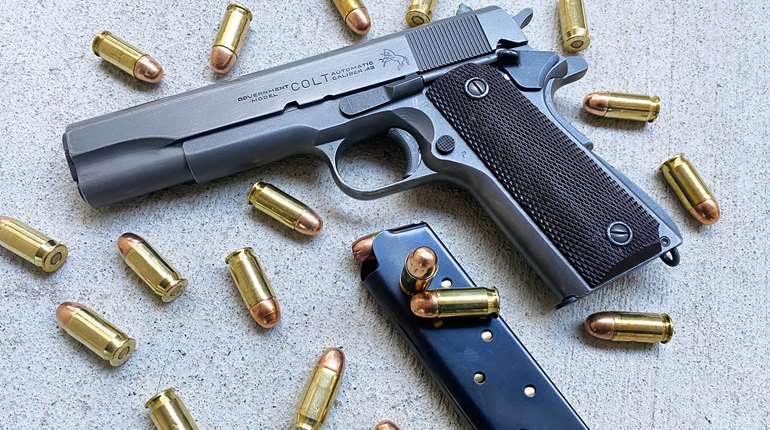
Along the road to 40 million holsters, gun belts and accessories bearing his name, Bianchi made quite a few detours, each of which contributed not only to his success but to the entire firearm culture in America. While he was a member of the Monrovia Police Dept. in the late 1950s and early ’60s, his first customers were fellow officers. “I’d make a holster at night, take it to work the next day and sell it. I was making traditional-style belt holsters for some of the detectives, and that’s when I realized there was a need for high-performance concealment carry holsters, which, for the most part, didn’t exist.” As a result of John’s ingenuity in holster design, he broke more ground in concealed-carry holster development by the late 1960s than anyone in the preceding 50 years. His early product line was marketed under the name “Combat Action Holsters ‘Protector Brand’ by John Bianchi.” It included the No. 2 Speed Scabbard for the Colt M1911. “This was the first commercially successful, high-production concealed carry holster for the Model 1911. It’s been in production for over 50 years,” Bianchi said proudly.
During the 1960s Bianchi expanded rapidly from a two-car garage behind his home into a small storefront in Monrovia. He had left the police department in 1965 confident that he could make it in the holster business. And that he did. Within a few years he moved into a new 4,000-square-foot manufacturing facility. He had stopped selling mail order and was now selling to wholesalers and retailers. “We were extending credit and buying supplies in quantity. Everything was tied up in receivables and inventory, and there was a constant quest for working capital because we needed an even bigger building to meet manufacturing demand,” Bianchi recalled. “That was scary, but the contractor that built the 4,000-square-foot building said he had another lot on Foothill Boulevard and offered to make a deal. He said, ‘I’ll take the equity you have in your present building and sell you the new lot, then you can get 100-percent financing to build a new manufacturing facility.’ The new property was large enough to accommodate a 10,000-square-foot building. Somehow we pulled it off. We built a great building, two stories up front with offices upstairs and production facilities in back. In the next two years we went from 35 employees to 65.”
By the early 1970s, Bianchi had become the person everybody came to when special products were needed, and that eventually included the U.S government. He was asked to do work for the Executive Protective Section of the State Department, which employs the agents who travel with foreign dignitaries, the secretary of defense, secretary of state, et cetera. Bianchi was contracted to make special briefcases that held secret communications and miniaturized tracking devices. “When events in the Middle East began to surface as an international terrorist threat, kidnapping of officials became a major concern of all intelligence agencies. At one point I was called upon to design and custom-make men’s trouser belts with concealed transmitting devices so they could be tracked. The belt was a new idea and worked well for several years.”
Another operation in which Bianchi was called to assist was during the Iranian occupation of the U.S. Embassy in Tehran. In late 1979 he was sent to a Special Forces training facility located in a high-security military base. The mission called for the design and training in the use of special carry equipment to accommodate M1911A1 pistols that had been modified for the Delta Force. “I was asked to equip a special team for an undisclosed mission. Though I had my suspicions as to the objective, I never learned of the actual mission or where it was to take place until the ill-fated Iranian rescue mission was announced worldwide by radio and television on April 25, 1980. Not only had the rescue, led by U.S. Army Col. Charlie Beckwith, with whom I had consulted on training and equipping his Delta Force operatives, failed due to a massive dust storm hampering helicopter operations and logistical coordination in the desert, but several of his soldiers had been killed. I realized these were some of the men I had helped train and equip, and my heart just sank. Later, after the classified restrictions had been lifted I convinced Col. Beckwith to write the story of the mission in his own words rather than wait and have someone else, who wasn’t there, tell the story. The book, “Delta Force—The Army’s Elite Counterterrorist Unit,” came out in 1983.”
John’s reputation and that of his company were growing exponentially. In 1979 he launched the first Bianchi Cup pistol match. Today, it is the NRA Bianchi Cup, the crown jewel of international shooting competitions. By the early 1980s he had risen to the rank of lieutenant colonel, and rekindled his childhood love of the Old West by adding a line of Western holsters and gun belts to the Bianchi catalog.
In 1982 he achieved another of his dreams, opening the Bianchi Frontier Museum, the first large-scale Old West attraction of its kind. Unfortunately, Temecula was too far from the beaten path at the time for it to be financially successful; the operating costs of the 25,000-square-foot museum and its staff were beginning to drain the manufacturing company’s operating capital. In 1985 John made the tough call. He closed the museum and sold his lifetime accumulation of Western guns and memorabilia to Gene Autry. “My collection became the basis for the Autry National Center, without which there would be no Autry Museum today,” lamented Bianchi.
As fate would have it, that period of his life also coincided with the most important project of his career. “One day in 1981 the phone rang and it was the Department of Defense. The caller said, ‘You’ve probably heard that the government is looking to replace the 1911 pistol and we haven’t made a decision on what that will be, but we need to concurrently come up with a new design for the holster. We read your book [“Bluesteel & Gunleather” (1978)] and we are convinced that you are the final authority on holster design.’ I was very flattered to hear they had read my book at the Department of Defense, and then they really threw me a curve. The caller asked if they could send a team of acquisition people out to Bianchi Int’l to get some ideas on how to design a new military holster.”
When the DoD team arrived they were carrying a copy of the book. “They sat down in my office and started going through it from one page to another saying, ‘This is fascinating, and this is fascinating, absolutely fascinating,’ and then they dropped the big question, ‘What should the new holster consist of?’ I said that’s a big question and it’s a dynamic challenge. Thirteen percent of the military is left-handed and there are no left-handed holsters, so it has to be ambidextrous to minimize inventory items. They looked at me and said, ‘That makes sense.’ And then I told them, it needs to appeal to Army, Air Force, Marines, Navy, and Coast Guard, so that means it needs to be environmentally balanced, suitable for extreme cold, extreme heat, humidity, dust, salt water, everything.
“They looked at each other again and said they’d never even thought about that. I told them the carry method with the brass prong had to go. It had to be more secure; it had to ride higher on the hip. We talked about the holster needing to protect the gun against environmental factors, as well as abrasion, rolling on it, and falling on it. It had to be able to be cleaned very quickly. And it couldn’t be leather. If it is leather and it gets wet, it takes forever to dry. Troops are in the field, and can’t have a wet holster. We talked for three days, and they jotted down everything I said. They toured the plant and left.” By this time Bianchi Gunleather was in its new home in Temecula, Calif., with a facility that covered more than 50,000-square-feet and employed more than 350 workers. Bianchi had no idea of the impression he had made. About six months later he received a Request for Quotation in the mail to design the holster.
“I looked at the RFQ and it’s this thick,” Bianchi said as he held his thumb and index finger about an inch apart, “and it had 64 points of compliance! Did I say all that? Everything I had suggested they put in the RFQ! They wanted a quote for the design and creation of a prototype, so we got our team of accountants, production managers, and designers together and worked out a design timeframe of 18 months and a bid for the project. We sent it in, and two months later we get a call. We’d been selected and were to begin work within 30 days.”
In typical fashion, Bianchi decided not to wait for the money and immediately started working on preliminary designs. They were two months into the project and they still hadn’t heard a word from Washington.
“After six months we finally get a phone call. ‘Bad news, Congress cut all developmental funds. We thought you ought to know. You can continue with development if you want. There’s no guarantee when you’ll be paid.’ If it were any other public company they would have stopped development right there. Stockholders wouldn’t have put up with it. Well, I was the principal stockholder,” John said with a laugh, “and I decided to proceed. Luckily, about six months later the funds were reinstated and we began getting progress payments.”
The holster’s design posed some enormous challenges in synthetic materials development, manufacturing, and in achieving John’s first caveat, it had to be ambidextrous. That was a strategic word in Bianchi’s vocabulary. He was left-handed, and had in fact been responsible for Armand Swenson developing the ambidextrous safety for the Colt M1911. Swenson crafted the first one for Bianchi.
Bianchi got to the point at which the holster was completed except for a functional ambidextrous fastening mechanism. “One day I left the plant and on my way home it hit me like a bolt of lightning. Whammo! There it was. I saw it in my mind’s eye. I rushed into the house, got a coat hanger and a beer can and I fabricated a working model. The next week our design staff made the first prototype by hand out of sheetmetal and a spring wire clip. We put the finished holster together and submitted it for approval.” The Bianchi design was accepted by the DoD in 1984, and that is where the designation UM84 (Universal Military 1984) originated. Bianchi Int’l initially produced around 70,000 M12 (the military designation for the UM84) holsters.
Just about every holster Bianchi has designed, or some variation of it, is in use today somewhere in the world. As for the M12 it became the most successful military holster ever devised and is still in use by the U.S. more than 25 years later, while Bianchi Int’l (which John sold in 1987 and retired from in 1992) continues to offer civilian UM84 versions in a variety of configurations and colors for the Beretta 92FS and other models.
Looking back on the development of the UM84, Bianchi admits that it was the most demanding, expensive design project in the history of the company, but through the years its technology led to the development of the Ranger line of synthetic holsters, belts and accessories and the AccuMold Elite police duty gear in use today. Like many things throughout Bianchi’s life the UM84 went beyond the profit motivation and truly became a labor of love. “Our goal was to design a holster that would be in service for the foreseeable future, and we achieved that goal,” he said.
“Voids beg to be filled,” said Bianchi. After about a year in retirement, he established Bianchi Frontier Gunleather, specializing in handcrafted Western holsters and gun belts. It is now in its 17th year. And that is the stuff legends are made of.
Most Popular