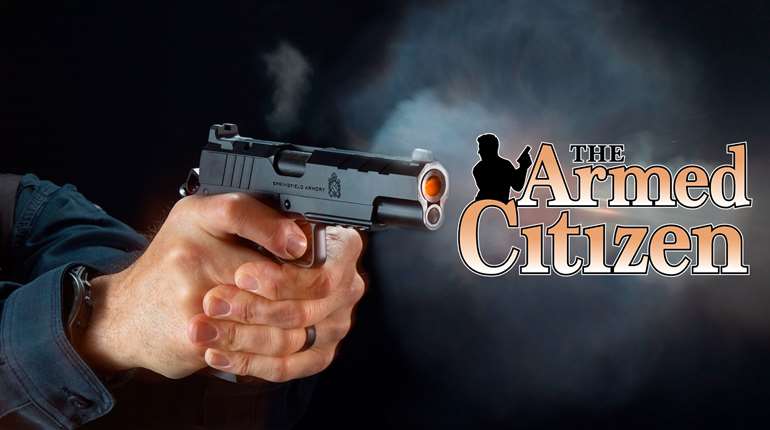
Murvaux, France, Sept. 29, 1918. The blazing remains of three German observation balloons had barely settled to earth when their assailant force-landed in the gathering dusk. Second Lieutenant Frank Luke had taken off against orders and undoubtedly would be court-martialed upon return to the 27th Aero Squadron, but that was far from his mind. He had enjoyed a record string— 18 enemy aircraft destroyed in as many days. But now, wounded by German anti-aircraft fire, he landed his SPAD fighter, climbed from the cockpit, drew his service pistol, and chambered the first round. Losing blood and alone behind enemy lines, he hefted the Colt and perhaps took comfort from its familiar weight. The 21-year-old Arizonan was expert with the Model of 1911 U.S. Army, and he intended to use it.
Members of the German garrison grabbed their Mausers and advanced toward the SPAD. But Luke, the hot-headed aviator, was in no mood to surrender. When he thought he heard movement in the brush near a stream, he fired three rounds.
Moments later Luke was dead, Colt in hand, a long way from the reality of Phoenix and the heritage of Tombstone. After the Great War, which ended six weeks later, he received a posthumous Medal of Honor.
Luke was not the only member of the American Expeditionary Force to use the M1911 that day. Private Frank Gaffney of the 27th Infantry Division and Lt. Col. Fred Smith, a battalion commander in the 77th, both earned their nation’s highest award in actions involving John M. Browning’s masterpiece on Sept. 29. Smith’s award was posthumous.
In the seven years since the Army had adopted the M1911, the Colt had seen limited combat use. The big pistol had been carried by then-Brig. Gen. John J. Pershing’s troopers during the 1916 punitive expedition into Mexico, but no Medals resulted; however, once Americans were committed to combat in the Great War, John M. Browning’s classic began earning a stellar reputation.
The first Medal awarded to a .45 ACP man went to 1st/Lt. William B. Turner of the 27th Division’s 105th Regiment. In a night action on Sept. 27, 1918, Turner rushed a German machine gun, which opened fire on his group, and he killed the crew with his pistol. Then he pressed forward to another machine gun post 25 yards away and killed one gunner before the rest of his detachment arrived to put the gun out of action. Turner continued leading his men over three lines of hostile trenches, cleaning up each one in turn. Despite repeated wounds, he pressed the attack, and after his .45 ammunition was exhausted, he picked up a rifle and bayoneted several enemies in hand-to-hand encounters. He then organized a counterattack until he was finally surrounded and killed.
The most famous episode occurred on Oct. 8, when Cpl. Alvin York of the 82nd Division used his rifle and his M1911 to kill 25 German machine gunners and infantrymen while capturing an incredible 132 more. Eight decades later, examination of cartridge cases found in the area of York’s action indicated that he may have used his pistol more than his rifle.
Four more doughboys used Colts in Medal of Honor actions that same day, including three from the 30th Division. A junior officer from the 29th, 2nd/Lt. Patrick Regan wielded an empty M1911 to capture 30 Austrians manning four machine guns. The next month 1st/Sgt. Benjamin Kaufman, 77th Division, also bluffed several Germans with an empty pistol.
On Oct. 11 the 30th Division’s Sgt. Richmond H. Hilton used his Colt to kill six enemy soldiers and capture 10 before losing an arm in a shell blast. Another marksman wielding his sidearm was 1st/Lt. Samuel Woodfill on Oct. 12. Despite being gassed, Woodfill—a superb hunter—made 300-yard head shots with his rifle on Maxim gunners, then closed on the enemy. He carried an M1911 given to him by a French civilian who had found the pistol after doughboys had left the area. Though more familiar with revolvers, Woodfill put the semi-automatic to efficient use in clearing the German trenches.
In all, seven officers, three noncommissioned officers and three enlisted men were presented the pale-blue ribbon with 13 white stars for actions involving the Colt semi-automatic during September and October 1918. That figure would be eclipsed in the next world war.
Seventy-Five Years Of 1911s
In the 75 years from 1918 to 1993, at least 55 Medals of Honor were presented to men carrying the .45 ACP. The next cases involved at least 20 M1911 actions in World War II, a dozen in Korea, seven in Vietnam, and finally two in Somalia. The exact total is unknown, as most citations only refer to “pistol” or “revolver” and some famous events do not mention sidearms at all. York’s is one case, and so is the only known interwar MOH event: Marine 2nd/Lt. Herman Hanneken’s methodical hunt for the Haitian bandit leader “Charlemagne” in 1919. While Hanneken used his Colt to end Charlemagne’s depredations, Cpl. W.R. Button used another Browning classic—the Browning Automatic Rifle—to chop down the outlaw’s bodyguards.
The World War II actions were equally divided between the Pacific Theater of Operations and the European area. The first event occurred in the Philippines during February 1942 when 1st/Lt. Willibald C. Bianchi died while leading his Filipino Scouts against the Japanese invaders. Almost a year later, Maj. Charles W. Davis wielded his Colt in leading men of the 25th Infantry Division on Guadalcanal in the Solomon Islands. Neither officer was known to have killed enemy troops in those actions, but the citations make it clear that both carried M1911s while performing “above and beyond the call of duty.”
Two of the most remarkable M1911 actions came in the Marianas in June and July 1944. The Army’s 27th Division, stalled in its advance on Saipan, met determined Japanese defenses in depth. Private Thomas A. Baker of the same regiment as Lt. Turner in 1918 had received a Medal nomination for his courage and initiative in reducing enemy bunkers during June. By July 7 he was a sergeant manning a perimeter attacked by thousands of Japanese from three sides. Though wounded, Baker remained on the line, fired his rifle empty, and then used it as a club. Baker declined the chance to be evacuated in the forced withdrawal, saying he did not want to slow his men’s progress. He asked to be left with the last ammunition available—an M1911 containing eight rounds.
The citation said, “When last seen alive, Sgt. Baker was propped against a tree, pistol in hand, calmly facing the foe. Later Sgt. Baker’s body was found in the same position, gun empty, with eight Japanese lying dead before him.”
At that same time Lt. Col. William J. O’Brien carried two Colts, firing with enthusiasm if not precision in defense of his battalion’s perimeter nearby. He fought until killed manning a Browning .50-cal. machine gun.
As the Central Pacific campaign drove westward, MacArthur fulfilled his pledge and returned to the Philippines in the fall of 1944. Two G.I.s fired their Colts in earning Medals of Honor that December, providing a geographical symmetry to the cycle begun by Lt. Bianchi almost three years before. Private First Class George R. Benjamin of the 77th Division was killed while serving as a radio operator, and PFC Dirk J. Vlug of the 32nd used a bazooka and his pistol in destroying five tanks.
Iwo Jima was the bloodiest battle in Marine Corps history, and three leathernecks of the 4th and 5th Divisions used sidearms on the sulphrous island during February and March 1945. Two of the men, Sgt. Darrell S. Cole and 1st/Lt. Harry L. Martin, were killed in the actions for which they were decorated.
The final recorded M1911 action in the Pacific came on Okinawa that May. A navy corpsman, 19-year-old Robert E. Bush, used a pistol to defend wounded Marines in danger of being overrun by Japanese troops, who were not inclined to take prisoners. Bush’s action also was the last involving an M1911 in the Second World War.
Meanwhile, G.I.s fighting in Europe performed heroic deeds that came to the attention of the Army Awards and Decorations Committee. In October and November 1943, a 3rd Division captain and PFC both used pistols to good effect during fighting in Italy’s Volturno River region.
Following the jump into Normandy, Lt. Col. Robert G. Cole of the 101st Airborne Division carried his Colt in the week after D-Day, holding a hard-pressed position until relieved by an armored column. At one point he used his pistol butt to knock on a tank turret to get the occupants’ attention.
An M1911 action fought against appalling odds occurred near Basancon, France, on Sept. 7, 1944. Manning a 3rd Division observation post, Technician 5th Grade Robert D. Maxwell and two other soldiers were armed only with pistols due to the weight of field telephones and wire spools they carried. Thus, the Americans were vastly outgunned when a German platoon assaulted the position, supported by automatic weapons. The attackers must have been confident of success as they advanced within 10 yards of the observation post, but the three G.I.s used their Colts to prevent the enemy from coming closer. However, a German tossed a grenade into the position. Maxwell instantly grasped a heavy blanket and threw himself on the grenade before it exploded, preventing harm to his men. The enemy withdrew, and though badly wounded, Maxwell miraculously survived.
Not only infantrymen used the service pistol in Medal of Honor actions. Two tankers, 2nd/Lt. James L. “Red” Harris and S/Sgt. Clyde L. Choate, were decorated for their exploits in France that October. Harris died after his action, but Choate survived.
In December Cpl. Henry F. Warner of the Big Red One used a bazooka and his Colt to stop a German armored thrust. Warner’s citation says he won a pistol duel with the commander of a panzer threatening to overrun his position. The tank withdrew but the gallant North Carolinian was killed the next day.
Using a sidearm in Medal of Honor combat proved a high-risk venture in World War II. Of the 20 known recipients, 12 were killed. It’s worth noting that two other Medals went to G.I.s who used Lugers and an unidentified German pistol during their actions.
Korea
The survival odds were even worse in Korea, as seven of the 12 men lost their lives. The first recipient was SFC Ernest R. Kouma, another armored trooper, who used his M1911 during the desperate fighting the summer the war began in 1950. As before, the recipients ranged from privates to lieutenant colonels, with nine soldiers and three Marines represented.
An event eerily reminiscent of Sgt. Turner’s posthumous action on Saipan occurred in June 1951. Private First Class Jack Hanson, a 20-year-old Mississippian, volunteered to cover the withdrawal of four wounded men from his squad. When his platoon counterattacked, his body was found with machine gun ammunition expended, his right hand grasping an M1911 with the slide locked back, and a bloody machete in his left hand. More than 20 enemy bodies were found nearby.
The last Korean War M1911 award went to Cpl. Dan D. Schoonover, an engineer of the 7th Infantry Division. He was decorated for a three-day action in July 1953, the month the armistice was signed. After extraordinary heroics in reducing enemy bunkers, Schoonover was killed while defending his position successively with a Browning machine gun, a BAR, and finally his pistol.
Vietnam
During the Vietnam War, pistols were perhaps best known in the esoteric role of “tunnel rat” wherein single soldiers squirmed into Viet Cong tunnels too small for anything but a handgun. Of the seven Medal of Honor pistol actions in Vietnam, three were performed by leathernecks. The most notable occurred in July 1966 when Staff Sgt. John J. McGinty of the 3rd Marine Division single-handedly re-established contact with a missing squad, saw North Vietnamese flanking the squad, and killed five NVA with his Colt. The last recorded MOH pistol action of the war occurred in January 1969 when Capt. Harold A. Fritz used his M1911 and a bayonet to repulse an enemy ambush of his armored cavalry convoy.
One of the most remarkable Medals of Honor in any war involved a tank driver. In January 1968, Sp5 Dwight H. Johnson’s “track” became immobilized in an ambush. He dismounted, emptied his M1911’s magazines in killing several North Vietnamese, then returned to his Patton for a submachine gun and carried a casualty to safety. Next he employed the main gun on the platoon leader’s tank, used his pistol again, and finally a Browning .50 cal. For variety of arms in a single MOH action, Johnson undoubtedly sets the record. However, barely three years later he was killed during a robbery in his hometown of Detroit.
Somalia And Beyond?
Twenty-four years passed before the next Medal of Honor event for the ageless Colt—a period equal to the span between 1918 and 1942. In Mogadishu, Somalia, on Oct. 3, 1993, two Delta Force snipers volunteered for insertion near the wreckage of a downed helicopter. Master Sgt. Gary I. Gordon and SFC Randall D. Shughart were landed 100 meters from an UH-60 Black Hawk shot down by Somali warlords. Crash survivors were completely isolated and in danger of being overrun by hordes of Somalis, but Gordon and Shughart insisted on trying to cover the rescue attempt. With their long rifles of limited use in the crowded, narrow streets, they used their Colts as necessary until reaching the helicopter and fired most of their ammunition. When Shughart was fatally wounded, Gordon retrieved a carbine with five rounds from the wreck, gave it to the injured pilot and said, “Good luck.” He then continued firing his M1911 until killed. The Black Hawk pilot survived capture and eventually was released. Press reports stated that 300 or more Somalis and 18 Americans had been killed in the action, which included an abortive rescue by troops in trucks.
Thus far all the Medals of Honor awarded in the war against terrorism have been posthumous—although at the time of this writing a very much alive S/Sgt. Salvatore Giunta is poised to be bestowed with America’s highest combat honor for his valor in Afghanistan. In any case, the old warhorse shows no sign of retirement, despite its nominal replacement by the M9. But as long as special operations forces continue carrying John Browning’s superb sidearm, the potential remains unabated as the M1911 reaches its centennial.
View the Medal of Honor Recipients who used a 1911.
Most Popular