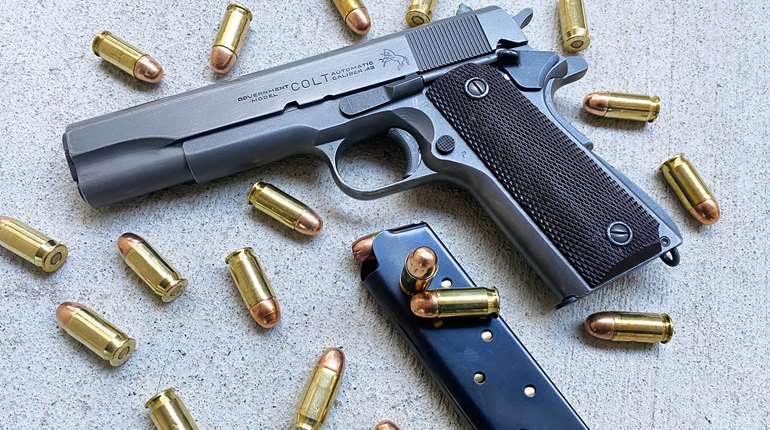
It has been said that for people to accept anything new, it has to be at least 50 percent old. If that is true, the gun-buying public should readily embrace one of Colt’s newest offerings, the 21st Century Commander, designed by noted handgun expert, gunwriter and American Rifleman Field Editor Wiley Clapp, and marketed by TALO Distributors, Inc. Although the pistol is not a radical departure from the proven, 100-year-old O-frame design, it does incorporate a number of features that define a state-of-the-art carry M1911.
The Commander Legacy
First, a little history. Colt’s Commander model originated in the years after World War II in response to the U.S. military’s interest in a smaller, lighter alternative to the M1911A1 intended to be carried by officers. The specifications for this new pistol, issued in 1949, included a maximum length of 7 inches and a maximum weight of 25 ounces. Along with Colt’s prototype, samples were submitted from Inglis, FN and Smith & Wesson. Although none of the submissions was selected, Colt wisely chose to go into commercial production with its design. Introduced in 1950, the 4.25-inch-barreled Commander, as it was then known, was notable in two ways: It was the firm’s first full-size pistol with an aluminum-alloy frame, and it was also Colt’s first M1911 chambered in 9 mm Luger. Both .38 Super and .45 ACP versions were also produced. In 1970 the steel-frame Combat Commander was released, and the designation of the aluminum-frame gun was changed to Lightweight Commander. Among the fans of the Lightweight Commander was modern pistolcraft guru, Gunsite founder and NRA Board Member the late Jeff Cooper.
Even with the proliferation of accurate, reliable carry pistols, most with aluminum or polymer frames, the M1911 is still considered by many to be the ultimate fighting handgun. Arguably no other pistol provides a better combination of ergonomics, ruggedness and superb trigger quality, and it can be had in a plethora of calibers and factory variations, with barrels from 3 to 6 inches. Moreover, the M1911 is unparalleled in its potential for customization and accurization. True, older or unmodified Government Models sometimes have trouble digesting modern hollow-points; however, in my years as a gunsmith with legendary pistolsmith Austin Behlert and his son-in-law, Art Leckie, I learned that with simple reliability work, the M1911 can be made as dependable as any other semi-automatic handgun.
A New Classic Emerges
The 21st Century Commander was created as the result of a conversation a couple of years ago between Clapp and Bob Coyle, his friend and executive director of TALO Distributors. TALO, which was formed in 1965 by hunting and fishing wholesalers in Texas, Arkansas, Louisiana and Oklahoma (hence the TALO name), is a wholesale buying cooperative of major firearms distributors. TALO’s collective buying power has enabled it to originate special-edition and custom-designed firearms, and to make them available to the shooting public.
As is often the case with pistol buffs, Clapp and Coyle’s conversation turned to the ideal carry M1911. Clapp’s long and diverse firearm experience gave him some pretty firm opinions on what works and what doesn’t, and his concept gun so impressed Coyle and other TALO members that the group asked Colt to produce a Lightweight Commander model made to his specifications. Colt agreed, and the 21st Century Commander was born, with production guns hitting dealer shelves around mid-2011.
The governing principle behind the design of the 21st Century Commander was, “Everything you need, nothing you don’t.” The gun that resulted from this philosophy was neither austere nor lavish, but was supplied with all the features needed for everyday carry.
As with Colt’s standard Lightweight Commander, the new TALO pistol features a forged, carbon steel round-top slide and a forged, aluminum alloy frame, which, for all practical purposes, is just as serviceable as a steel frame. I have seen numerous aluminum-frame Commanders with 20,000 or more rounds through them that showed no more frame wear than minor peening where the recoil spring guide head seats (which is also observed on steel frames). However, owners of aluminum-frame guns should be aware that some magazine followers (such as the steel followers in Devel magazines) can gouge the feed ramp.
The slide has a polished, black-oxide finish on the flats and a matte-black finish on the top and rear. It features angled front and rear cocking serrations and a fluted and cleared ejection port that is moderately lowered to a height of 0.470 inches. The frame and frame components all have a matte-black finish, although the steel parts—slide stop, thumb safety, magazine release and grip safety—have more of a satin-black appearance. The slide stop, magazine and thumb safety follow the original M1911A1 pattern, while the grip safety is a Colt beavertail design with a raised palm pad for positive activation.
Missing from this gun—and for many shooters, thankfully so—is the Series 80-style passive firing pin safety mechanism incorporated into Colt O-frames since 1983. The 21st Century Commander’s Series 70 mechanism is mechanically simpler and is considered by some authorities to offer a slightly crisper trigger pull.
The flat Smith & Alexander mainspring housing is steel and is checkered in a 20-l.p.i. pattern. A moderate bevel is machined into the mouth of the magazine well to facilitate magazine insertion. The frontstrap is machine-checkered at 25 l.p.i., and the radius where it meets the trigger guard appears to be somewhat reduced, allowing a higher hand position. The machine checkering is particularly well-executed, being sharp but not painful and terminating symmetrically on both sides of the frontstrap, parallel with the front edge of each of the stock panels.
Of special interest are the gun’s Dymondwood Tactical Oval stocks, designed by Clapp and produced by Altamont of Thomasboro, Ill. Both stock panels have “fingerprint checkering,” a pattern in which checkered areas are located only where finger contact is made. More subtly, the panels have an asymmetrical rounded cross-section that is fatter in the rear and tapers inward to the frontstrap in the front.
Also noteworthy are the sights. The 0.125inch-wide Novak front post is mounted via a transverse dovetail, and its slightly ramped face sports a 0.077-inch-diameter brass bead. In the rear is a plain Novak Lo-Mount fixed sight, unremarkable except for the 0.170-inch-wide notch specified by Clapp. Not only does this wider notch afford more rapid sight acquisition and alignment for fast defensive or combat shooting, but it also promotes sight visibility and sight alignment in low-light situations.
Internally, the 21st Century Commander is classic Colt. The stainless 4.25-inch barrel is rifled in the standard 1:16-inch left-hand twist, with thorough throating around the entrance to the chamber and a shallow trough at the bottom of the throat to promote feeding. Also located in the slide are a conventional Commander-length bushing; a short recoil spring guide, plug and single coil recoil spring; a conventional firing pin, firing pin spring and firing pin stop; and an extractor with a beveled and relieved claw. Inside the frame is the conventional M1911 ignition system, consisting of Colt hammer, sear, disconnector, sear spring and mainspring, as well as a long, solid aluminum trigger with a black finish. Pinned to the top of the frame is a long ejector. Each 21st Century Commander is serialized with a unique number that contains the letters “WC” for Wiley Clapp.
In The Hand
My first impressions of the 21st Century Commander were wholly positive. The trigger broke cleanly at a flat 4 pounds, the sights provided a good flash sight picture, and the combination of 25-l.p.i. frontstrap checkering and the Tactical Oval stocks gave a surprisingly comfortable and controllable grip on the gun. Overall, the Commander seemed a bit better fitted than most factory pistols, with just a bit of slide-to-frame play and about 0.006-inch gap between the sides of the barrel hood and its recess in the slide. For a carry pistol, a little bit of slop is not bad, as it may keep things running under dirty or grimy conditions that would jam a more tightly fitted gun.
At the range, I ran several kinds of .45 ACP defensive ammunition through the Commander: Hornady’s 200-grain TAP FPD +P load; Remington’s 185-grain Golden Saber load; Speer’s 230-grain Gold Dot load; and a Winchester Personal Protection load featuring a 230-grain hollow-point bullet. I also tried some Federal Gold Medal Match ammunition with a 185-grain FMJ semi-wadcutter bullet, primarily to see if the pistol would feed and cycle the short, light recoiling round. Accuracy testing was performed at 25 yards off sandbags, with additional defensive-style shooting at 3, 7 and 15 yards.
Compared to a full-size Government Model, or even a steel-frame Commander, recoil was more pronounced, particularly with the more energetic Hornady and Speer loads. Controllability, however, was good, thanks to the frontstrap checkering and the Tactical Oval stocks. Reliability—the prime requisite of any gun that may be used for defensive purposes—was flawless, with not even the hint of a stoppage of any kind during more than 120 rounds of testing. As expected, all controls worked as designed, and the supplied Colt magazine dropped freely. Wilson, McCormick and even no-name and G.I. surplus magazines functioned without a hitch.
The Commander shot very close to point of aim, except with the Hornady TAP ammunition, which grouped slightly high and to the right. Accuracy was excellent for a lightweight, short-barreled factory M1911, with the best-performing loads, from Federal, Remington and Winchester, all grouping into less than 3 inches at 25 yards. Even the worst-performing load still averaged a respectable 4.28 inches, which is more than adequate for home defense or concealed carry. Keep in mind that a gun that does no better than a paltry 6 inches at 25 yards still keeps all its shots touching a silver dollar at the more realistic defensive distance of 7 yards. Aiding accuracy was the brass front bead, which was surprisingly visible under a variety of light conditions.
Drawn from Blade-Tech and Milt Sparks holsters, the Commander presented and tracked to the target smoothly. I found that the Tactical Oval stocks helped me establish a consistent initial grip and contributed to that kinesthetic sense or “feel” that allows one, with practice, to draw and bring the gun up with the sights already in near-perfect alignment.
Final Comments
There is little doubt that Wiley Clapp’s 21st Century Commander fulfills the objective of “Everything you need, nothing you don’t.” Although I might prefer a tactical thumb safety or an arched mainspring housing, and would have liked the sharp edges on the gun dehorned, overall I would not hesitate to carry the gun as-is into the most hostile or dangerous environment. This is as strong an endorsement as I can give any gun, and it is a testament to the soundness of Wiley Clapp’s vision. By combining the virtues of the 62-year-old Commander design with a select group of modern enhancements, Wiley Clapp, Colt and TALO have produced a handgun that is both old and new, innovative and traditional, and which truly deserves the name of “21st Century Classic.”
Manufacturer: Colt’s Mfg. Co.; (800) 962-2658; www.coltsmfg.com
Distributor: TALO Distributors, Inc., www.taloinc.com
Caliber: .45 ACP
Action Type: recoil-operated, single-action semi-automatic pistol
Frame: forged aluminum alloy
Barrel: stainless steel, 4.25"
Rifling: six-groove, 1:16" LH twist
Magazine: detachable steel box, seven-round capacity
Sights: Novak ramped front post with 0.077" brass bead; Novak Lo-Mount rear fixed, drift-adjustable for windage, with 0.170" notch
Trigger Pull: 4 lbs.
Stocks: Dymondwood, Tactical Oval design with fingerprint checkering
Overall Length: 77⁄8"
Width: 15⁄16"
Height: 57⁄16"
Weight: 29.4 ozs.
Accessories: hard plastic case, gun lock, empty chamber indicator, owner’s manual
Suggested Retail Price: $1,379
Most Popular