In late 1973, I found myself at the FBI Academy in Quantico, Va., starting New Agents Training. I had 11 years of law enforcement behind me as a state investigator and was an NRA Firearms Instructor and an FBI National Academy graduate. But one morning in late November, I was just one of 30-plus students meeting their issue sidearms for the first time. We were each issued a Smith & Wesson Model 10 with a 4" barrel, PC stocks (the base of the wooden stock was rounded for concealment) with a grip adapter. As an S&W-trained armorer, I noted that mine appeared new and had an excellent, but conservative, action job. There was more than 40 years of FBI firearm history before I was issued that model and there would be a lot of makes, models and calibers afterward.
When Walter R. Walsh joined the FBI in 1934, he was in the first class of new agents to be officially armed. Prior to that class, agents often obtained commissions from local sheriffs and chiefs of police in order to carry a handgun. One wonders just how legal these commissions were, and what happened in cases when the gun had to be used.
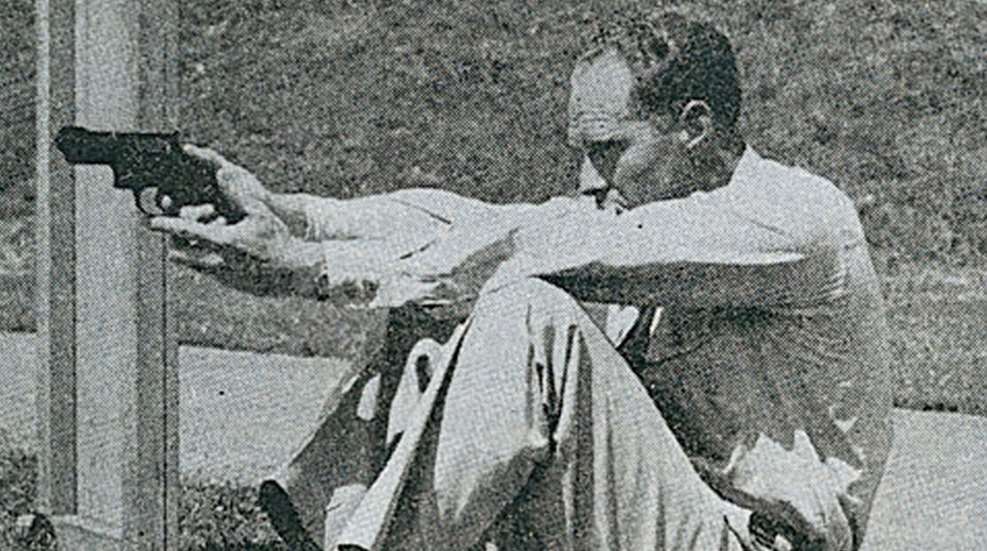
Walsh was issued a 4"-barreled Colt Official Police revolver in .38 Spl. upon his graduation but immediately began carrying a personal Colt M1911A1 in .45 ACP. It was the handgun he carried when he arrested Doc Barker in Chicago in 1935, and it was one of two handguns he had in Bangor, Maine, in the shootout with the Brady Gang on Columbus Day 1937. He was certainly more familiar with the .45 than the revolver as he was an award-winning marksman in competition, using an M1911 in both civilian and military matches.
Gallery


The Bureau’s regulations on carrying a personal handgun were lenient then, certainly more so than at present. Walsh recalls that no paperwork was required for him to carry the .45 and that when he purchased a pair of registered .357 Magnums in 1937, he could carry either, or both.
While 1934 was the first year of official handgun issue for the FBI, the older Bureau of Investigation issued a number of guns, including the .35-cal. Smith & Wesson semi-automatic (Model of 1913), the .45 Colt Government Model, and the S&W .38 Spl. Military & Police. Roy McHenry, who was in the Bureau from 1917 to 1920, wrote of using a .35 Smith while shooting at bootleggers trying to steal whiskey from a federal warehouse. He said this was well before the agents were specifically given arrest powers. There were no formal qualifications, but agents would pay for their own ammunition and shoot paper targets and even at empty beer kegs rolled down an incline as moving targets.
After initial authorization in 1934, a number of models were acquired and issued to agents. These included the Colt Government Model in .38 Super, registered N-frame .357 Mag. revolvers and S&W .38 Spls. FBI Director J. Edgar Hoover was known to have owned or been issued several different revolvers. One, a Colt Pocket Positive in .32 caliber with a bobbed hammer, is in the FBI Academy Gun Vault. He was also given a Smith & Wesson .357 Mag., Registration No. 1-but its present whereabouts are unknown (at least to the FBI). Both the .38 Supers and the .357 Magnums were acquired to better penetrate car bodies as well as the steel-plate vests often used by the gangsters of the period.
As an interesting aside, the FBI later acquired some rather rare revolvers to aid in training. The Model 45 was an S&W K-frame, 4-inch-barreled revolver, but chambered in .22 Long Rifle. The thought at the time was that the lighter recoiling gun might be a help those agents having problems with the recoil of the .38 Spl. The project was soon scrapped.
Concealability (or convenience) must also have been a factor as a number of small-frame revolvers were purchased and issued through the years. They included the Colt Pocket Positive, S&W’s Model 49 “Bodyguard,” Colt’s Detective Special (with hammer shroud) and later the Smith Model 60 “Chief’s Special.” Agents who had Bureau-approved, small-frame revolvers were known to carry the smaller guns on the street but qualify with their issue 4-inch models. Because of this practice, new FBI regulations required qualification with all models agents were authorized to carry.
Only one popular revolver was adopted that was old. The FBI acquired a number of unique Smith & Wessons from the U.S. Navy, Office of Naval Investigations. These were specially made Model 19 “Combat Magnums” with 4-inch barrels and round butts. These revolvers were earmarked for the FBI’s field SWAT teams, although many were diverted to use by other field agents. Of all the handguns the FBI had, this model, known in the Bureau as the “O.N.I.,”’ had to be the one most agents hated to give up. In fact, there was quite a number of personally owned and Bureau-approved regular square-butt Model 19s converted to round butt by the talented gunsmiths at Quantico.
By the mid-1970s, the Bureau tried to reach a happy medium between caliber and size. For an investigative agency, the larger K- and N-frame revolvers with 4-inch barrels were a belt full, but it was difficult to qualify with the little J-frame revolvers with their 2-inch barrels. The first attempt at compromise was the S&W Model 10-6, a .38 Spl. with a 2½-inch barrel and a round butt. This proved to be an unpopular choice as the ejector rod was too short to eject the fired cases efficiently, and the short sight radius made low-light sight alignment difficult. Many agents had the rear notch on their 10-6s opened up to allow a better sight picture.
The next attempt was an unqualified success. The Model 13 was a round-butt K-frame with a 3-inch barrel in .357 Mag. It proved to be an ideal sidearm for an investigative agency. Most agents still carried the .38 Spl. service load (158-grain lead hollow point +P), but they could carry the Bureau’s magnum load, the Winchester 145-grain Silvertip. The Model 13 was the last revolver issued by the FBI. After more than 50 years, the primary sidearm of the agents would become the semi-automatic pistol.
The first semi-automatic pistols, issued in the early ’80s, were earmarked for field SWAT teams and the newly formed Hostage Rescue Team. The first pistol for field SWAT was the S&W Model 459, equipped with a fixed, white-outline rear sight and red-insert front. It proved to be an excellent and reliable handgun. It was used in many shootouts around the country and did its work well. Critics knocked the 9 mm after the infamous “Miami Shootout” of April 11, 1986, but the adoption of deeper-penetrating ammunition (Winchester’s 147-grain subsonic) made the gun more effective, at least as a temporary fix.
Recognizing the need for more firepower, the FBI adopted the SIG P226 in 9 mm Luger around 1988, mostly for the field SWAT teams, to replace the aging 459s. The SIG P228, also in 9 mm Luger, was then selected for general agent use. It was an extremely popular choice, both for the agents and the FBI gunsmiths who maintained them. Compact, lightweight and reliable, they served the FBI well for many years. In 1988, I acquired one of the first 228s to be “Bureau approved” for carry and carried it during my last five years in the FBI. I still use it for annual qualifications under HR 218, The Police Officer’s Protection Act.
The Bureau wisely allowed those agents close to retirement to continue to carry their familiar wheelguns rather than transition from revolvers to pistols.
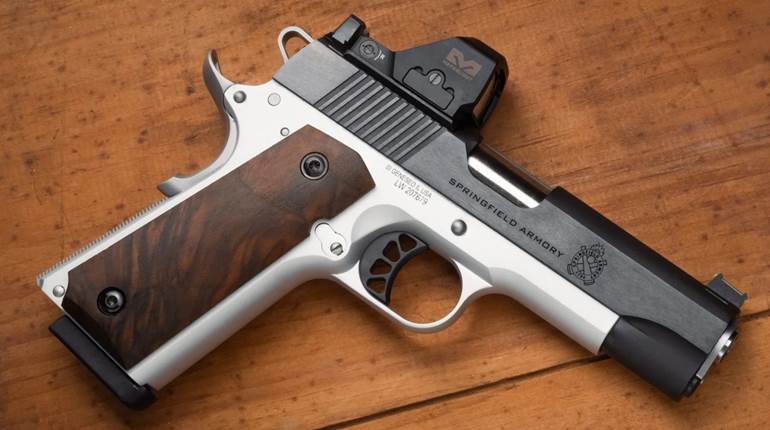
Also in the ’80s, HRT adopted the Browning Hi-Power. The first Hi-Powers were customized by Wayne Novak and later ones by the FBI gunsmiths at Quantico. They were popular with the “super SWAT” guys, and several hesitated to give them up when they were replaced by .45 ACP single-action pistols, the first ones built by Les Baer, which used high-capacity Para Ordnance frames. Later, Springfield Armory’s “Bureau Model” replaced the Baer guns. Field SWAT teams were also issued .45s, and most still use them.
After the 1986 Miami shootout, there was a strong effort to find a more efficient caliber for FBI use. One faction wanted to remain with the 9 mm Luger but with better ammunition. Another pushed for the .45 ACP. Recognizing the advantages and disadvantages of each, and after extensive testing using the Bureau’s then-new “forty round ballistic criteria,” a compromise was reached with the .40 caliber. However, the only .40-cal. then available was the 10 mm. This was a very hot load, unsuitable for the average brick agent. And the other disadvantage was the requirement of a large-frame pistol, then made by only two major manufacturers, S&W and Colt. (The Bren Ten was out of production.) A downloaded 10 mm was tentatively adopted by the FBI using a 180-grain jacketed hollow-point bullet (Sierra) pushed (or lowered) to 950 fps. It proved to be an excellent ballistic combination, although the long case was a problem. The model adopted was the S&W Model 1076.
Not known to the Bureau at that time was that S&W and Winchester Ammunition were already involved in a secret, joint project for a ballistically identical cartridge in a shorter case, similar to the wildcat “Centimeter.” This was, of course, the .40 S&W, perhaps one of the most successful calibers in modern law enforcement history. Meanwhile, the Bureau started receiving its S&W Model 1076s. The results were poor. Originally, many agents thought the guns too large and heavy for plain clothes work. Later, serious problems arose with reliability. Eventually the guns were withdrawn from use and replaced with SIG 226s in 9 mm Luger as an interim fix. Later, SIG 228s were also issued.
In May 1997, the FBI officially adopted the Glock .40 S&W pistol for general agent use and first issued it to New Agent Class 98-1 in October of 1997. Initially, Models 22 and 23 were issued. At present, the Model 23 “FG&R” (finger groove and rail) is the issue sidearm, allowing the agents to attach tactical lights to their pistols. The only personally owned handguns now on the approved list are the Glock 21 (full-size .45 ACP), the Glock 26 (sub-compact 9 mm) and the 27 (sub-compact .40 S&W). This cuts down somewhat on parts inventory at the Quantico gun vault and provides the agents with some variety in a system with which they are already familiar.
With the recent developments in handgun technology, it will be interesting to see what Special Agents of the FBI will be carrying in, say, 10 years. I can hardly wait.
Most Popular