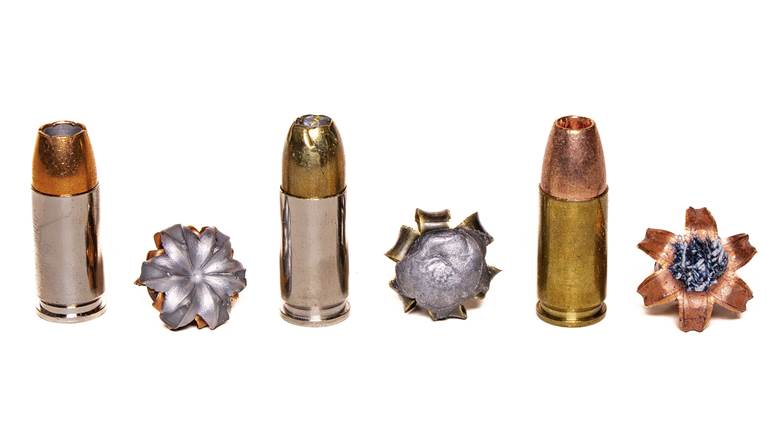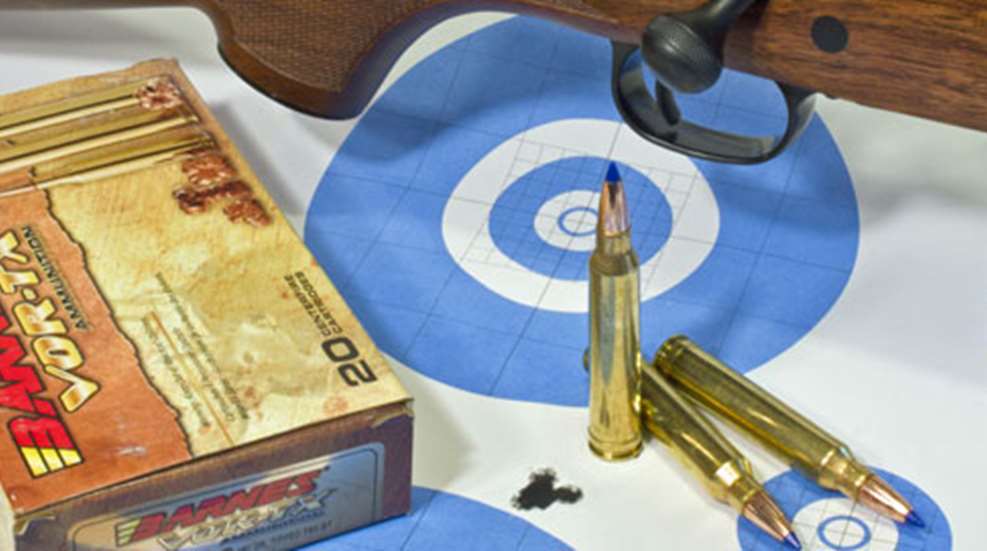
Lead-free bullets are all the rage. This was mostly the result of Barnes modifying its X-Bullets with relief grooves and re-naming them Triple Shocks. Prior to that, the solid copper bullet was literally a hit or miss in the accuracy department. This simple modification made X-Bullets some of the most accurate hunting bullets you could buy. When hunters learned how accurate Triple Shocks were, and how deep they could penetrate, ideas about lead-free bullets began to change.
There's no doubt that some of the unfounded claims about how bullets made with lead can lead to health problems drove some hunters to lead-free (monolithic) bullets, too. But the real reason lead-free bullets have become so popular is because of their performance. To capitalize on the Barnes Triple Shock's success, Hornady, Nosler and Remington have introduced their own lines of lead-free hunting bullets. Actually, the bullets Remington loads in its factory ammunition and calls the Copper Solid is the lead-free Hornady GMX bullet with a different color tip.
If you shoot common hunting calibers like .30-06, .270, .308 or the .300 Win. Mag. you can likely find lead-free bullet options in factory ammunition. If you drive a less popular cartridge, like a .300 Savage or a .257 Roberts, you'll need to load your own. Of course some like to handload anyway. If you're looking to handload bullets built from solid copper or gilding metal, there are some things you need to know.
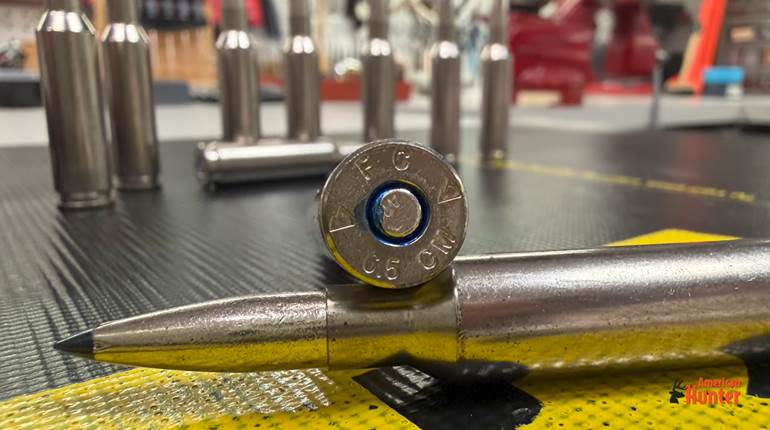
Lead-free bullets are extruded from a solid billet of copper or gilding metal which is 95 percent copper and 5 percent zinc. Copper is not as heavy as lead. This means that when a 150-grain, .30-caliber bullet is made without a lead core it will be larger—longer—than a traditional lead-core bullet of the same weight. This additional length translates to a longer bearing surface and the lack of the lead core means the bullet is harder. Both affect internal ballistics.
All things being equal, pressures can be higher with gilding metal, lead-free bullets. For example, Nosler suggests that when loading its lead-free E-Tip bullet not to exceed mid-range loads. The company also tells you that E-Tips will perform best when seated between .050 and .090 of an inch off the rifling. If you look over the Hornady load manual, you'll see instances, like with the .243 Win., where they instruct you to use 85- to 87-grain bullet load data with the 80-grain GMX bullet.
This is not entirely true with the softer, all-copper bullets from Barnes. The Barnes reloading data generally matches the data for conventional lead-core bullets and in some cases a touch more powder is required to achieve conventional bullet velocities with Barnes Triple Shocks, Tipped Triple Shocks or MRX bullets.
Of course, all this is contingent on your rifle. You should always begin with starting loads and work up, looking for pressure signs as charge weight is increased. Remember, bullet manufacturers develop load data in pressure barrels that will be slightly different than your barrel. The data you see in load manuals is only a guide—not an absolute.
The other aspect of longer bullets that needs to be considered is how they will relate to the twist rate of the rifling in your rifle's barrel. Longer bullets need to be spun faster for proper stabilization. Depending on your rifle, the cartridge and the bullet you choose, this may or may not be an issue.
It was for me when I tried the 90-grain Nosler E-Tip in my .243 Win. The rifle had a 1:10-inch twist, but specified twist rates are never exact. Your actual twist rate might be off by a few tenths of an inch in either direction. The best accuracy I could get out of my rifle with 90-grain E-Tips was five-shot groups that measured about 2 inches across. No, it was not the rifle's fault; that rifle shoots many loads into itty bitty, sub-inch groups.
The problem was the twist rate. According to the Sierra Infinity Ballistics Program twist rate calculator, I needed a twist rate of that was at least 1:7 inches to stabilize the 1.178-inch long Nosler E-Tip at 3,200 fps. If I had been shooting a .240 Weatherby Magnum I could have driven the bullet to 3,450 fps and would have only needed a twist rate of 1:8.
What you may find is that the twist rate in your rifle is too slow to shoot a lead-free bullet of the same weight as the lead core bullets you used to shoot. As another example, consider that some .308 Win. rifles have a 1:12 twist. Swift's 165-grain, lead-core A-Frame bullet needs a twist rate of at least 1:17, and should shoot fine from a 1:12 twist. On the other hand, an ideal twist rate for Nosler's 168-grain E-Tip would be 1:11 inches. It might not shoot accurately out of your .308 with a 1:12 twist.
These long bullets also infringe on powder space. After all, your overall cartridge length is limited by your chamber and magazine box. When you seat these long bullets to the correct depth, you may not be able to load the same amount of powder you have been using to reach the desired velocity. You can work around this by switching to a powder that takes up less space, or in some cases, faster-burning powders. Regardless, it's something that needs to be considered.
The good news is that with the all-copper or all-gilding metal (monolithic) bullets you can step down in bullet weight and still see penetration that is equal to or even exceeds that of conventional lead-core bullets. This is because monolithic bullets do not shed weight like lead core bullets do. Most often, their recovered weight is identical to their unfired weight. This weight retention lets these bullets drive deep.
For example, when preparing my .243 Win. for a pronghorn hunt, I opted for an 80-grain Barnes Tipped Triple Shock bullet as opposed to the heavier 95-grain Ballistic Tip I most often trust. The bullet worked perfectly, dropping a nice buck at a bit over 220 yards.
Similarly, with the .308 Win. I can drop down from a 150-grain Sierra Pro Hunter to a 130-grain Tipped Triple Shock, or when loading for the .30 Remington AR I can opt for a 110-grain Tipped Triple Shock as opposed to a 150-grain lead core bullet. In either case, penetration will be at least as good, if not better. By going to a lighter (shorter) bullet you can circumvent twist rate problems.
That being said, the wound cavities created by monolithic bullets are generally not as wide as those created by lead-core bullets. This is because copper or gilding metal bullets do not shed material (lead core and jacket material) that can increase wound cavity size. Does this matter? Practically speaking; no. However, whether it matters to you or not will mostly depend on the type of bullet performance you desire.
Whether you are a handloader or not, there are a lot of lead-free bullet options in factory ammunition. Federal offers most popular hunting cartridges—even the .223 Rem.—with one Barnes bullet or another. Nosler and Winchester manufacture factory ammunition loaded with Nosler E-Tip bullets in many popular cartridges. And, Hornady and Remington offer a variety of loads stuffed with the Hornady GMX bullet. An assortment of smaller ammo companies like DoubleTap and Black Hills load lead-free bullets as well.
Are lead-free bullets best for you? In truth, if you shoot straight, all of the modern big-game bullets work just fine. Finding a handload combination that your rifle likes and one that increases your confidence should be your goal.