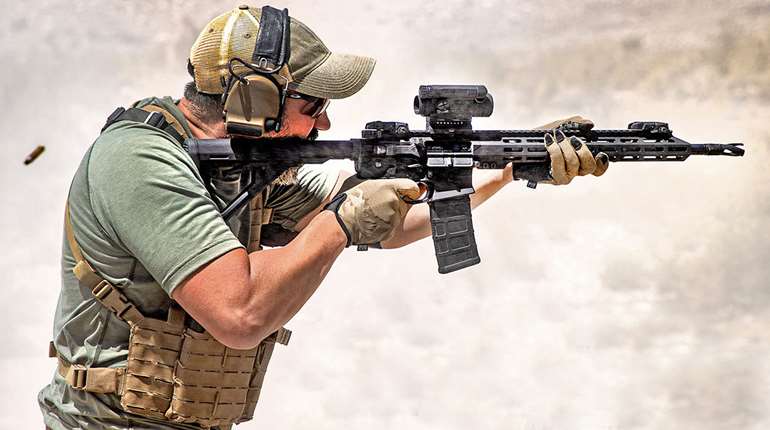
Three-gun competition can trace its roots back to the “Soldier of Fortune” matches in Las Vegas, Nev., starting almost 30 years ago. From those wild beginnings, it has expanded to become the fastest-growing shooting sport around today.
At the moment there is no single governing body controlling the rules for all 3-gun competition. I like that; too many rules spoil a shooting game. Most of the big 3-gun matches are “Outlaw” matches, which means they set their own rules. Of course, there has to be some consistency or it would get ridiculous. No shooter wants to spend thousands of dollars on gear only to find out that it’s disqualified for use the next big match. So, the International Multi-Gun rules (IMG) are more or less the guidelines used by most match directors. But that doesn’t mean those rules apply to every match, as there are some variations. The U.S. Practical Shooting Ass’n (USPSA) also has its own set of rules, and they are invoked at some big matches. Then there are the new Int’l Defensive Pistol Ass’n (IDPA) rules, which are different from those of everyone else. These rules can be important to your choice in pistols.
My first 3-gun match was put on by the Coast Guard Academy in Hartford, Conn., and I wasn’t sure what to expect. In such cases, I always err on the side of “bring everything.” My son and I loaded the truck with guns and ammunition until the springs bent backward, but we found out that we still didn’t have the right stuff.
I shot the match with an M1911 with 10-round magazines and 230-grain hardball factory ammunition. I quickly figured out that the gun didn’t hold enough rounds and had too much recoil to be competitive. The M1911 with a different magazine capacity has a home in 3-gun’s Heavy Metal division, but I wanted to shoot in Tactical Optics (TO). So, I started looking for another pistol. I shot the next season with a .40 S&W, but found that was a mistake as well. Bruce Piatt had told me to get a 9 mm Luger pistol and be done with it, but I didn’t listen. As I got to know more of the top shooters, I realized that they were almost all shooting 9 mm handguns in TO class.
I chose the .40 S&W because, at the time, I was also shooting a few USPSA handgun and Multi-Gun matches with power-factor rules, in which the 9 mm was limited to a minor classification and scoring. I thought the .40 S&W made sense as a compromise. The .40 S&W has more magazine capacity and less recoil than a .45 ACP, but unlike the 9 mm it is powerful enough to make major classification for scoring. It seemed like the perfect compromise, but I was wrong. The .40 S&W cost more than it gave because of more recoil and lower magazine capacity than the 9 mm. For every 3-gun match I shot in which the 9 mm was scored as minor, there were several others using the IMG rules in which the 9 mm competed with all other cartridges.
I didn’t want to be held back in those matches in which the 9 mm was considered a minor scoring cartridge, but I also didn’t want to be handicapped by the stiffer recoil and reduced magazine capacity of the .40 S&W in the majority of 3-gun matches that use the IMG rules.
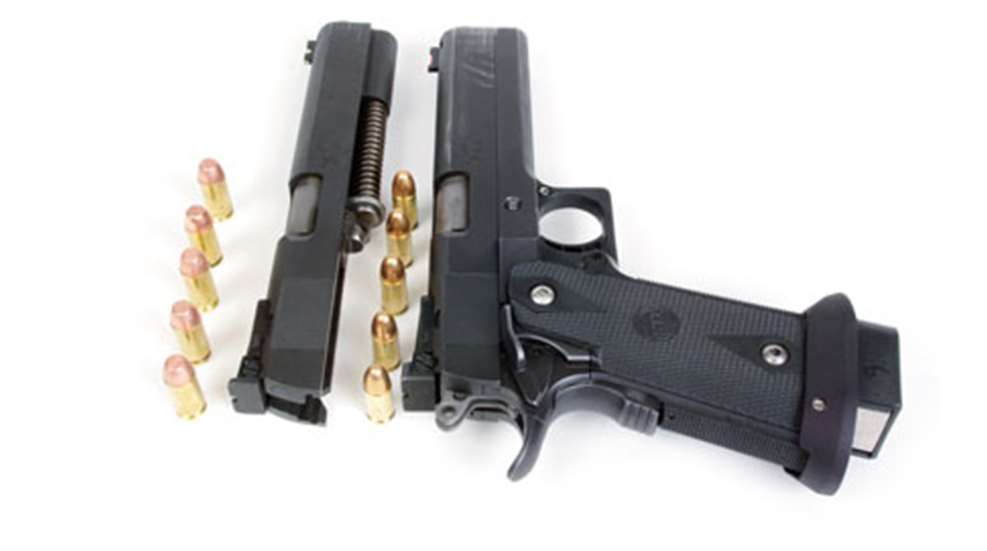
The answer was pretty clear for a gun guy: Just buy two guns. Any excuse for another pistol, right? But, I wanted to do something a little more unusual. I started thinking; I have multiple uppers for my AR-15 rifle. I use the same lower with different uppers chambered for .223 Rem., 6.8 SPC, 6.5 Grendel, .50 Beowulf and other cartridges. So why not create one handgun with two different uppers? One would be in 9 mm Luger for shooting most 3-gun matches, and the other would be in .40 S&W for those USPSA matches in which a major power-factor cartridge is important.
I called my buddy Larry Weeks at Brownells to see if this was possible. I wanted to build the gun myself in my shop. It was going to be based on the STI 2011 handgun, and Brownells sells the slides and frames in a set that are fitted so that most of the precision fitting of the two is already done. The Kart barrels we were going to use can be fitted with hand tools, so the project was well-within my capabilities and tooling—except I wanted the “switch-slide” capability so that I could shoot both 9 mm and .40 S&W with the same gun. That meant that two slides had to be precision fitted to a single frame. In this case the slides would be unfinished and would need a lot of work. I realized that I lacked the experience and equipment for that, because I didn’t have a milling machine or a lathe at the time.
Weeks introduced me to another Brownells employee, Tony Barnes, who builds competition handguns as a sideline, and that’s how my 3-gun pistol was conceived. Barnes had built a gun for Weeks to compete with, and I decided to have him do the same for me.
I traveled to Brownells’ headquarters in Iowa to watch Barnes do the initial work. For a gun guy who loves to tinker and do hobby gunsmithing projects, this was the ultimate journey. Brownells has been my go-to place for anything gunsmith-related. It operates with small-town values where honesty, integrity and quality are still important concepts. The company’s horizontal-format catalog is as much a part of gun culture as the smell of Hoppe’s No. 9.
The first step was to decide on the barrel length. I had been shooting a 5-inch STI in .40 S&W. That’s the same length as the familiar M1911, and I liked the “feel” of the pistol. But, in the interest of full disclosure, I confirmed the choice for that barrel length based on a foolish concept: I already had a custom Hillsman holster to fit it. In my own defense, finding a left-hand competition holster for an uncommon gun can be difficult.
I was fine with that choice until I was shooting the MGM Iron Man match with my buddy Randy Luth. Luth is the former owner of the DPMS rifle company, and he is a hardcore 3-gun shooter. We were talking about this pistol, and I mentioned that as I wallowed through my 50s I was having more and more trouble seeing the front sight on a handgun. “I did too,” said Randy. “Until I switched to a 6-inch pistol. That little bit of added distance from my eye to the sight has made a lot of difference. I also think I am more accurate with the longer sight radius and the extra barrel length and weight helps dampen muzzle flip. I have both 5- and 6-inch competition pistols, but I like the 6-inch better.”
Great, just what I needed, more doubt. If you have ever had to wait for a gunsmith to finish a custom gun, you know that the time is spent mostly second-guessing your choices. It turns out that we were too far into the project to change by then, so it remained a 5-inch gun.
Now, after two seasons of competing with it, I have no regrets. The balance and feel of the pistol work for me, and I shoot it well. I have found other ways to deal with the sight issue. One is to install Dawson fiber-optic sights on the gun. Barnes installed black-on-black target sights, which I have trouble using. So I ordered fiber-optic adjustable sights from Dawson. They have contrasting colors, green in the rear and red in the front. The sights are easily installed, as both the front and rear use a dovetail. The old sights can be pushed out with a sight pusher jig, or lacking that, with a non-marring punch and small hammer. On my pistol the front sight was pinned to the slide, so the pin had to be removed first. One trick here. If you use a brass punch, it will leave “tracks” on the sight. These brass marks can be removed with a cleaning patch and a strong copper-removing bore solvent like Barnes CR-10.
After installing the sights and measuring to ensure they were centered on the frame, I used a small file to carefully open the rear sight notch a bit wider to allow a little more light on each side of the front sight. With this system I can shoot well even with aging eyes. The front sight might not be as tack-sharp as it would have been in my 20s, but I can see it well enough that I own all my misses, free and clear of any excuses.
The pistol has the full-length dust cover and a lightweight, 17-degree-angle composite grip, so that there is plenty of weight in the front to help control recoil-induced muzzle flip for fast shooting. The barrel is fitted into a traditional M1911-style front bushing, unlike the similar “Edge” model which uses a tapered barrel.
Barnes spent a lot of machine time on the slides, adding the non-reflecting serrations on the top as well as the gripping serrations on the sides. One thing I wish I had insisted on was front-gripping serrations on the slide—he did not put them on either slide. While some say they are superfluous, I disagree. They are useful for safely press-checking the pistol to make sure it’s loaded and for emptying the chamber after a stage. Plus, I like the way they look.
I am a left-handed shooter, so of course there is an ambidextrous safety. We also kept the magazine release button to a reasonable height. There is a trend with some competition pistols to make the magazine release so tall it sticks up like a barrier column in a mall parking lot. When you shoot with the left hand, it not only gets in the way and prevents a proper grip, but it can cause you dump the magazine in the middle of a stage. The magazine release on my pistol rises 5/32 inches above the grip frame. That is enough for easy access, but it stays out of the way when shooting.
I believe that any gun is only as good as its trigger, and that that is never truer than with a pistol. Barnes and I actually differed a bit on the trigger pull. I wanted it lighter than he was willing to make it. We compromised, and, in the end, the gun had a 3-pound, 2-ounce trigger pull. It is very smooth, however, and it feels even lighter.
The gun has the Infinity Interlocking Trigger Insert System. This system has several options for inserts that fit on the front of the trigger. You can vary the shape and length of the trigger. I have short fingers and I have a tendency to push on the side of the trigger if the reach is too long, which is a bad idea that leads to misses. I tried several options before settling on the long-curved 2.3-inch trigger. This is the medium length. The shorter trigger option works well for small hands and helps position the finger correctly on the trigger.
The grip has an STI external magazine well to aid in quick reloads. The magazines themselves turned out to be a challenge. Despite the fact that everybody told me to expect problems, the .40 S&W magazines worked fine. But the 9 mm was not so easy. I got the magazine bodies and the conversion kits for use in 9 mm from Brownells, but I could never make them work. I learned that this is an art form that has been mastered by only a very few. In the end I ordered completed magazines direct from STI, which run just fine.
Switching cartridges is simple and fast. Pull the slide back until the relief cut in the slide is lined up with the slide stop lever, and push the slide stop out of the gun. Then pull the slide off the front of the frame. Push the new slide and barrel assembly onto the frame, lining up the guide rails. Push the slide back until the barrel link lines up with the hole in the slide and replace the slide stop. Insert the correct magazine for the cartridge, and it’s ready to go. Because the sights are mounted with the slide, you never lose zero, and the gun remains sighted in and ready for action.
I am unhappy with the blued finish. It’s not holding up well with all the tough use this gun is getting. My plans are to refinish it with Duracoat and to do the slides in different colors. That way I can know at a glance which slide is on the gun.
After two competition seasons I can say without hesitation that this was a good choice. The switch-top concept lets me adapt the pistol to any rules in effect at any 3-gun match, while maintaining essentially the same gun. That means everything else—grip, trigger, sights, etc.—remains constant. Everybody knows that consistency is the key to shooting well.