Three-gun is the most addictive competitive shooting sport I have tried—and is one of the reasons I will likely die broke. This sport is highly equipment-driven, so I decided to develop and build what I think is the best trio of firearms for competing in the Tactical Optics (TO) Division.
In the fast-action world of 3-gun shooting, the shotgun is both the hero and the villain. It can help you win the match, or it can reduce you to tears of frustration. Time and time again, the top shooters tell me that many matches—particularly in TO—are won or lost with the shotgun.
There are many reasons for that. The shotgun is loaded on the clock, and in TO it is the only gun that requires rounds to be individually loaded. Some matches have extensive shotgun stages with as many as 40 targets. In Open Class, shooters can use speed loaders or magazines in the Russian Saiga shotguns, but in TO, they are prohibited. So when the shells must be fed one at a time, the match can switch from a shooting contest to a loading contest. If you can’t reload the shotgun faster than the other guy, you will almost surely lose.
Also, many 3-gun shooters come from handgun-action-shooting backgrounds. The USPSA shooters can typically pick up on the rifle technique easily, as it is similar to that of a handgun. Many of them lack shotgunning backgrounds, and they struggle with the moving targets and the techniques used to hit them.
The greatest factor of why shotguns can determine the outcome of a match, however, is reliability. Shotguns were not really designed to be used and abused the way they are in 3-gun shooting. I have witnessed far more equipment failures during a match with shotguns than with the other two firearms combined. I have seen shotguns stop working in spectacular fashion, from jams to total and catastrophic failure when parts of the gun fall out onto the ground.
When I started shooting 3-gun I used a gas-operated shotgun that had served me well in hunting, sporting clays, 5-stand and any other shotgun sport I tried. But, in the rough-and-tumble world of 3-gun, it quickly succumbed to failure, and not just once. I tried three different guns—including two different models—and I can’t recall getting through a single match without a problem. I have enough other problems to worry about in any 3-gun match, so I started paying attention to the guns that worked. I noticed that many of the top shooters were shooting Benelli guns. When I asked why, the universal answer was, “Because they work!”
A good part of the Benelli’s legendary reliability is due its inertia system that cycles the action. Gas-operated guns get dirty. When you are rapidly shooting hundreds of rounds in a single match, the carbon, fouling and unburned propellant mix with the dirt, dust or mud that is often part of this game, and the guns can grind to a halt. There is less propellant ejecta and other undesirable materials entering the operating system with each shot to build up and stall the shotgun. Of course, there are some excellent gas-operated shotguns being used in 3-gun, but nobody can deny that they all suffer from more carbon buildup than the Benelli. My goal was to build the ultimate three-gun battery with no-compromise firearms. For me, the path was clear, and I ordered a Benelli M2 with a 21-inch vent-rib barrel.
Of the three guns, at least for TO, the shotgun is the easiest for a hobby gunsmith to modify—up to a point. There are some modifications that go beyond the hobby stage. Some shotgun guys modify the return spring and the action by milling the bolt to lighten the weight. The idea is to increase its cyclic rate. Some of the top shotgun shooters can outrun any shotgun’s action, so they want a faster cyclic rate. According to tests done by my buddy Pat Kelly, who is one of the fastest guys with a shotgun, the Benelli is capable of 0.13-second split times between shots. My splits in competition run about 0.2 second to 0.16 second. Because of my phobia about total reliability, I decided to leave the gun’s operating system the way it was designed. I will leave the door open to modification if I ever improve enough to need a faster cyclic rate, but with my limited practice schedule and rapidly aging body, that’s probably not going to happen.
Few of us will ever get fast enough to outrun any shotgun. At the 2011 Superstition Mountain Mystery 3-gun match, I listened to one competitor explain an elaborate and complicated process of milling parts and pieces on the operating system for his Benelli shotgun. “If you do all that it will run without a hitch,” he smugly finished. The other guy looked at him like he had two heads and said, “It runs without a hitch right now, why on Earth would I want to mess with that?” I’m with that guy! I have seen too many modified shotguns fail in the middle of a stage, including several at that match.
Another common modification is to bevel the edges of the receiver in the shotgun’s loading port. The idea is to help funnel the shells into the gun as you are loading. It probably is a good idea, but I just have not brought myself to attack my gun with a milling machine or Dremel tool yet. Some shooters weld shut the gap in the front of the loading gate. They have problems with the Benelli pinching their thumb when loading. It has never happened to me, probably because of my loading style, so again I am going to leave it alone.
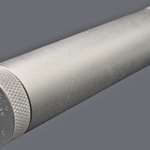
The one absolutely necessary modification is to add an extended magazine. I looked at a lot of magazine tube extensions before ordering the Nordic Components kit. I like the metal tube because I think it’s tougher and less prone to distortion from spring pressure or the barrel clamp. I also like the large metal clamp in the front that ties the barrel and magazine extension together. It’s rugged and large enough to spread the clamping forces over a large surface area, so there is less chance of distortion in the magazine tube or the barrel. A lot of problems with extended magazines come from the follower as it makes the transition past the joint between the magazine and the extension. The NC-anodized metal follower is Teflon-coated and works far better than a plastic follower. The plastic can become damaged and frayed, and it lacks the lubricity of the coated metal follower. Also, a plastic follower can bend or distort if it encounters resistance; metal will not.
The Int’l Multi Gun Ass’n (IMA) rules state that no more than nine shells total can be loaded at the start of a stage, so I originally elected to install an extension that would give me eight shots in the magazine. I have since learned about the benefits of a longer magazine with which you can load more than eight in the magazine after the stage starts, so I changed out to a 10-round magazine. So far it has run flawlessly in practice.
The spring that comes with the NC +5 (eight-shot total magazine capacity) kit is designed for this longer tube and is far too long for the eight shot. It must be trimmed to the correct length. One school of thought is to have just enough spring pressure to feed the last shell in the magazine into the action. But, that allows no margin of error. If there is a buildup of dirt, sand, or mud in the magazine, or if the shell has a burr on the rim or is distorted by an improperly seated wad or poor crimp, or if any one of a million other things are not perfect, there might not be enough pressure to push the shell into the action.
The need to apply a couple of ounces of more pressure on the shell as I am loading is an acceptable trade-off for the gun firing every time. So, by trial and error I cut the magazine spring so that when the gun is fully loaded I can push the ninth shell only about one-third of the way into the magazine. This gives me a margin of extra spring pressure to allow for all those aforementioned problems and to compensate for spring fatigue over time.
When I installed the magazine extension I put a drop of blue Loctite on the screws for the forward clamp. This allows me to remove the clamp for cleaning the gun, but keeps it in place during competition. I did not Loctite the fine threads on the magazine tube or the end cap, because I remove them often for cleaning and the fine threads do not respond well to Loctite buildup. But, I check them often during the match to ensure they are tight.
I replaced the bolt charging handle with a Nordic Components extended model so that I can hit it fast. This is easy: just pull straight out on the old handle until it comes out, then push the new handle straight in, line up the cutout in the bolt with the anti-rotation tab on the handle, and push until it clicks into place. One should note that the extra weight of an oversize charging handle can slow down the cyclic rate and even cause jams in some guns. This aluminum handle is lightweight and is more rugged than the old NC design. I have bent the old-style handle a couple of times in the heat of competition. This has actually caused some cosmetic damage to the receiver. Competition guns do, however, get beat up. I replaced the handle with a new one, and I keep the straightened original as a spare in my shooting box.
An oversize bolt release is another potential source of problems. I have seen the plastic, lever-style releases break, so I decided to go with the metal Nordic Components Speed Button. Both designs that I have tried require drilling and tapping the gun’s existing bolt-release button. It can be done while in the gun. But, if you decide to do that, tape-off the area around the release button with masking tape to keep the chips out of the action. The best way is to remove the magazine-release lever and clamp it in a vise while drilling and tapping the hole for the screw.
Mark the center of the button with a center punch, and then carefully drill a hole with a No. 36 (0.106 inch) drill deep enough for the screw. Don’t forget to add some depth for the tap’s taper. The NC button uses a 6-32 screw, which is a small, fragile tap size. True to form I hit a hard spot in the steel and—with less pressure than I would have imagined—the tap broke. Extracting a broken tap is a nightmare, and in this case it was compounded by its tiny size. Before it was over I wound up making an entirely new release button on my lathe. A replacement from Benelli would have made more sense, but I had a match in the morning. Fortunately, I had ordered a few extra taps from Brownells. My advice is to gently handle that little tap. Go slow, and use a lot of oil. Also, don’t make modifications to your guns the night before a match.
While a lot of shooters who first learned to shoot a shotgun in a tactical class prefer sights on their gun, I do not. Like most shooters with a wingshooting background, I shoot instinctively at all my birdshot targets. I am cross-dominant, and I do not like ghost rings or any other large sights in front of my eye. If anything is blocking my shooting eye, the other eye takes over, and I miss. But 3-gun shooting will have a lot of long-range slug targets that require some precision in aiming. I compromised by installing the low-profile fiber-optic TruGlo Universal Dual-Color adjustable sight system on the rib. The adjustable sighting system allows me to aim my slugs, but is not horribly intrusive when I am “wing” shooting. The mounting system for the front sight was a little suspect, so I added some superglue between the sight and the vent rib for insurance.
I also added a Mesa Tactical metal side-saddle shotshell holder on the receiver. This attaches to the gun with a screw through the receiver that fits into an acorn nut on the other side. It is important to degrease the screw and nut and to use plenty of blue No. 242 Loctite so it stays in place because it can be overtightened. While it seems less of an issue with the Benelli, I have seen guns that stopped functioning when the screw was just a one-half thread too tight and was distorting the receiver. So, snug it up and depend on the Loctite to keep it in place. I also added one of Mark Otto’s two-shell holders on the fore-end, because you can never have too many shells with you.
With a 3-gun shotgun I believe the key to reliability is to keep it simple, keep it clean and keep it running. For me, a hopeless tinkerer and gunsmith hobbyist, it’s painful to maintain this almost hands-off approach. My reward is that in two dozen or so matches and countless practice sessions during which I bring my reloaded shotshells in five-gallon buckets, I have had no ammunition-related stoppage or jam. Nothing makes for a winning 3-gun shotgun like total reliability.
Most Popular