In the late 19th Century, American gunsmith Henry Deringer invented and became famous for some of the most commercially successful pocket guns of all time. His products did so well that his name, eventually misspelled as “derringer,” became synonymous with any pocket-size single- or double-barrel pistol. Perhaps the most famous double-barrel cartridge loading pistol to receive the derringer moniker is the Remington Model 95.
Remington's compact two-shot over-under pistol was available from 1866 to 1935. It's the same little gun that's so often seen jumping out of boots and vest pockets when cowboys and card sharks just can't get along at saloon card tables in the classic Old West movies. Bond Arms of Granbury, Texas, has taken this venerable 19th century pistol and redesigned it for 21st century concealed carry, resulting in one of the most compact and powerful pocket pistols available.
Pistol Features
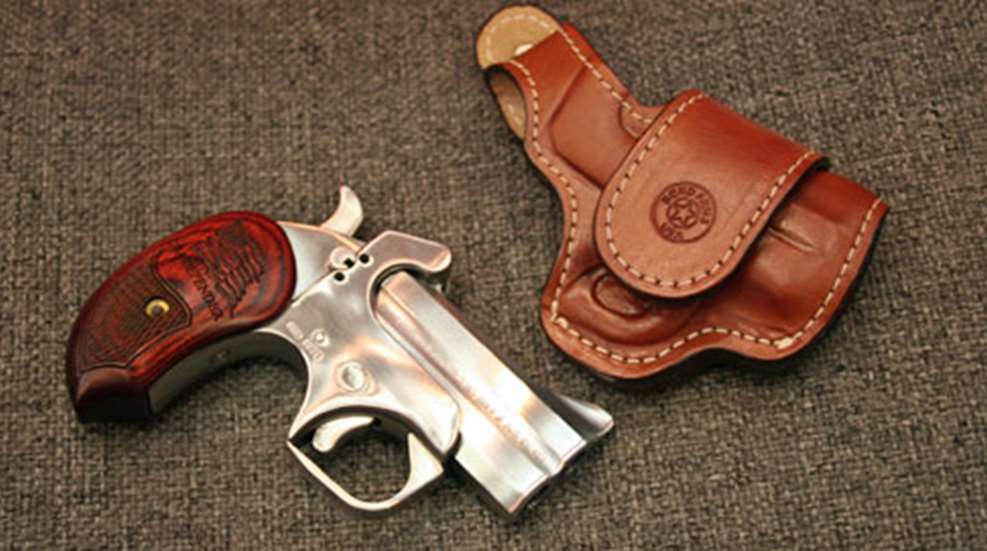
First and foremost, Bond pistols are strong. Unlike some modern derringers, with frames made of an unidentifiable lightweight alloy, Bond frames and barrels are built like Army tanks from nothing but sturdy stainless steel. The sight system consists of a fixed-blade front sight, and a notched rear sight. The trigger is single-action only, meaning that the hammer has to be manually cocked for each shot. The grip is a rounded bird’s head shape providing a two-finger grip when fitted with standard grip panels. The pistol frames are available with or without a removable trigger guard. The swing-up barrels for these pistols are fitted with a shell ejector for rimmed cartridges or a notched chamber opening for rimless semi-auto cartridges.
An important part of the Bond re-design is the incorporation of modern safety features. The original Remington 95 had no safeties, except for a half-cock position for the hammer. The Bond firing mechanism features a rebounding hammer design. Each time the gun is fired, the hammer rebounds and locks in a half-cock position away from the frame. This means the hammer never rests against the firing pins. A push-button, cross-bolt safety, commonly found on rifle and shotgun triggers, can block the hammer from striking the firing pins even if the pistol is fully cocked and the trigger is pressed. The third safety to note is, simply stated, a hook on the trigger that locks the barrel release lever into the closed position as the pistol is fired. This prevents the barrel release lever, if accidentally bumped by the shooter’s thumb as the pistol recoils, from popping the barrels open as the pistol fires. This is a patented safety feature not available on other Remington 95-based handguns.
Bond Arms pistols were modular before modular guns became all the rage. All Bond barrels, pistol frames and grip panels are interchangeable. This allows any frame to switch caliber, barrel length or grip size. The turn of a screw will change the grip panels from the standard two-finger grip to a three-finger extended grip or even a hand-filling jumbo grip. With the use of an Allen wrench, the barrel hinge pin can be quickly removed to install barrels in assorted lengths and calibers. Among the most popular barrels are the .45 Colt/.410 Defender and Snake Slayer models that allow the use of 2 1/2 or 3-inch .410 shot shells. However, a variety of calibers are available—from rimfire rounds like the .22 Long Rifle and .22 Mag., to popular semi-auto loads like the 9 mm and .40 S&W and potent pistol cartridges like the 10 mm, .357 Mag. and .45 Colt.
At the Range
For this shooting session, three new guns from the Bond Arms 2012 catalogue were tested. The first two are the new Mini models. Both pistols use the cowboy-style frame with no trigger guard and the brand new 2 1/2-inch Mini barrels. The Mini features a .45 Colt only barrel and an engraved rosewood grip. The Bond Girl Mini is fitted with a .38 Spl./.357 Mag. barrel and a Bond Girl pink synthetic pearl grip. The third pistol in the test set is the new USA Defender featuring a 3-inch .45 Colt/.410 barrel, a removable trigger guard and an engraved extended rosewood grip. All three guns showed an excellent level of fit and finish, and they all fired a variety of ammunition without any malfunctions.
Two things are important to note before moving on. First, derringers never have been, nor will they ever be, long-range defensive handguns. Like many other sub-sub compact pistols, these derringers are designed to be easily concealed at the sacrifice of some shootability. Bond Arms compensates for the reduced range, and also the two-shot capacity, of its pistols by chambering them for powerful defensive calibers.
Secondly, the over-under derringer design requires some adjustments in sighting technique. The sights are fixed, but the two barrels shoot to different points of aim. For example, if the shot fired from the first barrel hits the center of the target when the sight blade is level with the rear notch, then the second barrel is likely to shoot 2 or 3 inches low using the same sight picture.
As a result, the shooter is left with two sighting options. One is to practice adjusting the sight picture by raising the front sight up a bit for the low barrel shot in order to bring it up to the same strike point as the first barrel. The other choice is to practice for acceptable combat accuracy with a fixed sight picture, making sure both shots are within an acceptable strike zone on the target.
I tried both sighting methods and found either one will produce acceptable combat accuracy at 7 yards. Adjusting the sight picture of the stubby 2.5-inch Mini barrels produced 2- to 3.5-inch groups when 10 rounds were fired at the same spot on the target. Using a fixed sight picture produced 2-inch wide groups with a 5- to 6-inch vertical spread when 10 shots were fired at 7 yards. Again, not target competition accuracy, but dependable for combat-accurate center-of-mass shots.
Along with testing for accuracy, considering the pistols' size and chamberings, it seemed sensible to pay attention to the level of felt recoil produced by various loads. The Bond Girl Mini, chambered to shoot .38 Spl. or .357 Mag., produced a very manageable level of recoil when firing the new HPR .38 Spl. 158-grain jacketed hollow points. Federal's .38 Spl. 125-grain +P Hydra-Shoks were also comfortable to work with. Winchester's .357 Mag. 110-grain jacketed hollow points were fun to shoot. The noise and flash from the snubby barrel caught other shooters’ attention, but the stout recoil was still manageable. Out of curiosity, I tried some heavier loads as well. For example, one of the best all-purpose loads for handguns and rifles is the Hornady 140-grain FTX LeveRevolution. Four rounds of this potent load left my shooting hand begging for mercy, as did other loads at or above the 125-grain mark.
For the .45 Colt-Only Mini, I tried out a variety of the modern self-defense hollow points currently available. The rounds that produced the best balance of effective bullet design and manageable recoil were the DoubleTap 160-grain Barnes Tac-X hollow point, the Hornady 185-grain Critical Defense FTX and the Winchester 225-grain PDX1 jacketed hollow points. All three loads produced 7-yard, five-shot groups with an average size of 3 inches, but the DoubleTap was the most pleasant to shoot because it produced the lowest level of felt recoil.
When it came time to work with the USA Defender, I reached for a variety of 2 1/2-inch .410 shot shells. The longer grip with the trigger guard worked together to help tame the recoil of this pistol. It's interesting to note that the recoil produced by a 2 1/2-inch .410 shell loaded with shot pellets of one kind or another is usually less intense than the recoil of.45 Colt loads from the same barrel. It's still stout, but not as intense.
With a shot shell loaded in the USA Defender's 3-inch barrel, only about 1/2 of an inch of barrel is left past the shell's crimp. As a result, shot pellets spread very quickly when fired from this derringer. Test shells were fired into 12x18-inch targets set at 10 feet. Federal Premium's .410 Handgun shell, loaded with No. 4 Birdshot, covered the entire target, with only 41 percent of the shot striking the target itself. Remington's HD 4-Pellet 000 Buckshot produced 5-inch groups at this distance. When loaded with the Winchester PDX1 .410 shells, the USA Defender produced a best-of-both-worlds result. The three defense disks (essentially pre-flattened buckshot pellets) formed 2-inch groups on the bullseye, with the 12 BB-sized pellets spreading out to cover the rest of the target.
Final Thoughts
Bond Arms claims to produce, "The smallest and most powerful personal protection you can carry!" After shooting these three new guns, it’s hard to argue with that statement. The Minis are some of the most compact pistols available for the calibers they fire. The USA Defender is a handsome addition to the line that allows shooters to show their patriotism while still enjoying the flexibility of shooting bullets, slugs, bird shot, buckshot and mixed payload .410 shotshells all from the same barrel. The Bond Arms double-barrel pistol may not be for everyone, but for those who want a potent defensive cartridge in a pocketable pistol, the Minis and Defender are well worth considering.
Most Popular