Originally published in April, 2003
When I heard that Benelli was building the military’s U.S. M1014 Join Service Combat Shotgun, my first thought was, “Benelli? That would make it a semi-automatic, wouldn’t it?” As would most who have an interest in military firearms, I recognized this as significant. Since World War I, American servicemen have, in matters of large-scale procurement, used one form or another of the slide-action, or pump, shotgun. “The military must have gone with Benelli’s inertia recoil system,” was my second thought. Wrong. It was the first of myriad revelations the gun provided for me. Not only does it represent a new direction for the United States military, but also for Benelli itself.
Although the M1014 has a host of significant qualities, the most significant is the fact it is gas-operated rather than recoil-operated. Benelli built a reputation for reliability on its “Inertia Recoil System,” which uses the energy of the recoil impulse to operate the action. The question is, why did Benelli change from its original system?
Recently, American Rifleman received a pre-production Benelli M4 Super 90, the civilian version of the M1014, for testing and review. I called Craig Johnson, Benelli’s Customer Service Manager, and asked him why the shotgun did not use Benelli’s inertia system. He explained, “The military guys wanted to be able to attach night vision and other equipment to the shotgun.” Perplexed, I asked him why this necessitated a change in operating systems. He said that Benelli’s inertia system requires the gun to be kept within a particular weight range—those attachments add weight that could throw off the balance of the gun and, consequently, the functioning of the inertia system. The answer was to go to a gas-operated action.
Accepting that, it is noteworthy that Benelli recognized, when designed a firearm, a balance must be struck between innovation and proven design. The goal for Benelli was to retain the reliability of its shotguns and incorporate a new operating system—all while not reinventing the wheel.
Benelli’s answer, the ARGO system, became the heart of the new shotgun. ARGO, which stands for “Auto Regulated Gas Operated,” is directly related to the gas system found on the R1 rifle previously covered in these pages (February 2003, p.58). In the ARGO system on the M4 Super 90—designed to function with 2 ¾” or 3” shells—dual stainless self-cleaning pistons, located just ahead of the chamber, are impinged by hot gases through dual gas ports located just forward of the forcing cone. This system is, by nature, cleaner than most gas-operated semi-automatics as the gas tends to be hotter and cleaner at a point so early in the firing cycle.
Obviously, the ARGO system is quite a development for Benelli. But, as noted earlier, it is prudent to balance innovation with proven design. This is where the bolt mechanism comes into play. While the ARGO system is new, the bolt mechanism will look familiar to anyone who has dealt with an inertia-operated Benelli. It employs the familiar two-piece design made up of a bolt carrier and a rotating bolt head with two lugs that lock directly into a barrel extension. Gas from the ports impinge the gas system’s dual pistons, which then move toward the receiver and provide rearward thrust to the bolt carrier.
So, the question is, is this shotgun “worth its salt?” To answer that, it is best to go to the sharp end—those who actually use it. A call to the Marine Corps’ press affairs office put me in touch with both the 4th Marine Expeditionary Brigade (Anti-Terrorism)—4thMEB(AT)—based at Camp Lejeune, N.C., and with the Marines’ Quantico, Va., Special Reaction Team, which is the equivalent of a civilian SWAT team.
“Is the semi-automatic operation of the M1014/M4 Super 90 an advantage in your opinion?” M/Sgt. Luis H. Hernandez, the 4thMEB(AT)’s staff non-commissioned officer in charge of the unit’s training center, responded, “It is a plus, in my opinion. Fast follow-up rounds in close quarters are a definite advantage.” S/Sgt. Kurt D. Vermazan, also of the 4thMEB(AT) and chief instructor for its Shotgun Training Course, added, “The semi-automatic operation has another advantage. It removes the risk of ‘short-stroking’ the action, which can happen under stress.” S/Sgt. Eric Meek of Quantico’s Special Reaction Team had similar feelings. “In my opinion, the M1014 far surpasses [previous] shotguns. the semi-automatic operation eliminates any human error because the cycling of the weapon is done for you.”
When asked what they thought of the shotgun in general and how it has been received in the Marine Corps, S/Sgt. Meek said “Great gun, extremely fast action. I specifically like the way it handles—the recoil is very easy to control, making multiple target engagement easy.” Vermazan noted that younger Marines take quickly to the shotgun. “This is an advantage with the younger Marines who have no experience with a shotgun. They like the way it looks and don’t have pre-conceived notions about how a shotgun should work. It makes it easier to train them.”
Vermazan did point out, though, that the Benelli is naturally more complex than the earlier slide actions. “It does require more practice to become proficient, but more training is never a bad thing, and more trigger time is always a plus.”
Upon inspection of the M4 Super 90, I would have to say that I concur with the Marines’ positive impressions. Overall, it possesses many of the attributes of a conventional Benelli—familiar control locations, ergonomically designed pistol grip, similar bolt design and operation, etc. Where it stands apart is in the modifications stemming from its military-based design.
The M4 Super 90 is an impressive combination of polymer, aluminum, and steel with a matte-black finish to protect against corrosion. The aluminum receiver is anodized and the phosphated, 18 ½” steel barrel has a chrome-plated bore for durability. The sighting system is exemplary. Made by Italy’s LPA Sights, it is what is popularly known was a “ghost ring,” in which the rear sight is designed to fade out of view when the eye focuses on the front sight. The system incorporates white dots and optional tritium inserts. The sights are all-steel, click adjustable for windage and elevation and are heavily bult and reinforced.
Another nice feature of the M4 Super 90 design is its accommodation for “southpaws.” All sling attachment points are ambidextrous, and the over-sized safety at the rear of the trigger guard is reversible.
The most obvious indicators of the M4 Super 90’s military heritage are the stock design, Picatinny accessory mounting rail, ease of disassembly and the modular nature of the design. Modularity was a key design factor of the M1014. Consequently, the M4 Super 90 has the option of switching out the barrel or the type of stock easily and without tools.
Although the M1014 features a fully collapsing stock, the M4 Super 90’s stock is fixed in the extended position for compliance with current law. While the aluminum stock itself is the same as the military version with a generous rubber recoil pad and comfortable cheekpiece, it is the design of the recoil tube that differs. Whereas the M1014 has two machined sections on the tube for either fully open or fully closed positioning of the stock, the M4 Super 90 has only the allowance for fully extended.
The Picatinny accessory-mounting rail, attached to the receiver top with five screws, is another significant design point. In addition to the high-quality sights, the rail allows for attachment of a broad range of optics and accessories.
Another design feature attributable to the military background of the M4 Super 90 is its blissfully simple disassembly procedure. I was able to take it down to its basic components in less than a minute. Additionally, the removable bolt handle doubles as a tool for disassembling the ARGO gas system.
There are three main design features that set the M4 Super 90 apart from the M1014, including the collapsing stock mentioned earlier. The magazine tube capacity of the M4 is limited to four rounds for legal compliance, and, rather than the full-length magazine tube of the M1014, the M4 Super 90 has an aluminum “blocker” threaded onto the shortened tube. That was necessary due to the barrel ring located at the end of the barrel that must slide over the magazine tube. The final difference is the incorporation of choke tubes in the design. While the M1014 has a fixed modified choke, the M4 Super 90 uses Benelli’s interchangeable choke tube system.
Operating the M4 Super 90 admittedly necessitates more training than a slide-action shotgun, but it is not overwhelming. Loading is accomplished by pressing shells up through the bottom of the receiver into the tubular magazine. Once the tube is loaded, the user has two options. He can simply open the action, drop in a shell and release the bolt. The other method requires manipulation of the cartridge drop lever located forward and to the right of the trigger guard. Activating the lever releases a round from the magazine onto the carrier. Cycling the action will load the round into the chamber. When the gun has been fired and the magazine tube is empty, the bolt will lock open. The bolt is released by pressing the carrier control button, or bolt release, located on the forward right side of the receiver. The design allows users to easily change the type of ammunition in the chamber without accessing the ammunition from the magazine tube.
The M4 Super 90 handles quite well. Good ergonomics in the design of the controls as well as the buttstock/pistol grip/handguard combine to make for a quick-handling and easy-shooting shotgun. Rate of fire is very fast, and recoil surprisingly easy to control, making follow-up shots accurate. But a well-made firearm is more than simply the sum of its parts—it must prove itself on the range.
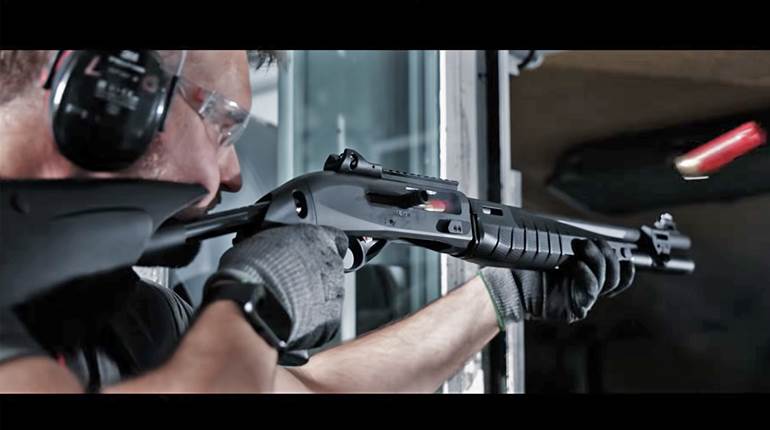
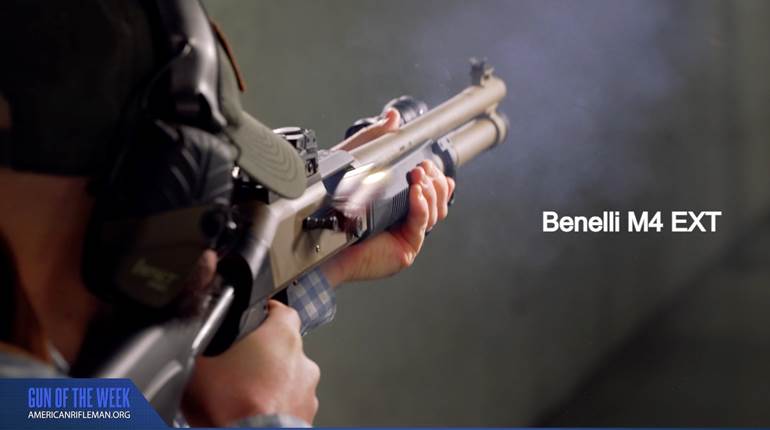
To “wring out” the M4 Super 90, I enlisted the help of Lt. Michael Clayton of the Person County, N.C., Sheriff’s Department. We put the shotgun—fitted with the optional full pistol grip stock—through its paces at the department’s training facility. Clayton, accustomed to using a slide-action shotgun on duty, mentioned that the Benelli is very “smooth shooting and easy to control.” He said, “I especially like the pistol grip as it makes it very easy to hold on target and fire accurately.” This was obvious as he consistently hit point of aim with slugs at 50 yds. within the first few shots. He also noted that the design of the pistol grip and overall excellent ergonomics result in a shotgun that is easy to maneuver with, allowing him a secure hold on the shotgun while moving around barriers and over obstacles. In the course of that session, we fired a combination of 2 ¾” and 3” buckshot and slugs, and the Benelli functioned without complaint.
While the gas-operated semi-automatic shotgun is by no stretch of the imagination a new development, the M4 Super 90 is representative of a new phase for the combat shotgun—in both its operation and its employment by our armed forces.
After closely examining the M4 Super 90 and testing it for performance and functioning, I have to say that I am glad that Benelli is planning to offer this version of the M1014 for sale to the public, although it will not be available until later this year. I was thinking I needed to enlist to get my hands on one again!
Specifications
Manufacturer: Benelli Armi, S.p.A., Via della Stazione, 50, 61029, Urbino, Italy
Importer: Benelli USA (Dept. AR), 17603 Indian Head Highway, Accokeed, MD 20607; (301) 283-6981; www.benelliusa.com
Gauge: 12 ga., 3"
Action Type: gas operated, ARGO semi-automatic shotgun
Receiver: anodized aluminum
Barrel: 18 1/2", phosphated with chrome-plated bore
Chokes: Benelli interchangeable choke tube system
Magazine: four round
Trigger: single-stage, 7lbs. pull
Stock: length of pull, 14 1/4"; drop at heel, 2 3/4"' drop at comb, 1 3/4"
Overall length: 39 3/4"
Weight: 8 1/2lbs.
Accessories: TBD
MSRP: TBD
Most Popular