Ammunition > News

Barnes Bullets TAC-XPD Defensive Handgun Cartridges

Barnes Bullets has released four semi-auto pistol loads specifically designed for personal protection.

Fred Barnes launched Barnes Bullets from a basement workshop in Bayfield, Colo., in 1932. The bullets he produced were constructed by surrounding a solid, pure-lead core with a thick jacket formed from copper tubing. These bullets were prized by hunters who bought them because of their dependable performance.

In 1974, the company was purchased by Randi and Coni Brooks with a plan to continue and expand upon Fred's legacy. The Brooks family worked diligently to grow the company using the lead core bullets they inherited, but Randy had an idea that inspired him to experiment with an all-copper bullet design. His goal was to produce a projectile that would expand rapidly, penetrate deeply and hold together when used for hunting the largest, toughest game. His work resulted in the release of the X Bullet in 1989. More than 20 years later, the company is still going strong with its current lines of all-copper bullets, including such offerings as the polymer-tipped TSX and LRX bullets for rifles, and the TAC-XP bullets for pistols.

Historically, Barnes has focused on providing bullets for both reloaders and ammunition manufacturers. About three years ago, Barnes decided to step into the factory-loaded cartridge market with its VOR-TX line of rifle, handgun and Safari ammunition. Following the success of this line, the company has launched a new-for-2013 line of self-defense handgun cartridges, the Barnes TAC-XPD.

Barnes' TAC-XP bullets for handguns have been hot sellers with top ammunition makers for some time, such as ASYM Precision, Buffalo Bore and DoubleTap to name a few. Designed for use in law enforcement and personal-defense applications, this bullet contains a large, deep hollow-point cavity that expands and penetrates consistently. The all-copper construction allows them to maintain their original weight and to fly true, even after passing through intermediate barriers such as car doors, plywood and automotive windshield glass.

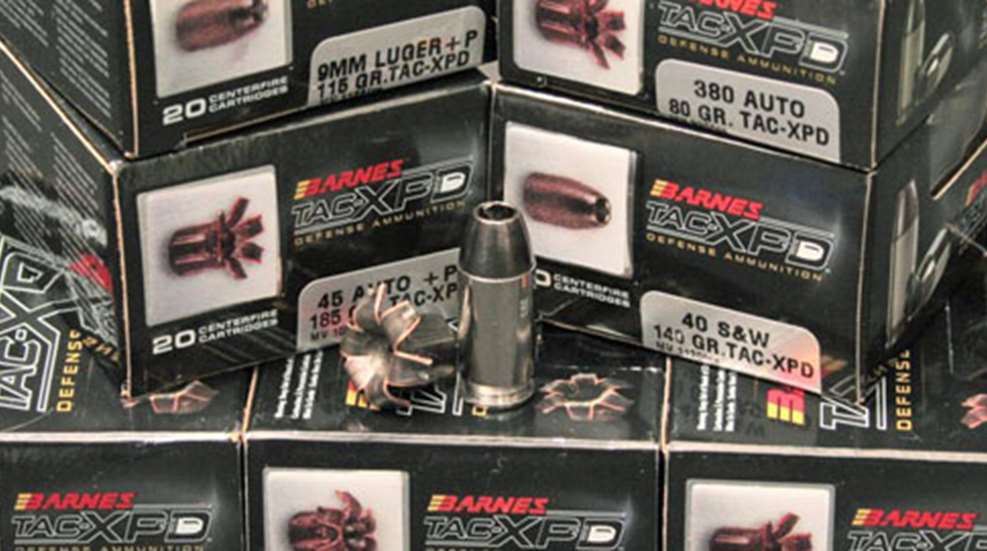
To get the ball rolling on this new line of products, Barnes launched its TAC-XPD ammunition in four loadings—an 80-grain .380 ACP, a 9 mm +P with a 115-grain bullet, a 140-grain .40 S&W load and a .45 ACP +P topped with a 185-grain bullet. The cases are nickel-coated for smooth operation, and the copper bullets are coated with black nickel to give them a distinctive appearance.

I had the opportunity to begin testing this new defensive-handgun ammunition with a visit to the Barnes Bullets factory, located in Mona, Utah. Along with impressive tool making, manufacturing and quality control centers, Barnes maintains a world-class ballistics and bullet testing laboratory. The setup and staff are so well respected that the company often leases them out to gun manufacturers and government agencies for product testing.

It was in this laboratory setting that I had the opportunity to belly up to a shooting bench and test fire the 185-grain .45 ACP +P TAC-XPD load. The round was fired from a benchrest using a Colt 1911 pistol with a 5-inch barrel. The test medium was 10 percent ordinance gelatin positioned 10 yards from the muzzle of the pistol and covered with four layers of denim. Both the distance of the gel blocks and the thickness of the fabric layers exceeded FBI testing requirements. At 10 yards (instead of 10 feet), the bullet penetrated 14 inches into the gel, yielding a maximum expansion of 0.763 inches. This was impressive, to say the least.

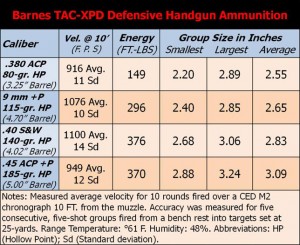
But as useful as laboratory results can be, it seemed logical to conduct additional testing out in the field. So arrangements were made for off-site testing of all four of the new TAC-XPD loadings. In order to mix things up a bit, the test-gun set included two tried-and-true personal pistols (Glock G23 .40 S&W and a Colt Government Model .380 ACP) and two factory-fresh test guns (Kimber Tactical Entry II .45 ACP and a TriStar T-120 9 mm). This test set had the advantage of representing guns that were old and new, imported and domestic, with sizes ranging from pocket pistol to full-size duty arms. Velocity was checked by firing 10-rounds over a CED M2 chronograph at 10-feet, while accuracy for all gun and ammunition combinations was verified by firing five consecutive, five-shot groups into targets at 25 yards.

The now discontinued Colt Government .380 with a 3.25-inch barrel has been a family favorite for years. Having proven to be quite accurate in the past, this pistol and ammunition combination outshot the larger handguns with the smallest five-shot group of the entire test, 2.2 inches. It averaged 2.55-inch groups with the 80-grain TAC-XP. Recoil was modest and manageable, suggesting that the .380 ACP load will be a good choice for the myriad of pocket .380s currently on the market. The fastest round of the test was the .40 S&W load fired from the 4.02-inch barrel of a Glock G23. The 10-shot average was 1,100 fps, which was only 20-feet below the published velocity.

Overall, accuracy from all the guns was excellent. The reliability required for defensive ammunition was certainly evident as there was not a single jam, failure to feed, failure to eject or misfire in the entire group.

Branching out into a new facet of the shooting industry could be a challenge for some companies. Sometimes it takes a while to work out all of the kinks and bugs before a product is at its best. This, however, is not the case for Barnes Bullets and its new TAC-XPD line of self-defense ammunition. The same dedication to quality that has made its bullets world famous is evident in the care that's been taken in developing and producing these new, fully loaded cartridges. This ammunition demonstrated a high level of performance, accuracy and reliability. Choosing handgun ammunition for personal protection requires some serious thought and testing, but the TAC-XPD is an excellent new option for semi-auto pistol owners. I’m looking forward to using this ammunition in the future, and hopefully we can anticipate the continued growth of this ammunition line with the addition of more calibers.
Share |

Comments

ADD YOUR COMMENT

Enter your comments below, they will appear within 24 hours


Your Name


Your Email


Your Comment

12 Responses to Barnes Bullets TAC-XPD Defensive Handgun Cartridges

Brad wrote:
November 25, 2013

Bigfoot, I think you miss my point on my first post. I want to know how THAT particular ammo preforms. Maybe it DOES penetrate to acceptable depths, but we don't know because of an incomplete test! A bullet that passes through its target has wasted energy. Ideally that bullet should just fall out the other side of a body, meaning all of the bullets energy was expended inside of the target, causing the most damage. In your lone reference, you state and I quote, ' IF THE BULLET DOES NOT RELIABLY PENETRATE TO THESE DEPTHS, IT IS NOT AN EFFECTIVE BULLET FOR LAW ENFORCEMENT USE!' Well neither me or my wife are law enforcement. The rules for law enforcement don't always apply to us citizens. You assume that every altercation ends in firing your weapon. It has been proven that just aiming your gun at the offending person ends the conflict. Also, your quoted statement is untrue, 'If you expect your target to be wearing heavy winter clothing and to have skin, ribs, sternum, or arms in front of his heart and lung region, your bullet is going to expend a lot of its penetration potential before it even enters the body.' The last time I checked the skin, ribs, sternum, and arms ARE ALL part of the body silly!! Hitting and arm and breaking it has the potential to end hostilities. Some people will stop fighting at the sight blood and a hole in them. You don't have to kill someone to win a fight. You also win when the other person stops fighting and you have control. Listen, I know the .380ACP cartridge is marginal at best for defensive purposes. My wife is petite and doesn't like the recoil of the bigger cartridges. So this is a trade off for a bigger caliber gun that she flinches with, to a softer shooting cartridge in a Ruger LC380, that she can put on target swiftly and repeatedly. I just prefer a bullet that will expand AND penetrate that minimum 12' against a bullet that can easily pass through a body with NO expansion. Again, Thank you for your input. I do appreciate others advise, and my freedom to agree or disagree with them.

BigFoot wrote:
November 21, 2013

PART 2 Finally, here are their words on over penetration: 'An issue that must be addressed is the fear of over penetration widely expressed on the part of law enforcement. The concern that a bullet would pass through the body of a subject and injure an innocent bystander is clearly exaggerated. Any review of law enforcement shooting will reveal that the great majority of shots fired by officers do not hit any subjects at all. It should be obvious that the relatively few shots that do hit a subject are not somehow more dangerous to bystanders than the shots that miss the subject entirely. Also, a bullet that completely penetrates a subject will give up a great deal of energy doing so. The skin on the exit side of the body is tough and flexible. Experiments have shown that it has the same resistance to bullet passage as approximately four inches of muscle tissue. Choosing a bullet because of relatively shallow penetration will seriously compromise weapon effectiveness, and needlessly endanger the lives of the law enforcement officers using it. No law enforcement officer has lost his life because a bullet over penetrated his adversary, and virtually none have ever been sued for hitting an innocent bystander through an adversary. On the other hand, tragically large numbers of officers have been killed because their bullets did not penetrate deeply enough.'

BigFoot wrote:
November 21, 2013

PART 1 Brad: While that 24 inches of penetration might look like too much, consider the FBI findings on the subject of penetration: 'It is essential to bear in mind that the single most critical factor remains penetration. While penetration up to 18 inches is preferable, a handgun bullet MUST reliably penetrate 12 inches of soft body tissue at a minimum, regardless of whether it expands or not. IF THE BULLET DOES NOT RELIABLY PENETRATE TO THESE DEPTHS, IT IS NOT AN EFFECTIVE BULLET FOR LAW ENFORCEMENT USE.' The test you refer to was penetration in 10[%] ballistic gelatin without any barriers. If you expect your target to be wearing heavy winter clothing and to have skin, ribs, sternum, or arms in front of his heart and lung region, your bullet is going to expend a lot of its penetration potential before it even enters the body.

Brad wrote:
November 21, 2013

Bigfoot, I checked the Buffalo Bore web site out. That article and one done by American Rifleman on handgun stopping power, August 2012, (http://www.americanrifleman.org/article.php?id=13419&cat=20&sub=21&q=2) showed me why I want an expanding bullet. It causes more damage and is less likely to over penetrate than a solid bullet. The bullet that Buffalo Bore (27A) advertises Penetrates over 24' with nearly no expansion (per the data in the American Rifleman article). That could penetrate through 2 human bodies and keep going. I would rather my bullet not penetrate far enough, than penetrate that far and endanger anything beyond my target (another person behind a Sheetrock wall not seen. Now explain that one to an innocent persons family). Thank you for your info though. I can make a better choice on my ammunition when I have more information to digest.

BigFoot wrote:
November 18, 2013

Brad: Want to know how good these bullets are in a .380? Check the Buffalo Bore web site for their article 'When dealing with small and under-powered pistol cartridges such as 32 ACP, 380 ACP or 9X18 Makarov, it is a possibly fatal mistake (to the user) to use expanding bullets for self defense.' Go here: https://www.buffalobore.com/index.php?l=product_list&c=60

Brad wrote:
November 18, 2013

That was a good article but there is something missing. How do these bullets preform going through denim and into Ballistic gelatin (I know this is just a medium and may not indicate performance on the streets). I am looking for a good .380 carry/home defense cartridge. This article tells how accurate and the velocity of this ammo, but it tells nothing of how well the bullet expands or how deep it penetrates. If your going to write an article on defensive ammunition, shouldn't you include how well the bullet preforms? Either they don't preform well, so that part of the article was left out on purpose to promote a particular brand of ammunition. Or maybe Mr Horman didn't feel it necessary to complete his review of this ammunition, or didn't think it was necessary. So while I thought it was a good article, it is not complete. How is a person supposed to decide on something so important without all of the facts. Please in the future if your going to write such articles, I ask that you do a complete review. Thank you.

Pete wrote:
November 08, 2013

I am among those who will buy any ammo I can find. We are still looking at empty shelves -- although it is getting slowly better.

Thomas wrote:
November 08, 2013

How do these work in a Beretta 92fs and a kahr 45 cw as both do not recommend using a +P ammo . Thank you for you time .

BRUCE PRICE wrote:
November 07, 2013

Nice that BARNS is bringing out this 'NEW' ammo. Now all we have to do is try to find it in the stores, and then 'if' we find it, can we afford it ???

john rigsby wrote:
November 07, 2013

where can I get 32 auto hollow point ammo

JG wrote:
November 07, 2013

Ditto, TS; Why is the 10mm always the redheaded stepchild? lol

TS wrote:
November 07, 2013

What? No 10mm...????