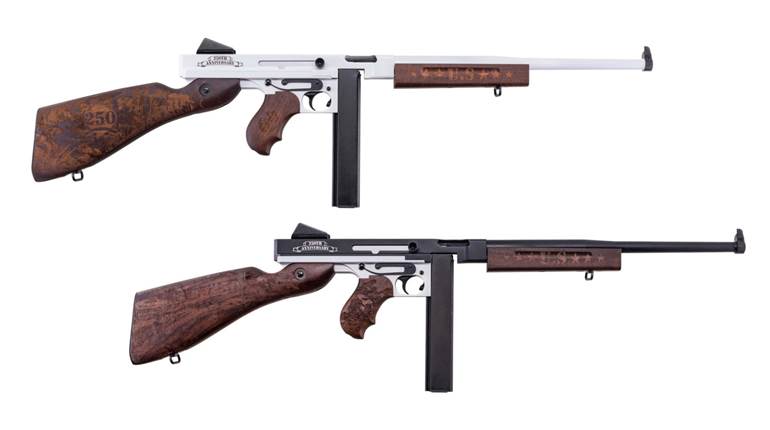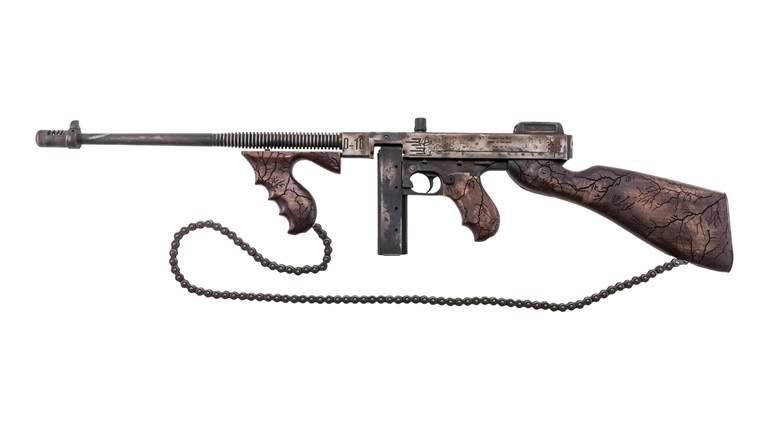
It is unlikely that any other firearm has captured the public imagination so thoroughly, both at the height of its era and continuing on long thereafter, as the Thompson Submachine Gun. Even today, more than 90 years after its introduction, the Thompson still dominates the iconography of the submachine gun. It is preeminent, impressive and an unmistakable figure of World War II American firepower.
Its role in Depression-era gangland violence made it infamous-despite the fact that it was intended for use “On The Side of Law and Order” and was more common in the hands of lawmen than criminals-and it earned defamatory nicknames including, “Chopper,” “Chicago Typewriter” and “Gangster Gun.” In 1926, Colliers described the Thompson as a “diabolical engine of death.” The negative publicity kept the Thompson from being viewed as an important military arm-until it was almost too late.
When the Thompson finally ended up in the hands of American Marines, sailors and soldiers, its reputation was already well established. In combat, the Thompson earned respect from all who fired it, and the gun instilled confidence in the men who carried it. My father, who carried a Thompson in Europe during World War II, once told me: “When the Krauts heard the blast of a Thompson, they either gave up or went away and bothered somebody else!”
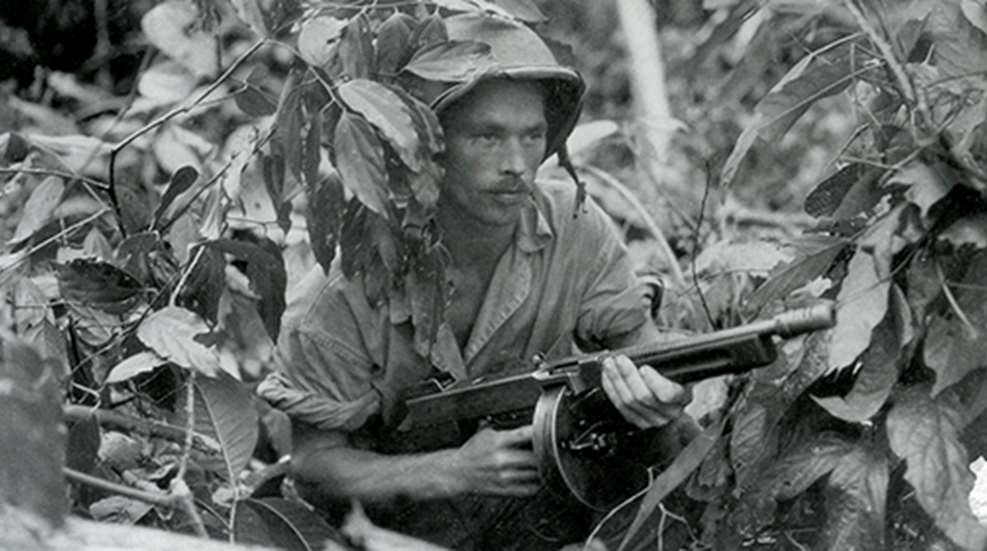
As a submachine gun, it excelled at close range. In the Pacific, it blasted Japanese through the thick jungle underbrush. In Europe, it pounded Germans in hedgerows and in house-to-house actions. It was heavy, but it was robust and reliable. It was expensive to produce, but the G.I.’s confidence in the gun justified the investment.
Through the years, I have heard and read many stories and myths about the Thompson. One Thompson accessory quickly dismissed as “too heavy,” “too complicated” or “too noisy” is the 50-round drum magazine. The drum was thought to have been quickly phased out early in World War II. But my photographic research doesn’t support that notion. You will see numerous photos of Marines using 50-round drum magazines throughout the war (including on Okinawa, the last major island battle). Obviously, some Marines valued the extra firepower inherent in the drum, and it is proven through the photos.
The Thompson has a classic, distinctive appearance. It is a legend among firearms, and photos of the gun speak for themselves, much like the “Tommy Gun” itself did, in its own unmistakable way.
Most Popular