The Vortex name may be new to some, but the company traces its origins back to 1986. Today the company offers binoculars, monoculars, red-dot scopes, spotting scopes, and several lines of hunting scopes, as well as a growing line of tactical products, including Razor tactical riflescopes in 1-4X 24 mm and 5-20X 50 mm configurations.
The Razor 5-20X is built around a 6061 T6 aluminum main tube 35 mm in diameter and nearly 2 mm thick, which allows the scope to offer an impressive 125 minutes/36 milliradians (mrad) of both elevation and windage adjustment, set by means of large target-type turrets on the saddle. On the left side of the saddle is the parallax focusing knob, with markings from 40 yards to infinity. The scope’s 50 mm objective is threaded for attachment of the included 4-inch lens shade, and the ocular features a rubber-coated magnification adjustment ring and a fast-focus ring for dialing in up to +/- 2 diopters of focus adjustment. On the upper left side of the ocular is the 11-position reticle illumination knob, which also contains the CR2032 battery.
The scope is filled with argon gas, which is inert and prevents fogging and corrosion in a wider range of temperatures than do other gases. O-ring seals help retain the gas and protect against the intrusion of moisture and dust. The tube, turrets and other external aluminum surfaces are hard-coat anodized in matte-black.
Each lens is locked solidly in place fore and aft by machined locking rings. The objective’s multi-element apochromatic lens system ensures true color fidelity and optimum sharpness, and Vortex’s proprietary XR lens coating, which is applied to all lens surfaces, delivers superior light transmission. Exterior lens surfaces are also protected by Vortex’s scratch-resistant ArmorTek coating. Vortex states that the Razor’s lenses, all made in Japan, are optically indexed for optimal alignment, resulting in a brighter view without a loss of resolution at the edges of the visual field. Additionally, it offers 3.9 inches of eye relief at all magnification levels.
The Razor is offered with two glass-etched reticles: the Vortex EBR-1, which features m.o.a. gradations on the vertical and horizontal crosshair, and the Vortex EBR-2 reticle, which features similar subtensions in milliradians. Both reticles are synchronized with the click adjustments on the elevation and windage turrets (i.e., the subtensions on the reticle match the click values of the scope). In both reticles, the horizontal crosshair is offset slightly above the midpoint of the field of view, giving additional elevation adjustment range. Both reticles are in the first focal plane, which means that the reticle changes apparent size as the magnification is changed, but retains the same proportions of target size and reticle subtensions.
The markings on the elevation and windage turrets and parallax focus knob are clear and can be seen without having to move the aiming eye overmuch from behind the scope (although the 35 mm rings partially obscure the windage markings). A red fiber-optic Radius Bar inset in the top of the elevation turret allows the operator to easily keep track of turret revolutions in all light conditions.
Also visible from the firing position is the patent-pending MagView System, a short fiber-optic rod on the ocular used with raised magnification references on the power ring to indicate the current magnification level. Features such as special long-wearing silicon brass turret screws and ultra-precise turret screw threads aid consistent, accurate and repeatable tracking.
Highly polished stainless steel pads on the tips of the turret screws impinge on a hardened steel ring on the machined brass erector tube, ensuring long life and low wear. Hardened steel splines inside the turret are engaged by the steel clicker balls, producing positive clicks and minimizing clicker system wear. Finally, a single fatigue-resistant chrome-vanadium erector spring provides precise and repeatable elevation tracking.
Vortex’s RZR (Rapid Zero Return) Zero Stop mechanism allows the operator to quickly return to a preset sight-in range without counting clicks or dialing below that zero. The whole process takes only a few minutes and can easily be repeated anytime the minimum zero range must be changed.
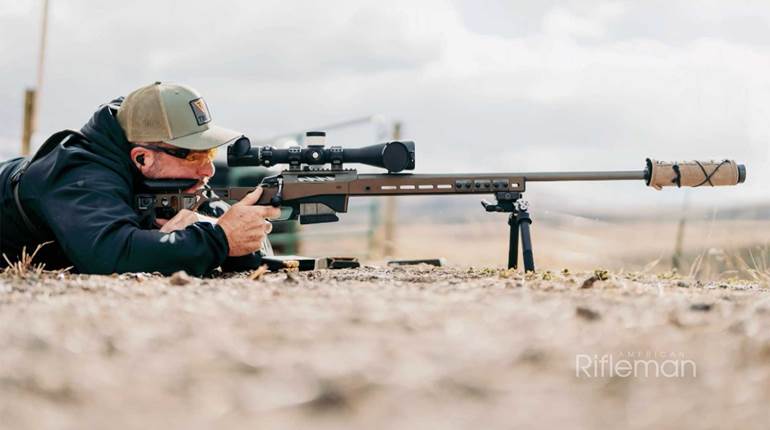
Using Vortex’s optional 35 mm steel rings, we installed and shot the Razor on several different guns, including a 7 mm WSM F-Class rifle, a DPMS LR-6.5 in 6.5 Creedmoor, and both Surgeon Rifles’ Remedy and Barrett’s 98B .338 Lapua rifles. Testing involved the traditional “shooting the square.” Also performed was a ladder test in which three shots were fired every two vertical clicks for a total of 40 clicks, and measurements made of the distance between each group and the total distance between the first and last groups. In both tests, the appropriate value for each click (0.1 milliradian or 0.36 inches) was achieved. When the zeroed scope was removed from the gun and then reinstalled, the zero did not change by any discernible amount.
The view through the scope was gratifyingly clear and sharp, with no visible distortion or decrease in brightness, color fidelity or resolution at the edges of the field of view. Light transmission was bright, in our estimation as bright as other premium tactical scopes we have used. Clicks on the elevation and windage knobs were judged to be quiet but still crisp and definite. Moreover, the first-focal-plane reticle was coarse enough to be easily seen at the minimum magnification of 5X, yet fine enough at the maximum 20X magnification to not interfere with target visibility. For most rangefinding purposes, however, we used a higher magnification to see the gradations on the reticle more clearly. We stored the scope in a freezer overnight, reinstalled it and shot a group; again, zero did not change. Later the scope was fully immersed in hot water for approximately one hour, followed by one hour immersion in ice water. No bubbles appeared and the lenses didn’t fog. All controls still worked smoothly at both extremes of temperature.
The Razor HD 5-20X 50 mm has one of the most carefully thought-out designs we have seen on a tactical scope, with rugged construction, a wealth of operator-friendly features, an unusually wide range of elevation and windage adjustments, and an easy-to-use, uncluttered rangefinding reticle. With these features, and a list price of $2,499, the Vortex Razor HD 5-20X 50 mm is comparable to other premium tactical scopes.
Specs:
Importer: Vortex Optics; (800) 426-0048; www.vortexoptics.com
Model: RZR551
Magnification and Objective: 5-20X 50 mm
Finish: hard-anodized Stealth Shadow black
Field of View (Ft. @ 100 Yds.): 13.6 (5X), 5.24 (20X)
Eye Relief: 3.9"
Click Value: 1/4 m.o.a. or 0.1 mrads (tested)
Windage and Elevation Adjustment Range: 125 m.o.a. or 36 mrads
Reticle: rangefinding EBR-1 (m.o.a.) or EBR-2 (milliradians, tested) illuminated glass-etched reticle, located in first focal plane
Length: 15.8"
Weight: 35.2 ozs.
Features: 35 mm main tube; side parallax adjustment from 40 yds. to infinity; + or – 2 diopter adjustable eyepiece, zeroable windage and elevation turrets; zero stop; XD glass; Radius Bar on elevation turret; MagView System on zoom ring; VIP unconditional lifetime warrantyAccessories: sunshade; anti-reflection device; bubble level; hex wrench
Suggested List Price: $2,499