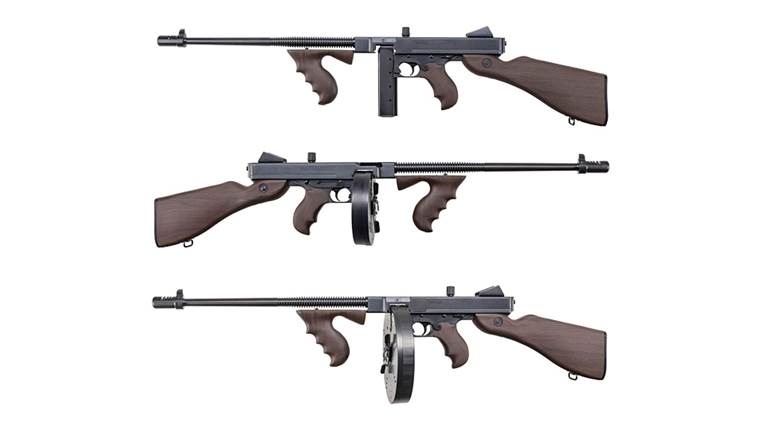
In May 1921, Gen. John Taliaferro Thompson went on a sales tour of Europe, visiting Belgium, Britain, France and Spain to promote his innovative “submachine gun,” a term he coined for the fully automatic .45 ACP that arrived too late for service in World War I. He was invited to demonstrate the Model 1921 at the Royal Small Arms Factory at Enfield on June 30, 1921, which he did with some success. The chief inspector of small arms’ report illustrates his concerns with the accuracy and reliability of the gun. He was particularly puzzled by the requirement for the Blish locking system, albeit couched in faintly impenetrable army technical language.
“There is an element of doubt as to whether the use of the lock is a positive one. The inclination of the sides of the ‘H’ and the corresponding angle of the grooves in the breech block tend to closure, whereas … the inclination of the outside ‘ears’ and the corresponding angle of the grooves in the receiver tend to release. It is well known that with pistol ammunition the inertia weight of the breech block and the resistance of its return spring afford sufficient resistance to hold up the cartridge [case] while the bullet leaves the barrel, provided such weight and spring resistance are correctly worked out.”
In simple terms, the chief inspector was questioning the necessity of the Blish lock, as the counterbalancing weight of the breech-block and its recoil spring, matched to the cartridge performance, should in theory provide sufficient delay on opening when operating on a straightforward, blowback principle. Indeed, the Small Arms staff at Enfield predicted the alteration of the design of later Thompsons by removing the Blish lock completely and then firing the gun remotely under safe conditions. The results were instructive: “The rounds were fired, both ejection and extraction being satisfactory. The gun functioned well and the condition of the spent cases was found to be identical with that of the spent cases … fired with the wedge assembled to the gun.” There was also doubt about the efficacy of the drum magazines: “The 20 round box magazines are much simpler than the drum magazines and appreciably lighter for the same number of rounds, 5 empty box magazines holding 100 rounds in all weighing 2 pounds as against 3 pounds, 2 ounces, for the 100 round drum and 2 pounds, 8 ounces for the 50 round drum. The box magazines are simpler for packing and transport.” There were a few reliability problems when the Thompson was tested, mostly with ammunition failing to fire (not necessarily the gun’s fault) and some ejection problems.
But overall the British report praised the Thompson: “The weapon is handy, compact and is designed in a manner convenient for manufacture.” But there were no orders forthcoming, the British government being reluctant to spend money re-equipping the army with a gun that was relatively expensive, unproven in combat and against its guiding principles of not issuing light-automatic arms to soldiers. This was, after all, the same army command that had insisted that the Lee-Enfield rifle be fitted with a magazine cut-off “to prevent the unnecessary expenditure of ammunition,” and which refused to countenance the issue of semi-automatic pistols to their soldiers during the Great War for similar reasons. The prospect of actually issuing the soldiery a gun capable of such high rates of fire horrified many at the Board of Ordnance, and in the wake of the public’s distaste for anything involving military expenditure after 1918, there was little chance of Britain adopting the Thompson. Nearly two decades later, that was to change.
When war broke out in September 1939, few, least of all those in Neville Chamberlain’s government, had even the remotest idea of the enormity of events that would soon unfold. The “phoney war” period was one of gathering forces, stockpiling existing arms and frantically ordering more. The Bren gun was in service along with the indomitable Lee-Enfield rifle, but the British Army, consistently underfunded in the 1930s, was bereft of light-automatic arms. Conveniently forgetting its earlier evaluation of the Thompson as “that tatty American gangster gun” after earlier testing, the Board of Ordnance requested that the government sanction the purchase of “as many Thompson machine carbines as possible.”
With the election of Winston Churchill as prime minister in 1940, things began to move quickly. Churchill, an ex-soldier and an arms enthusiast, was also a believer in the Thompson, publicly paraphrasing the “Time” magazine comment that “General Thompson’s gun may be, pound for pound, the most devastating weapon devised for war.” He immediately sanctioned the acquisition of Model 1928 guns, and the British Purchasing Commission, based in New York, placed the order in February 1940.
At first the commission ordered only 450 guns, and the subsequent contract did not actually specify a number—Britain needed all the guns it could get. Ordnance inspectors were sent from Britain to check and stamp all export guns destined for Europe, and many of the guns that never reached England bear their inspection stamps. Savage was to ship them as fast as possible at $225 apiece, and these guns, finished in commercial blue, were supplied in a transit chest with walnut stocks and two “L”-type drum magazines, five box magazines, a webbing sling, 1,000 rounds of ammunition and a cleaning kit.
The first units to receive the Thompsons were not regular army units but the men of the highly secret Home Guard Special Units, a small army comprised of professional soldiers and Home Guard with previous military experience, who together were to become the core of a country-wide resistance in the event of invasion. They had access to a series of specially constructed underground bunkers, cleverly camouflaged in remote areas, in which they stockpiled arms, food and radio equipment. These units had been formed at the start of the war, and they received the first deliveries of Thompsons in early spring 1940.
Exactly how many Thompsons were supplied is unknown, but doubtless some still lie, safely packed and greased, in sealed bunkers secreted in woods dotted around the country. It was not until early 1941 that the first 1928s began to find their way into the army, and initially the guns were issued to Commando units, as Sgt. Thomas “Tommy” Dales of No. 2 Commando recounted: “We were given a new carbine, the Tommy gun, in, I think April or May 1941. We had all seen them at the pictures, of course, Al Capone and the rest, so we went around talking like Jimmy Cagney for a while. In fact they were very well made, beautiful really. But blimey, they were heavy things.” Five Commando units were selected for early supply because of their need for a compact, fast-firing arm that was reliable and hard-hitting, and the Thompson fit the bill.
As the Lend-Lease program got underway, more and more Thompsons found their way to Britain. By this time, the U.S. government was wholly responsible for the supply of arms under Lend-Lease, and total British orders for the Thompson stood at 514,000. Despite the depredations of the U-boats on the Atlantic convoys, some supplies of Thompsons continued to reach Britain; but of the guns ordered, only 100,000 had arrived by April 1942. By the summer of 1942, however, panic measures set in to introduce some alternative to the costly Thompson, resulting in the production of the Sten submachine gun. Unlike the finely machined Model 1928, with its beautiful finish, the Sten was assembled by unskilled workers from black-painted parts supplied by subcontractors and cost £2.50 (about £112 or $180 in current values). It was unlovely, crude and dangerous if mishandled, but it was also serviceable and easy to manufacture. Sten guns became a priority for issue to all European Theatre of Operations (ETO) Commonwealth troops with the exception of the Commando brigades who were mostly supplied with Thompsons—and wanted to keep them.
Despite the availability of the Sten, Thompsons continued to be issued to Home Guard units. For some of these scratch-formed defence groups, the old jokes about taping a butcher’s knife to a broom handle were not so far from the truth, but in reality many units were issued new Thompsons, albeit initially with no ammunition. Peter Evans, ex-East Yorkshire Home Guard, said: “We had two Thompson guns and several dozen Enfield Pattern 1917 rifles, which were chambered for the [American] .30-calibre ammunition, but we were issued with .303 cartridges which were no use. We had no ammunition at all for the Thompsons though, and were told that in the event of invasion we were to apply to the nearest regular army headquarters for a supply of cartridges. This was daft, because they were 20 miles away, which meant we’d have to fight our way to get there with useless guns in order to get our ammunition! Things got much better later on, though, and we eventually became very well armed indeed; we had something like 20 Thompsons, as well as Browning machine guns, mortars and Enfield rifles. When we were photographed we looked like a regular army unit.”
The supply of Model 1928s was nowhere near enough, of course, and for propaganda reasons guns were often taken from one unit and passed to another so that suitably aggressive pictures could be taken. Indeed, many home service units were supplied with wooden “props’’ for propaganda purposes, as the Ministry of Defence knew that all pictures released to the public would be carefully examined by German intelligence staff. Even today, occasionally some wooden Thompsons appear in sale rooms and are typically described as “film prop guns,” but their history is often far more interesting.
As supplies of the Model 1928 began to dry up, they were replaced with the more basic M1/M1A1s, and these too were issued to line regiments. As a result, troops carried a great mix of different models, with old Model 1928s being used alongside the later M1 guns. In regions where supply was problematic, such as Burma and Madagascar, the early guns often saw service with Commonwealth soldiers right to the end of the war. Such was the esteem in which the Thompson was held that the Commando badge, worn on the upper shoulder, featured a Model 1928. Military production of the Thompson finally ceased in 1944, after 1,387,134 Thompson guns had been manufactured.