8/17/2012
I have no doubt that years from now sociologists will look back and label the 1950s and ’60s as a period that helped define the basic concepts of right and wrong for the baby boomer generation. Those were the golden years of Hollywood Westerns, and their impact continues among today’s viewers of DVDs and cable reruns of everything from “The Lone Ranger” to “Bonanza.” Hollywood Westerns—on the big and small screens—gave us role models to emulate, including wholesome heroes like late NRA Life members Roy Rogers and John Wayne.
But just as importantly, they fostered an appreciation for the guns of our frontier heritage. They were the reason Colt brought back the Single Action Army in 1955 (a gun the company decried as obsolete in a 1949 issue of American Rifleman). Moreover, in 1958 the popularity of “The Life and Legend of Wyatt Earp,” which aired on ABC from 1955 to 1961, was responsible for Colt’s introduction of a 12-inch-barreled Buntline Special, which remained in production for 30 years—far longer than the 1877 through 1890 time span of the 40 or so rare long-barreled originals.
Were it not for Hollywood’s Westerns, the late Val Forgett and Aldo Uberti might not have been motivated to replicate 19th century firearms that, from a technological standpoint, were passé. Hollywood also inspired the fast-draw sport of the ’50s and ’60s that, in more recent times, was the catalyst for cowboy action shooting.
Until recently anyone wanting to relive “those thrilling days of yesteryear” was limited to straight-from-the catalogue sixgun configurations of the Colt SAA, or Italian clones by firms such as Uberti, Cimarron Firearms and Taylor’s & Co., plus the Ruger Vaquero. Likewise, just as the Winchester 92 was omnipresent on big screen and small, we had to settle for originals and replicas of standard rifles and carbines, even though our tall-in-the-saddle movie and TV heroes often carried more elaborate versions.
Of course, what was good enough for Matt Dillon and Paladin was certainly good enough for us. But what about wanting to emulate Steve McQueen as Josh Randall with his chopped Winchester 92 in “Wanted Dead Or Alive”? Or to take aim with Chuck Connors’ loop-levered ’92 carbine, as seen in “The Rifleman”? Owning such look-alike theatrical arms was out of the question (not to mention the legalities of McQueen’s “Mare’s Leg” barrel length) unless one opted to invest in the services of a skilled gunsmith for such modifications.
Yet many years ago that is exactly what I did after seeing a VHS version of the 1939 motion picture “Stagecoach,” and having become captivated with one of the first guns ever modified for a Western, the loop-levered Winchester 92 carbine used by John Wayne as the Ringo Kid. Although Wayne had previously appeared in numerous B Westerns, “Stagecoach” director John Ford wanted this to be Wayne’s breakout role. As such, he envisioned a dramatic on-screen entrance for his young star.
“When the camera zooms in on you for your opening shot,” he told Wayne, “I want you to spin that rifle like a pistol.” Of course, Wayne knew it was impossible to twirl an unmodified Winchester in such a manner, but he wasn’t about to tell that to the irascible John Ford. Instead, he and stuntman Yakima Canutt devised a rounded lever that did indeed enable Duke to dramatically spin his Winchester 1892 carbine, one of two used in the movie—a .44-40 Win. for firing 5-in-1 blanks and a .32-20 Win. Trapper with a 15 1/2-inch barrel for spinning. As an aside, on June 5, 2007, the Trapper sold for $113,000 at Little John’s Auction Service in Anaheim, Calif.
Evidently it also inspired Winchester Repeating Arms, because, as an indication of today’s growing interest in replicating guns of the Hollywood westerns, this year Winchester unveiled its Model 1892 Large Loop Carbine, which had the added allure of not only being chambered in .44-40 Win., but in .357 Mag., .44 Mag. and .45 Colt. And at $1,256, it is substantially more affordable than the auction price of the Duke’s original Winchester.
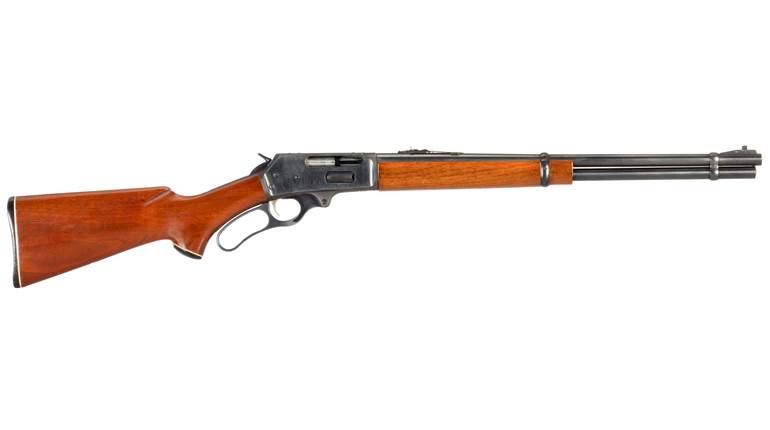
Following the evolution of Wayne’s “Stagecoach” loop-lever actions, the actor discovered that the wide three-quarter-circle lever was prone to becoming bent during action scenes. Thus, by the 1950s Stembridge Gun Rentals at Paramount Studios had modified the lever concept into a pinched oval or egg shape. This smaller contour, affixed to a standard Winchester 1892 carbine, became one of Wayne’s trademarks, and appeared with him in many Westerns, from “Rio Bravo” in 1959 to “The Shootist” in 1976. Although the smaller contoured lever was not particularly suitable for spinning, the Duke does give it a creditable twirl in one scene near the end of “El Dorado,” a movie in which Robert Mitchum, as town sheriff, and Wayne, playing a gunfighter, both carry identical Winchester 92s with modified levers. As they walk down the street during the first part of the movie carrying their carbines, Mitchum says to Wayne, “I had one made up just like yours.”
Now we can all quote that famous line, because a replica of Wayne’s carbine is offered as the El Dorado by Cimarron Firearms ($1,244), with a case-colored receiver, hammer and lever, and as the Rio Bravo ($1,253) either blued or case-colored from Taylor’s & Co. and Chiappa, both of which sell the loop lever separately for $109 for those who want to make their own conversion. Calibers include .38 Spl., .357 Mag., .38-40 Win., .44-40 Win. and .45 Colt, depending on company. Legacy Sports Int’l also has a Puma 16-inch Trapper version made by Chiappa for $1,031. Although some tout the large lever as suitable for gloved hands, in my opinion gloves have nothing to do with it. Like Robert Mitchum, we just want a carbine like the Duke’s.
A lot of us evidently feel the same way about the Mare’s Leg used by Steve McQueen as bounty hunter Josh Randall in TVs “Wanted Dead Or Alive,” which aired on CBS from 1958 to 1961, as there are four different companies offering versions of what has to be one of the most impractical yet unforgettable firearms ever depicted in any Western. With a 9-inch barrel, no sights and a stock cut-off just behind the comb, it started out as a Winchester 92 and ended up being carried by McQueen like a pistol on his hip in an open, spring-clipped holster. The gun, which never existed before in either the real or “reel” West, was conceived by series producer John Robinson, who wanted McQueen to pack something unique. Adding to its distinctiveness was the fact that even though McQueen’s Mare’s Leg was chambered in .44-40 Win. (thus enabling it to fire 5-in-1 blanks), the actor’s gunbelt sported .45-70 Gov’t cartridges, as Robinson felt they looked better on television. (No one ever accused Hollywood of being influenced by reality.)
Indeed, it was difficult to define the Mare’s Leg as a handgun or a rifle, a problem that also perplexed the U.S. Treasury’s Alcohol and Tobacco Tax Division when its agents spotted it on TV. They ended up categorizing it as a machine gun, and promptly slapped Robinson with $11,000 in fines and registration fees, making it the most expensive gun on any TV Western. But it was McQueen who actually gave the Mare’s Leg its name. A conscientious method actor, he took the sawed-off gun to the range to experience what it was like to actually fire it with live ammunition. With the muzzle blast from its stubby barrel and basically no stock to anchor it, he claimed the gun kicked like a mare’s leg.
Unlike the originals, all of the replicas have 12-inch barrels, which translate into six-round-capacity magazines. Rather than being cut-down rifles, the replicas are factory-assembled as pistols, which make them legal in all but a few backward-thinking states, such as California, which share the antiquated Alcohol and Tobacco Tax Division’s confusion of not knowing whether to classify this firearm as a rifle or handgun. Jim Buchanan of J.B. Custom was first out the gate with a Mare’s Leg replica and now offers two versions by Chiappa, a standard model ($1,295) and a takedown ($1,695), which features an octagon barrel, as seen in the latter episodes of the TV series. Although the rest of the replicas use round barrels as initially seen in “Wanted Dead Or Alive,” the show’s latter-style triangular lever appears on the Puma Bounty Hunter from Chiappa and Legacy Sports, which is available in .44-40 Win., .44 Mag. and .45 Colt ($1,212). Taylor’s & Co. announced its Boot Leg matte black version in .45 Colt, although prices were not yet available. The Rossi Ranch Hand ($536 to $655) is chambered for .357 Mag., .44 Mag. or .45 Colt, and sports a wider-looped lever reminiscent of the first guns seen on the series, although McQueen’s lever was slightly more rectangular in design.
In 1958 loop-levered Winchester 92s were at the forefront of TV westerns, because the same year and month McQueen starting stalking outlaws with his Mare’s Leg, Chuck Connors, as Lucas McCain, began dispensing justice in North Fork, New Mexico Territory. He used a modified, extra-wide-looped Winchester ’92 carbine that enabled the ex-baseball star to crank off 10 shots in fewer than 10 seconds during the opening sequence of “The Rifleman,” which remained on the air until 1963. The secret to Chuck’s rapid-fire prowess was a screw that protruded through the trigger guard and could be adjusted to trip the trigger every time the lever slammed home. Or it could be backed out so the carbine fired in normal fashion. Early in the series Connors added a nut to secure the screw so that it could not accidentally back out, as it did during his appearance on the Johnny Carson Show, resulting in him rapidly ejecting 10 unfired blanks from the carbine, which clattered onto the stage floor.
“Oh, did you want me to fire the gun?” Connors quipped to a bemused Carson. And at six-five, the ambidextrous Connors could shoot with either hand and spin-cock the carbine—one of two Winchesters and an El Tigre used on the show—with ease. Having known Connors and now owning one of the carbines that hung on his Tehachapi ranch house wall, a few years ago on “American Rifleman Television” I demonstrated the speed with which this gun could be fired, using blanks, like on “The Rifleman.” Shooting live ammunition in such a rapid-fire manner is extremely dangerous, as recoil will cause the muzzle to go wild.
It is for this reason that the limited-edition offering of a .44-40 Win. Chuck Connor's Commemorative 1892 Carbine by Legacy Sports a few years ago has a non-functioning set screw, which is strictly for appearance. The left side of the receiver and right side of the stock features Chuck’s etched signature, along with an inlaid silver medallion with Chuck’s portrait. Priced at $1,299 each, which includes a DVD of two “The Rifleman” episodes plus a black-and-white portrait of Connors and a certificate of authenticity signed by Jeff Connors, one of Chuck’s four sons, only 1,000 sequentially numbered commemoratives were produced, and a few may still be found on some dealers’ shelves.
Fans of NRA board member Tom Selleck’s “Quigley Down Under” might want to check out the tack-driving Davide Pedersoli-made Quigley replica (actually an 1874 Sharps with Hartford fore-end and an 1863 patch box) sold by Cabela’s ($1,999), Dixie Guns Works ($1,850), Taylor’s & Co ($2,492), and Cimarron Firearms ($2,204 to $2,588 in calibers from .45-70 Gov’t to .50-90). As a further tribute to Selleck, Cimarron also catalogues an Uberti casehardened Crossfire Trail 1876 carbine ($1,816) in .45-60 Win. and .45-75 Win. calibers.
In fact, Cimarron has the largest offerings of Hollywood western movie replicas, including its “Holy Smoker” ($945), a 4 3/4-inch-barreled single-action .45 Colt with gold cross grip inlays that duplicates the sixgun used by Russell Crowe in the remake of “3:10 To Yuma.” Then there is their Rooster Shooter, an “original finish” (antiqued) single-action with faint finger grooved faux “aged ivory” stocks that duplicates the well-worn Colt SAA John Wayne carried in some of his roles, including as Rooster Cogburn in “True Grit.” Available in .357 Mag., .44-40 Win. and .45 Colt and priced at $888, it is a bargain, considering Wayne’s actual sixgun sold for $95,000 at auction a few years ago.
Although Colt is not currently producing its third-generation Buntline Special, in 2010 it made a limited-edition Hugh O’Brian-Wyatt Earp Tribute Buntline cased set (in honor of the actor who played Wyatt Earp in the TV series) with a matching 4 3/4-inch Peacemaker. However, inspired by the 1993 film “Tombstone” starring Kurt Russell, Cimarron has brought out a 10-inch-barreled .45 Colt Wyatt Earp Buntline ($888), complete with sterling silver-inlaid grip presentation plaque, although the 10-inch version used in the movie sported a brass plaque engraved by craftsman John Ennis. Actually, there were three consecutively numbered Buntlines used in the movie, one of which is now owned by Kurt Russell, who played Wyatt Earp. Like the movie guns, Cimarron’s Buntline is made by Uberti (although the movie guns used Colt barrels).
However, as an unabashed fan of the Sergio Leone spaghetti westerns starring Clint Eastwood as “The Man With No Name,” one of my favorite replicas is Cimarron’s MWNN ($599), which is basically an Uberti 1851 Navy converted to fire .38 Spl., just as the cap-and-ball movie guns were converted to fire blanks and—like Eastwood’s movie gun in “The Good, The Bad and the Ugly”—is complete with rammer, which obviously serves no purpose. But for $842, you can get this highly accurate six-shooter with an optional inlaid silver rattlesnake grip, as used by Eastwood in this epic Italian western. An MWNN 5 1/2-inch or 4 3/4-inch barrel .45 single-action is also offered with silver rattlesnake grip for those who prefer the earlier gun Eastwood used in “A Fistful of Dollars” and “For A Few Dollars More.” Some might remember when Eastwood, as Rowdy Yates, took a similar gun from an outlaw he had dispatched in the TV series, “Rawhide,” which aired on CBS from 1959 until 1966.
Indeed, just as John Wayne never abandoned the loop lever carbine that launched his career, and Clint Eastwood resurrected the silver rattlesnake stocks at the beginning of his climb to stardom, today’s replica guns of the Hollywood westerns are, for many of us, today’s real shooting stars.