From the February, 1952 issue of American Rifleman
Last month, the controversial debate between the United States and the United Kingdom over the adoption of a new lightweight automatic rifle took an interesting twist. Army Ordnance, traditionally tight-lipped about developmental projects, demonstrated its own automatic lightweight rifles and a new shortened .30 caliber cartridge, the T-65. The surprise showing of the rifles and cartridge, which are not ready to go into production, was held at the Ordnance Corps' Aberdeen Proving Ground, thirty miles north of Baltimore, Maryland.
It was a cold day the Army picked to show of its new lightweight rifles. A strong easterly wind whipped across the Proving Ground, spreading dampness and cold from the Chesapeake Bay. GI's shooting the rifles and preparing exhibits were shivering, as were the half-hundred spectators in the reviewing stand. Thoughtfully, the Army provided blankets and hot coffee for the spectators; the GIs were not as lucky.
In the chilly reviewing stand when the show began were many newspaper reporters from the Pentagon, and several prominent rifle experts, including famed Marine combat leader Major General Merritt A. Edson, Executive Director of the National Rifle Association, and Major General Julian S. Hatcher, former Ordnance officer who has headed the NRA's technical section since his retirement.
Leading the show was Colonel René R. Studeler, Chief of the Small Arms Branch, Research and Development Division, U.S. Army Ordnance Corps. While Colonel Studeler is not the inventor of the new rifles, he has carried the responsibility for their development throughout the last six years. A slight, distinguished-looking man with a small mustache, Colonel Studeler is perhaps one of the world's greatest authorities on small arms and small-arms ammunition. When not out in the field testing new rifles and ammunition, Color Studeler is busy with paper work in the Pentagon. He is known by his fellow workers as being an extremely apt diplomat, and more than once he has brought foreign authorities around to the U.S.'s point of view.
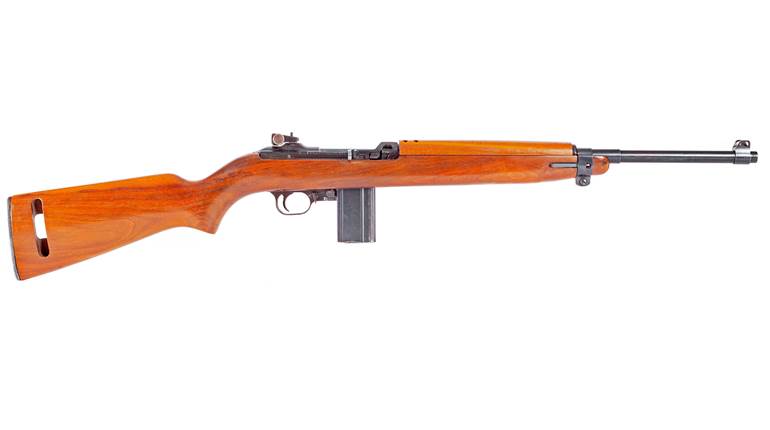
The demonstration Studeler conducted was centered around the Army's two newest lightweight automatic rifles. Both rifles are being considered by the Army to replace the M-1 Garand. One is called the T-44 and the other is the T-47. The T-44 and T-47 bear a strong resemblance to the old M-1 Garand. Both rifles are gas operated, have open sights and stocks like that on the M-1. The T-44 has an M-1 type action, or an M-1 type bolt and receiver. The T-47 has a 'tilting block' type action similar to that on the Browning automatic rifle. Both the T-44 and the T-47 rifles have twenty-round magazines, and a lever on the right-hand side above trigger guard which allows the shooter to switch selectively from semiautomatic to automatic fire. Each rifle is fitted with a muzzle brake with recoil reducing effects. The magazine of the T-47 projects straight downward from the rifle, but the magazine of the T-44 tilts forward slightly.
During the exhibition, expert Army riflemen potted away at several targets, called 'kneeling silhouette type' by the Army. This was a simulated combat problem put on for the benefit of the spectators to illustrate rapidity of semiautomatic fire with the M-1 and the two new lightweight rifles, but the weather was in no mood for comparison demonstrations. It was bitter cold (the temperature was below freezing), and a strong 35 miles per hour crosswind hampered firing by numbing ungloved fingers of the shooters and slowing the changing of clips and clearing of jams. The target was at one hundred yards. There was a time limit of one minute imposed on the shooter. All shooting was semiautomatic, aimed fire, prone with a sling. Here are the results:
|
Shooter No. |
Rifle |
Rounds Fired |
Number of Hits |
|
1 |
M-1 |
32 |
29 |
|
1 |
T-22 |
40 |
34 |
|
2 |
M1 |
32 |
32 |
|
2 |
T-47 |
46 |
44 |
|
3 |
M-1 |
40 |
28 |
|
3 |
T-44 |
30 |
26 |
|
4 |
M-1 |
40 |
28 |
|
4 |
T-47 |
65 |
40 |
While these tests were going on before the reviewing stand, a solider was busy firing an accuracy test from a bench rest. He shot ten rounds for group semiautomatically from, first, the M-1 Garand and, then, ten rounds from one of the lightweight rifles at 200 yards with metallic sights. When his targets were measured, the M-1 had placed its ten shots in a group which measured ten inches, extreme spread, and the lightweight rifle had put its ten shots in a group with an extreme spread of eight inches. Discounting one flier in each, the M-1 group measured seven inches and the group of the lightweight rifle measured five and one-half inches.
Throughout the cold morning, prior to the firing of the T-44 and the T-47 lightweight rifles, Ordnance men demonstrated the early experimental models which led to the development of the two new rifles. They displayed a standard M-1 fitted with a selective lever to permit firing either semiautomatically or fully automatic. (Known as the T-20, this rifle was pictured under the heading "New U.S. Army Rifle?" on page 16 of the Rifleman, June, 1951.) Colonel Studeler told newspapermen that 100,000 of these had been ordered before the end of World War II, but that none had been delivered in time for combat use. Ordnance also disclosed an early model, straight-stocked lightweight rifle, the T-25, with a cyclic rate of 700 to 800 rounds per minute.
Other demonstrations with the T-65 cartridge put on by Ordnance included the firing of an M-1 rifle which had been rebarreled for the T-65 and which had a filler placed in the magazine so it could handle the T-65. A Browning automatic rifle and a light air-cooled machine gun adapted to fire the T-65 were also fired at targets. Later Colonel Studeler said that the Army could modify all existing small arms weapons which currently use the .30-'06 cartridge to fire the T-65 by rebarreling and inserting fillers in magazines. However, he pointed out that such a conversion program would require perhaps a year or more to accomplish.
The Ordnance Corps is also thinking about one of the new rifles as a replacement for the Browning automatic rifle. They fired one new rifle fitted with a heavy barrel, which though it weighs 11 pounds is considerably lighter than the 20-pound BAR.
Another exhibit included firing the new lightweight rifles from the shoulder as submachine guns. When firing the weapons fully automatic, the muzzle has a tendency to move to the right, as newsmen learned in the afternoon when they were invited to shoot the new T-44 and T-47.
Several reporters asked Colonel Studeler if experimentation with the automatic rifle by the Army indicated decreased emphasis upon aimed fire. He replied that it did not, and that aimed fire was still a doctrine of the Army, but that experiences during World War II and in Korea had proven to the Army that under certain conditions it is desirable to have an automatic shoulder weapon in the hands of the infantrymen. This is particularly true of defensive perimeters.
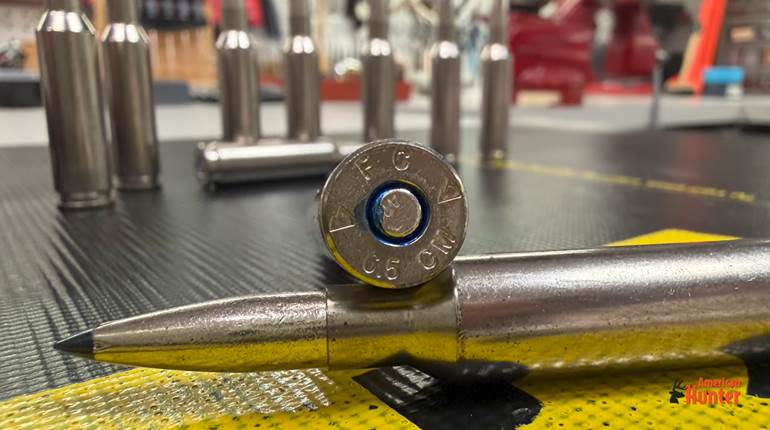
Though the details of the rifles were interesting in themselves, the details of the new lightweight cartridge developed by Ordnance attracted as much attention among the rifle experts. The T-65 is an amazing little cartridge. Loaded with any of several .30 caliber bullets, the T-65 cartridge is a half inch shorter than the M-1 round, measuring 2.84 inches to the M-1's 3.34 inches. Possessing the same ballistics as the M-1 round, the T-65 case is shorter because Ordnance has eliminated from the .30-'06 cartridge the excess air space resulting from the use of improved powders.
Ordnance had several variations of the T-65 on hand at the demonstration. One was loaded with the obsolete 172-grain M-1 ball bullet for comparison only. This one registered a muzzle velocity of 2,672 feet per second. Another, the M-2 armor-piercing bullet, weighed 165 grains and travelled at 2,787 feet per second muzzle velocity. Another loaded with the M-2 ball 150-grain bullet registered a muzzle velocity of 2,812 feet per second. Two other cartridges were loaded with 'developmental' 140-grain bullets. One had an instrumental velocity of 2,800 feet per second, the other had an instrumental velocity of 2,530 feet per second which is, according to published reports, the muzzle velocity of the .280 cartridge fired by the new British automatic rifle.
Ordnance shot a tracer version of the T-65. These bullets were fired at an 'enemy tank' parked 400 yards down the range. Perfect hits were scored by Ordnance riflemen. The fiery tracers whanged off the tank and zipped several hundred yards before falling to earth. An 'observing' round was also demonstrated. Designed for use in directing mortar and machine gun fire to enemy targets too large for riflemen to handle, the 'observing' bullet sent up a puff of dense smoke when it hit the 'enemy' tank 400 yards away. Armor-piercing bullets were fired at a Russian general-purpose vehicle (a converted U.S. Jeep) armored with 1.4-inch steel. By mistake, Ordnance riflemen fired 'soft' steel-core bullets at the jeep on the first test, and the bullets failed to penetrate. One the next test, hard-steel armor-piercing bullets tore jagged holes in the side of the jeep at two hundred yards range.
Significantly, the program announcer said: "By the use of lead-core bullets, higher velocities can be obtained than when using other types of bullets that are necessarily longer because of less specific density. The longer bullets must project further into the cartridge case and use up needed power spaces. Lead is in critical supply in this country, so other types of bullets must be used in most cases." Rifle experts in the crowd interpreted this remark as a delicate reference to published reports that the British have been firing lead-core bullets in demonstrations of their rifle abroad. Ordnance was careful not to mention the British rifle throughout the demonstration.
GI's produced a block of six one-inch pine boards to prove that the T-65 can also penetrate wood with a lead-core bullet. Ordnance had fired several rounds at the pine block. Five of the boards were completely penetrated, and the bullets were imbedded in the sixth. But the range was extraordinary-2,000 yards! "The accepted criterion," the announcer intoned, "for lethality at that range is the penetration of one of these boards."
Later Ordnance produced a steel U.S. helmet that had been completely penetrated by a T-65 armor-piercing bullet at the range of 1,200 yards, 200 yards better than the British bullet which, according to press reports, punctured a British helmet at 1,000 yards. And finally, in a climactic move, Ordnance hauled out a shell of 1/2-inch homogeneous steel armor plate. At a range of 100 yards, the T-65 AP bullet had bored completely through the steel. Standard M-2 ball ammunition (fired at the same time) failed to penetrate the steel, and simply splattered against the heavy sheet.
In a final spectacular demonstration of the new rifles and the T-65 cartridges, an Ordnance rifleman fired a mixed magazine of ball, AP, and varying bullet weights from 172 to 140-grain, and velocities varying from 2,530 to 2,812 feet per second. Firing the mixed magazine, the announcer said, demonstrated the versatile of the light rifle and the T-65 cartridges.
Later, after the show, Studeler gathered with the rifle experts and newsmen to answer questions about the new rifle. He pointed out that the new rifles were designed specifically at the request of the ground forces combat leaders who wanted a new rifle that had all the reliability and accuracy of the Garand, plus the two new features of lighter weight and automatic fire. The rifles the Army had shown at Aberdeen were the results of six years of working toward that goal, Studeler said.
Colonel Studeler explained that these two rifles are still in 'competition' with one another, and that it hasn't been decided which of the two rifles will be adopted, or whether either will be, when and if the Army shifts from the Garand to a lightweight automatic rifle. He said he thought the 'competition' between the two rifles would be over sometime in 1952. The Army does not intend to go into production of either one in the near future. Said the Army: "The question may arise as to why the Army's new rifles are not being released for production, although production of more M-1's has been started (a multi-million dollar contract was recently let to International Harvester to make M-1's). The answer is basically that it is necessary to start producing rifles immediately. For this reason substantial new production orders have recently been placed for the M-1 (Garand) rifle. The M-1 rifle, having been produced in quantity can again be put into production much more quickly than a new rifle. In addition, large stocks of ammunition for the M-1 are available now wherever the Army is stationed."
The issues surround the question of whether the British or the American lightweight automatic rifle should be adopted by NATO have at times become clouded and confused, because of propaganda, security classifications, and because the British actually had two rifles under development. One is called the Enfield rifle, and it was built by the Enfield Arsenal. Apparently, it has subsequently been named the EM-2. The other rifle was built by the Fabrique Nationale Arms plant in Belgium, which by the way is a commercial plant and not a government installation. That rifle is commonly referred to as the 'F.N.' rifle.
The rifle the British have been showing off to the press is the EM-2, Enfield rifle. It weighs about eight and a quarter pounds without sling and magazine. The F.N. rifle is heavier; models brought over for testing in the United States weighed almost as much as the Garand (10 pounds).
The British apparently did not adopt the F.N. rifle. Perhaps they reasoned it would be better to adopt the 'British' lightweight rifle, the Enfield rifle. U.S. Ordnance was surprised when the British chose the EM-1 over the F.N. because Ordnance thought the F.N. was the better of the two rifles.
After the British unveiled the EM-2 rifle last August, the F.N. people unveiled their own rifle on September 6, at Brasschaef (pictured on page 20, Rifleman, November 1951). The press attended and discovered that the F.N. rifle used the same cartridge as the EM-2 rifle. Perhaps that is better put in reverse: The British EM-2 rifle uses the same cartridge as the Belgian F.N. It apparently was F.N. that finally perfected the cartridge. In any event, the front page of the brochure distributed at the F.N. Brasschaet demonstration reports: "F.N.-as was recently acknowledged officially-finally brought (the cartridge) to its present satisfactory stage of development." At that demonstration, F.N. officials declared that the cartridge had a muzzle velocity of 2,300 f.p.s.
When the British originally brought the lightweight automatic rifles to the United States for testing, along with the cartridge, they brought along a steel-core bullet, the presently accepted battlefield bullet material. The bullet weighed 140 grains. This bullet, in U.S. tests registered a muzzle velocity of 2,300 feet per second. For a military rifle and cartridge, a muzzle velocity of 2,300 f.p.s. is not acceptable by U.S. standards. It was been proved, for example, that in cold weather, the rifle loses at least 200 feet per second. Therefore, in cold climates, such as Alaska, or Greenland, where the U.S. might be fighting in the next war, the British cartridge would register a muzzle velocity of only something in the neighborhood of 2,100 f.p.s., not enough power in extreme cold weather to operate the mechanisms of the rifle with any amount of safety factor.
The loss of muzzle velocity directly affects the trajectory of the rifle. The trajectory figures of the British bullet have not been released, and, as one writer describing the British rifle said, it was one of the two questions the British would not answer about their rifle.
Anyone having an elementary knowledge of ballistics will have no trouble in working out approximate figures for the British steel-core bullet, and it is plain that the trajectory is very poor. With a target distance of 700 yards it is conjectured that this bullet would rise to 6 feet above the ground at 200 yards from the firing point, and midway to the target it will be feet off the ground. It is only at 600 yards (one hundred yards from the target) that the bullet returns to the six-foot mark to descend to the target at the 700-yard mark. In short, for 400 yards of the 700 yards range the British bullet would have passed completely over the head of a six-foot man.
Such a trajectory is not acceptable by U.S. standards. The new U.S. T-65 bullet fired under the same conditions, stays flat, and passes through equivalent height of the chest of a six foot soldier at mid-point to the target. In short: Since Ordnance claims the T-65 will do everything the .30 will do, the highest point of the trajectory of the U.S. T-65 bullet must be five feet, or slightly under.
The British team went back to England after the disappointing results of the tests conducted here in the United States. By then, they had learned of the new U.S. T-65 cartridge which U.S. Ordnance experts had produced. They problem the British faced was a complex one, that of finding a method of stepping up the muzzle velocity of the rifle from 2,300 f.p.s., to something near acceptable U.S. standards, while retaining the 140-grain bullet.
They subsequently found a solution, of course, because in all recent displays of the British rifle the muzzle velocity has been stated at 2,530 f.p.s., still weak by U.S. standards, but nonetheless better than an unacceptable 2,300 f.p.s.
How did the British step up the muzzle velocity? As indicated by a recently published article, they have substituted a lead-core bullet in place of the original steel-core bullet. Since the density of lead is greater than that of steel, the British could afford to chop off some of the length of the bullet in the cartridge case, and in the space saved stack in more powder. The extra powder packed into the cartridge, made possible by the use of a lead-core, cupro-nickel coated steel jacket bullet, gave the cartridge extra zip, and stepped up the muzzle velocity of the rifle from 2,300 f.p.s. to 2,530 f.p.s. The weight of the bullet remained at 140-grains. With the lead-core bullet, then the British increased the velocity of the rifle, and in doing so, managed to improve the trajectory of the bullet. Trajectory figures on the British rifle firing a lead-core bullet are now considered classified, but it is believed that the present trajectory of the bullet fired from the EM-2 rifle is within the area of acceptance by U.S. Army Ordnance. Trouble is, that it is all done with a lead-core bullet.
Ordnance, and the U.S. Army have long since ruled lead-core bullets obsolete simply because, while they may suit the sportsman, they do not measure up on the battlefield. They are fine for penetrating wood, and the British bullets, according to reports, have penetrated three and a half feet of soft wood at 100 yards range. This is not a particularly spectacular feat. As most experience riflemen know, lead-core bullets under certain conditions regularly penetrate more wood than steel-core bullets. At the same given weight, a lead-core bullet is apt to be more stable in flight, and more stable as it enters the wood, because it is shorter than a steel-core bullet. A steel-core bullet is longer for the same given weight (because lead is more dense) and therefore less stable as it enters the wood, and frequently flips off course.
But the U.S. Army attaches little significance to the amount of wood a bullet may penetrate at any given range. Long ago, they found that there was 'more steel on the battlefield than wood,' or that steel was more often used as protection from the enemy solider than wood. No modern military vehicles are covered with wooden boards.
In Ordnance tests of new cartridges then, greater significance is attached to the amount of steel a bullet may penetrate than to the amount of wood a bullet may penetrate. The British lead-core bullet will not penetrate steel in ordinary thicknesses encountered on the modern battlefield. In tests conducted in the United States, a lead-core bullet simply splattered against the side of a comparatively thin (1/4 inch) piece of armor plating.
The British note that the British bullet will penetrate a standard British helmet at 1,000 yards range. This, on the surface, is apparently a satisfactory test of the penetrating power of the rifle. Brigadier C. Aubrey Dixon (on page 40, Rifleman, January 1952) makes a great point of this, when he says: "If you can kill...at over 1,000 yards range through a steel helmet, you are surely doing well enough for moderate combat conditions." He is referring, as other writers have, to the British helmet. If war occurs, will the British be firing at British helmets, or will they be firing at Russian helmets? The Russian helmet and the U.S. helmet is much thicker and harder than the British helmet. The question is really: at what range will the British bullet penetrate a Russian, or a U.S. helmet? The British have not yet released that information. It is considerably less than 1,000 yards. At what range will the Russian 7.62 mm. rifle, fired at a muzzle velocity of 2,800 f.p.s., penetrate a British helmet? 1,500 yards.
The British rifle is inadequate in other respects. The straight stock arrangement of the British rifle is frowned upon by the Army, because it exposes the shooter unnecessarily. If a soldier is shooting over a foxhole or a trench with the British rifle, he must necessarily expose more of his face when aiming the rifle, because of the straight stock. Another bad feature of the British rifle is the telescopic sight which in battle can easily become disarranged, fogged, or packed with mud.
The British, then, have substituted a lead-core bullet in order to increase the velocity of the EM-2 rifle. As has been pointed out, the lead-core bullet, while it may penetrate more wood under certain circumstances, will not pierce many thicknesses of metal commonly encountered on the battlefield. There is some doubt as to the feasibility of producing an effective observing bullet in so small a caliber as .276. This doubt was expressed by British Ordnance experts. When the British cartridge is fitted with a steel-core bullet of 140 grains, the velocity of the rifle is reduced to 2,300 f.p.s., too low for U.S. Ordnance standards. As has been pointed out, in cold weather this might even drop to 2,100 f.p.s., a hazard for soldiers who will depend on perfect function of the rifle for their lives.
The demonstration of the new U.S. Army's T-65 cartridge at Aberdeen showed clearly that the T-65 round designed for use in the new U.S. automatic rifle possesses the same characteristics as the .30-'06 cartridge and is far superior to the British .280 cartridge on all accounts.
In a fact sheet on the new rifles put out by the Army, the issue of the U.S. vs. the British rifle was assumed as all but settled as far as the U.S. military forces are concerned. Said the Army: "The U.S. Army plans to retain caliber .30 for both its standard infantry rifles as well as for new rifles being developed.
"The Army is firmly opposed to the adoption of any less effective smaller cartridge for use in either its present riddle, or in the new weapons being developed. Any new rifle cartridge must have the wounding power, penetration performance, and ballistics at least equal to that in use today. Battle experience has proven beyond question the effectiveness of the present rifle and ammunition, and there have been no changes in combat tactics which would justify a reduction of rifle caliber and power."
Recently, President Harry Truman and Britain's Prime Minister Winston Churchill, conferring in Washington on military and economic problems, announced that NATO troops would be armed immediately with M-1 Garand rifles. Almost simultaneously the Pentagon announced that a million-dollar contract for manufacture of Garands has been placed with International Harvester.
Does that mean the British .280 and U.S. .30 caliber lightweight rifles are confined in limbo? Probably not. Military men of both nations are vitally interested in perfecting and adopting a lightweight automatic rifle for use by infantry. But neither Britain nor the U.S. is ready with its automatic rifle. Shortly after his re-election as prime minister, Churchill told the House of Commons that "It would not be possible to rearm the British forces with the .280 rifle on the scale of the millions required for a considerable number of years." At Aberdeen, Maryland, after the U.S. Army's demonstration of its new experimental automatic rifles and new .30 caliber cartridge, Colonel Studeler said that a decision as to which automatic rifle, the T-44 or the T-47, will be used to arm U.S. troops would be made up before this year is out, but that the rifle could not be put in the hands of the infantry for another year or longer. Meantime, the mass attacks of Chinese and North Korean hordes against U.N. troops are too fresh in memory for U.S. and British brass to think about any other type of shoulder weapon.